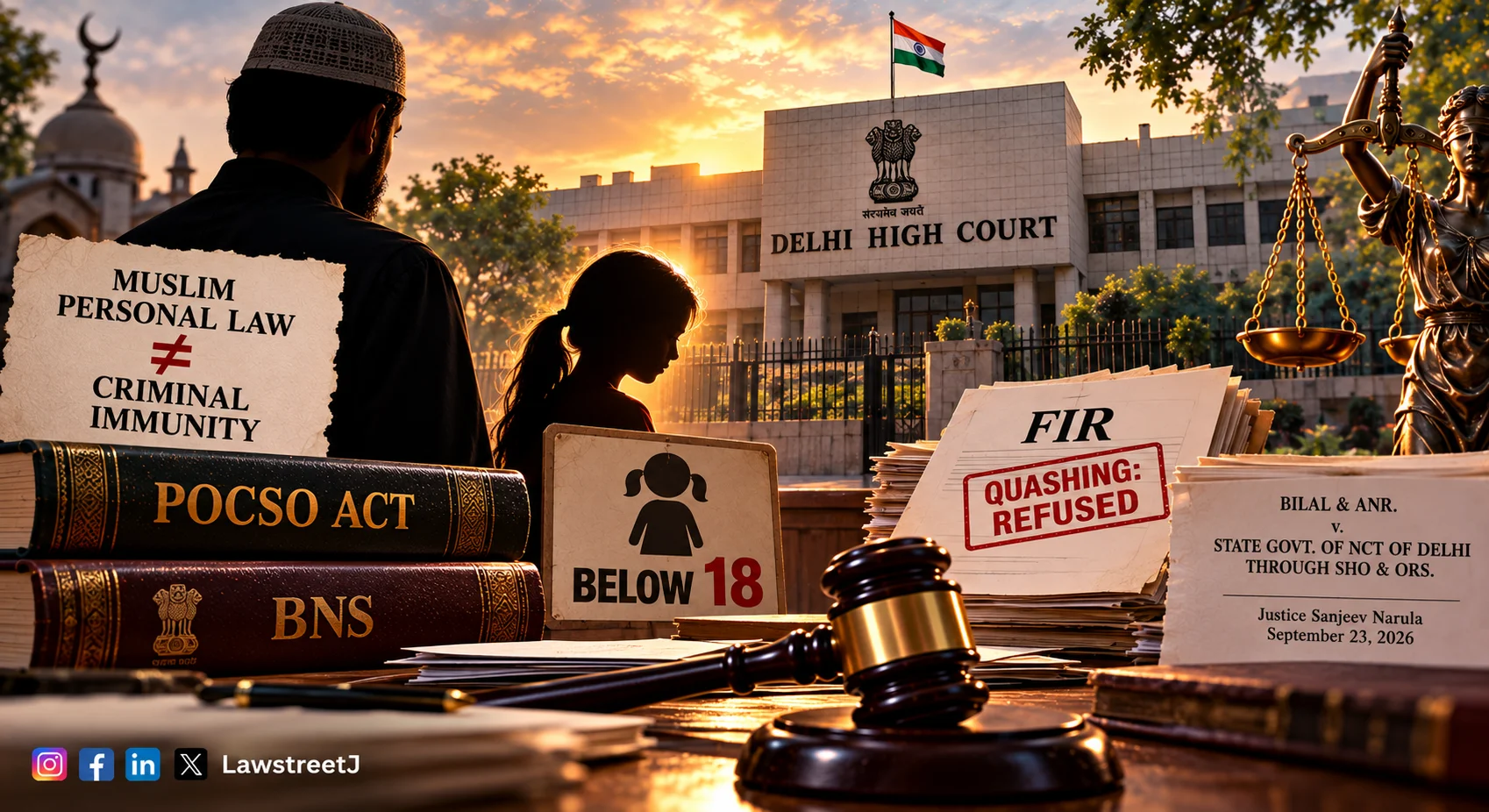
New Delhi: The Delhi High Court has dismissed a writ petition seeking quashing of an FIR registered under the Protection of Children from Sexual Offences Act, 2012 and the Bharatiya Nyaya Sanhita, 2023, holding that a marriage recognised under Muslim personal law does not, by itself, exempt sexual intercourse with a wife below eighteen from prosecution.
Justice Sanjeev Narula, framed the core question as “whether consent and the asserted validity of the marriage can displace” the statutory protection that fixes eighteen as the age below which consent to sexual activity has no legal efficacy.
The petitioners, had approached the Court seeking quashing of FIR No. 189/2026 registered at P.S. Daryaganj under Section 64(1) BNS and Section 6 of the POCSO Act. Petitioner No. 2 was born on 19th September, 2008 and married Petitioner No. 1 on 20th December, 2024, when she was sixteen years and three months old; Petitioner No. 1 was then nearly twenty-eight. Her age came to light when she visited a government hospital, about eight months pregnant, and doctors obtained her school record.
The petitioners relied on Section 2 of the Muslim Personal Law (Shariat) Application Act, 1937, and on the principle that a Muslim who has attained puberty is competent to marry, arguing that once the nikah is recognised in law, the subsequent physical relationship cannot attract criminal liability.
Rejecting this submission, the Court held that personal law “cannot supply an exception to a criminal law where Parliament has provided none.” Examining the statutory scheme, it noted that Section 63 of the BNS treats sexual intercourse with a woman below eighteen as rape, and that the marital exception is available “only where the wife is not under eighteen years of age.” The Court observed that even where the woman is the man’s wife, “marriage itself does not remove the offence if she is below eighteen.”
Relying on Independent Thought v. Union of India and Society for Enlightenment and Voluntary Action v. Union of India, the Court reiterated that a man who has sexual intercourse with his minor wife remains liable under POCSO, and that “Independent Thought holds precisely to the contrary” of the petitioners’ premise that marriage dilutes the protection owed to a girl below eighteen.
The Court also rejected the argument built on the girl’s consent and the families’ approval of the marriage, holding that family consent “cannot enlarge the statutory capacity of the child to consent to sexual intercourse.” It further held that “marriage does not advance a child’s age,” and that a person who is sixteen before the ceremony remains sixteen afterwards for the purposes of POCSO and Section 63 of the BNS.
Distinguishing the precedents cited by the petitioners including Yunus Khan v. State of Haryana, Gulam Deen v. State of Punjab, Javed v. State of Haryana, and the Full Bench decision in Court on its Own Motion (Lajja Devi) v. State the Court found that none of them had adjudicated a prayer to quash a POCSO prosecution on the ground that a marriage under Muslim personal law had extinguished the offence.
The Court also declined to fault the registration of the FIR, noting that POCSO does not make prosecution dependent upon a complaint by the child, and that the hospital’s information triggered the statutory reporting obligation under Section 19 of the Act. The prayers for disciplinary action against the police and for compensation were accordingly declined as well.
Dismissing the petition, the Court clarified that its observations were confined to the prayer for quashing and would not bind the Trial Court’s assessment of Petitioner No. 1’s guilt, and that the bail earlier granted to him would continue to be governed by its own terms.
Appearances: Mr. Avnish Singh, Mr. Mahendra Vikram Singh and Mr. Suraj Sharma, Advocates, appeared for the petitioners along with Petitioner No. 1 in person. Mr. Rahul Tyagi, ASC (Crl.), with Mr. Sangeet Sibou, Ms. Priya Rai, Ms. Neha Ghugtyal, Mr. Ajay Jangra, Mr. Avinash Kumar Singh and Mr. Priyansh Raj Singh, Advocates, appeared for the State.
Case Title: Bilal & Anr. vs. The State Govt of NCT of Delhi Through SHO & Ors.


![Delhi High Court Sets Aside Arbitral Tribunal's Award Against NHAI in Highway Project Delay Case [Read Judgment]](/secure/uploads/2023/07/lj_9605_23374c2e-392c-4491-a2fe-f2f12fc5272f.jpg)
![Delhi Court Rejects Stay Request in Defamation Case Against Rajasthan CM Ashok Gehlot [Read Order]](/secure/uploads/2023/08/lj_5208_80de1ddc-d76a-4f7f-b180-408e3ae14fb4.jpg)