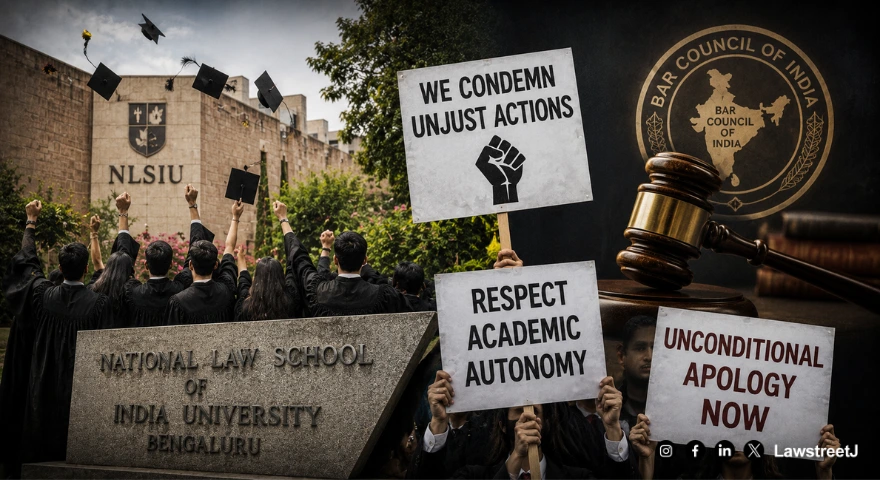
Bengaluru: Graduating students of the National Law School of India University, Bengaluru, supported by current students and alumni, have issued a statement condemning the Bar Council of India and its Chairman, Manan Kumar Mishra, over two letters dated 13th August, 2026 addressed to NALSAR University of Law, Hyderabad. The statement expresses unconditional solidarity with the students and faculty of NALSAR, noting that the BCI has since closed all proceedings initiated against the university.
According to the statement, the recall of the enrolment ban and the inquiry order does not alter the nature of the BCI's actions or dilute its responsibility, since the Council has at no point acknowledged that its actions were arbitrary or illegal. The signatories state that they are issuing the statement to set the record straight and to prevent similar action in the future.
The statement contends that the BCI's actions are ultra vires the Advocates Act, 1961. It states that while the Act permits the BCI to lay down standards of professional conduct and to promote legal education, it does not empower the Council to direct State Bar Councils to suspend or ban the enrolment of a person otherwise qualified to be an advocate. The signatories point to Section 24A of the Act, which limits disqualification to specified criminal convictions and does not contemplate denial of enrolment on the ground of a person having shown “no regard or respect” for a judicial officer.
The statement further notes that under Section 4 of the Act, the Bar Council of India is composed of the Attorney General, the Solicitor General and one member from each State Bar Council, so that the Chairman alone has no authority to issue orders of this nature, and that the direction to the Vice-Chancellor of NALSAR to furnish a report identifying students and faculty involved in the representation falls outside the Council's limited statutory function under Section 7.
The statement characterises the BCI's actions as a direct infringement of the right to free speech and expression under Article 19(1)(a) of the Constitution, describing the direction to NALSAR to separately identify participating students and faculty as a witch-hunt intended to create a chilling effect on dissent among students and citizens generally. The signatories also take exception to language in the BCI's letters describing the student representation as “dirty” and “nasty politics” and characterising certain students as “innocent” persons “misled” and “instigated” by “outsiders,” stating that they write of their own volition.
The statement further alleges that the episode forms part of a pattern of the Chairman using the statutory body to make partisan political remarks, pointing out that the second letter was issued “with the approval of the Council” while the first was not, and referring to earlier remarks by the Chairman describing protesting students at Jantar Mantar as “anti-social and anti-national forces” acting under the influence of “foreign adversaries.” The signatories state that this conduct has eroded public trust in the legal profession, and that a University Convocation, being a significant milestone for students and their families, is undermined when persons in high office who have publicly expressed disdain toward students are invited to confer degrees upon them.
The statement records four demands: an unconditional apology from the Bar Council of India to the NALSAR student and faculty community; an explanation from the BCI of the protocol governing use of its official letterhead by the Chairperson; disapproval of Mr Manan Kumar Mishra attending the NLSIU convocation without accounting for his conduct; and support for NALSAR's request to reconsider the choice of the Chief Justice of India as Chief Guest at its convocation, together with disapproval of the Chief Justice attending the NLSIU convocation for the same reasons.
The statement is signed by 165 students of the NLSIU graduating class of 2026 across its BALLB (Hons), LLB (Hons), MPP and LLM programmes, 409 current students across its BA (Hons), BALLB (Hons), LLB (Hons), MPP, LLM and PhD programmes, and 128 alumni spanning graduating years from 1993 to 2025.


![Supreme Court upholds order to bar Advocate from practice for running taxi service [Read Order]](/secure/uploads/2023/09/lj_8175_practicing_law_as_an_advocate_texi.jpg)