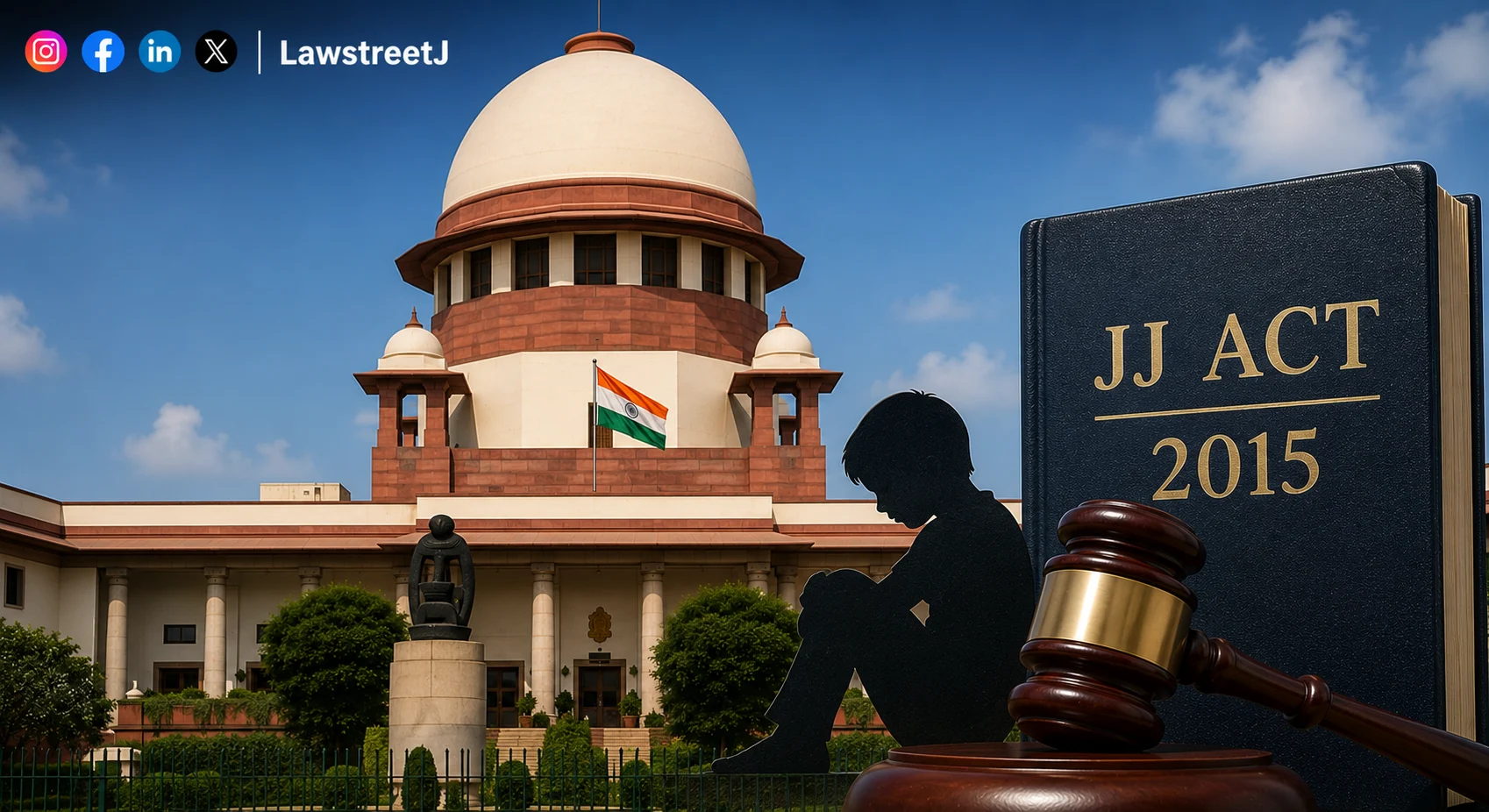
New Delhi: The Supreme Court has held that a Children's Court cannot proceed to try a child in conflict with law as an adult unless it first passes a reasoned order under Section 19(1) of the Juvenile Justice (Care and Protection of Children) Act, 2015, and that the absence of such an order vitiates the entire trial.
The bench of Justice Aravind Kumar and Justice Prasanna B. Varale was hearing an appeal filed by a man, tried and convicted for murder as a juvenile-turned-adult accused, against a Punjab and Haryana High Court order affirming his conviction.
The appellant, who was 16 and a half years old at the time of the offence in October 2018, was accused of fatally assaulting the deceased along with several others following a quarrel. The Juvenile Justice Board, Kaithal, after conducting a preliminary assessment under Section 15 of the Act, opined that the appellant had the mental and physical capacity to be tried as an adult, and accordingly committed the matter to the Court of the Additional Sessions Judge, Kaithal, functioning as the Children's Court, under Section 18(3) of the Act. The Children's Court went on to try the appellant, convicted him under Section 302 of the Indian Penal Code, and sentenced him to fourteen years of rigorous imprisonment, a conviction that was later upheld by the High Court.
During the hearing, counsel for the appellant pointed out that the Children's Court, despite having received the Board's preliminary assessment, had never passed any order under Section 19(1) of the Act determining whether the appellant was to be tried as an adult or as a child. Acting on this submission, the Supreme Court had earlier directed the Sessions Court concerned to verify the position, and upon examining the record, it was confirmed that no such order had in fact been passed before the trial proceeded.
Examining the statutory scheme, the court held that although Section 19(1) uses the word 'may', it must be read as 'shall', since the two possible outcomes under the provision, trial as an adult or an inquiry as a child, carry vastly different consequences for the child concerned, including the extent of punishment and the retention of criminal records. The court also relied on Rule 13 of the Juvenile Justice (Care and Protection of Children) Model Rules, 2016, which requires the Children's Court to record its reasons for deciding either way. The court observed:
“The statutory obligation is substantive in nature and not merely procedural, and the Children's Court assumes jurisdiction to try the child in conflict with law as an adult only upon recording satisfaction on the parameters laid down therein.”
The court further explained that non-compliance with Section 19(1) carries serious risks, since it could result in a child who ought to have been tried as a child instead being subjected to an adult trial and a sentence exceeding three years, contrary to the protective framework of the Act. It observed:
“Even a remote possibility that a child in conflict with law, who ought to be tried as a child, is subjected to an adult trial, such adult trial is wholly impermissible and it strikes at the very root of the protective framework envisaged under the Act.”
The court relied on its earlier decisions in Ajeet Gurjar v. State of Madhya Pradesh and Barun Chandra Thakur v. Master Bholu, both of which had underscored the mandatory character of the preliminary assessment and determination process under the Act, as well as its ruling in Thirumoorthy v. State, where non-compliance with the Act's mandatory provisions, including Section 19, was held to vitiate an entire trial and led to the accused's acquittal.
Applying the same reasoning to the facts before it, the court held that since Section 19(1) determines the very procedure a Children's Court is bound to follow, whether a Sessions trial or a summons case, its absence rendered the entire trial unsustainable. The court considered whether the sentence could instead be reduced to the period already undergone or capped at three years, but declined to adopt that course, holding that non-compliance with Section 19(1) could not be cured after the fact.
Noting that the appellant, now 24 years old, had already undergone over six years of incarceration, and that a meaningful assessment of his mental capacity at the time of the offence was no longer feasible after such a long lapse, the court held that no useful purpose would be served by remitting the matter to the Children's Court. The conviction and sentence were accordingly set aside, and the appellant was acquitted and ordered released.
The court also issued a word of caution to Children's Courts across the country, directing that upon receipt of a case committed under Section 18(3) of the Act, the first duty of the Children's Court, after taking cognizance, is to pass a reasoned order under Section 19(1) before proceeding further with the matter.
Case Title: Sagar v. The State of Haryana, (Arising out of SLP (Crl.) No. 8113/2024)