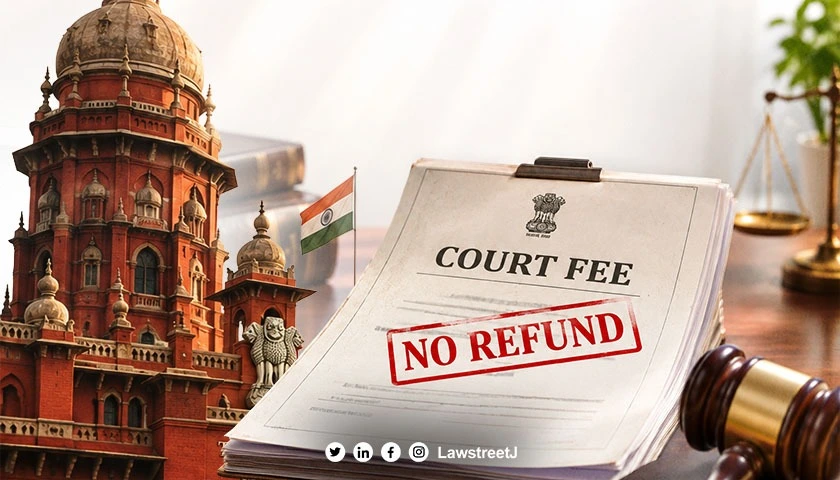
Chennai: The Madras High Court has held that a plaintiff is not entitled to any refund of court fee under Section 69 of the Tamil Nadu Court Fees and Suits Valuation Act, 1955 when a suit is compromised out of court after trial has commenced and evidence has been recorded, however little.
Justice P.B. Balaji declined to apply the Supreme Court’s decision in High Court of Madras v. M.C. Subramaniam (2021) 3 SCC 560 to such cases, and asked the Tamil Nadu State Law Commission to examine restoring the pre-2017 form of Section 69-A.
The Court was hearing CRP Nos. 4064 and 4106 of 2026. In the first, by Susheela Kawar against M. Pettu Lakshmi, a suit for specific performance was withdrawn on an out-of-court settlement, and the Trial Court at Ponneri refunded half the court fee less 5%. In the second, by the legal heirs of S. Ranjani against Gopi @ Gopala Krishnan and Hacienda Realtor Pvt. Ltd., the suit was dismissed on a joint compromise memo of 09.10.2025 and refund of the court fee of ₹2,54,326 was refused. The petitioners sought full refund, relying on Section 69-A and on M.C. Subramaniam, which held that even a private settlement outside the modes in Section 89 CPC entitles a plaintiff to a full refund.
Having doubts about the entitlement in view of Section 69, the Judge heard Advocate General N. Vijay Narayan, assisted by Additional Government Pleader S. Yogalakshmi, and appointed Advocate S. Suresh Sampath as amicus. They argued that M.C. Subramaniam dealt only with Section 69-A and did not consider Afcons Infrastructure Ltd. v. Cherian Varkey Construction (2010) 8 SCC 24 or Section 69.
The Court traced the statute. Section 69, in force since 1955, allowed refund of half the fee if a suit was dismissed as settled out of court “before any evidence has been recorded on the merits of the claim”. Act 6 of 2017 substituted “full amount” for “half amount”, but left that condition untouched. Section 69-A, introduced by Act 44 of 2007 and amended in 2017, deals with disputes referred to ADR under Section 89 CPC. The Legislature, the Court noted, never omitted or amended Section 69 when it dealt with Section 69-A, so Section 69 cannot be rendered otiose by applying Section 69-A “across the board”.
On Afcons, the Court recalled that the object of Section 89 is that settlement be attempted by an ADR process before trial. The ideal stage is after pleadings and before framing of issues, and once evidence commences the Court will be reluctant to refer the matter, lest ADR become a tool for protracting the trial. It said Afcons was not brought to the notice of the Supreme Court in M.C. Subramaniam, and that neither decision considered the stage at which settlement was sought. It held that it was therefore bound to follow Afcons instead of M.C. Subramaniam, an earlier ratio binding on a later bench of equal strength, citing State of Bihar v. Kalika Kuer and Union Territory of Ladakh v. J&K National Conference.
The Court also stressed the purpose of court fee:
“There is no doubt in my mind that a party is not entitled to any refund once evidence is recorded, if whatever little worth it may be.”
It added that fees go to the State to fund courts and trials, and substantial judicial time and money had been consumed in both suits. In CRP 4106, issues were framed and the plaintiffs’ witness, two defence witnesses and a court witness were examined with exhibits marked. In CRP 4064, issues were framed and the plaintiff’s proof affidavit was filed. The Court held that the Trial Court was right to refuse refund in CRP 4106 and dismissed it. In CRP 4064, the plaintiff was actually entitled to no refund, but because the State had not challenged the 50% less 5% refund, the Court did not disturb it.
The Court distinguished the other decisions cited by the petitioners as mere fallouts of M.C. Subramaniam that did not consider Section 69 or the stage of settlement. It noted that Sanjeev Kumar Harakchand Kankariya v. Union of India (2024) held, under the Maharashtra Court Fees Act, that a full refund follows only after a Section 89 process.
Dismissing both petitions without costs, the Judge directed a copy of the order to the Tamil Nadu Law Commission. Under the present Section 69-A, a party gets a full refund the moment a dispute is referred to ADR, and it is unclear whether the fee must be repaid if ADR fails and trial resumes. The pre-2017 version, which gave only a certificate for refund, to be encashed only if the dispute is settled, is “more practical and logical” and protects the State exchequer.
Appearances:
For the Petitioner in CRP No. 4064 of 2026: Ms. M. Meenarukmani, Advocate.
For the Petitioners in CRP No. 4106 of 2026: Mr. K. Sukumaran, Advocate.
Amicus Curiae: Mr. S. Suresh Sampath, Advocate. For the State: Mr. N. Vijay Narayan, Advocate General, assisted by Mrs. S. Yogalakshmi, Additional Government Pleader.
Case Title: Susheela Kawar vs. M. Pettu Lakshmi (with S. Ranjani (Died) & Ors. vs. Gopi @ Gopala Krishnan & Anr.), CRP Nos. 4064 & 4106 of 2026, 2026:MHC:4385