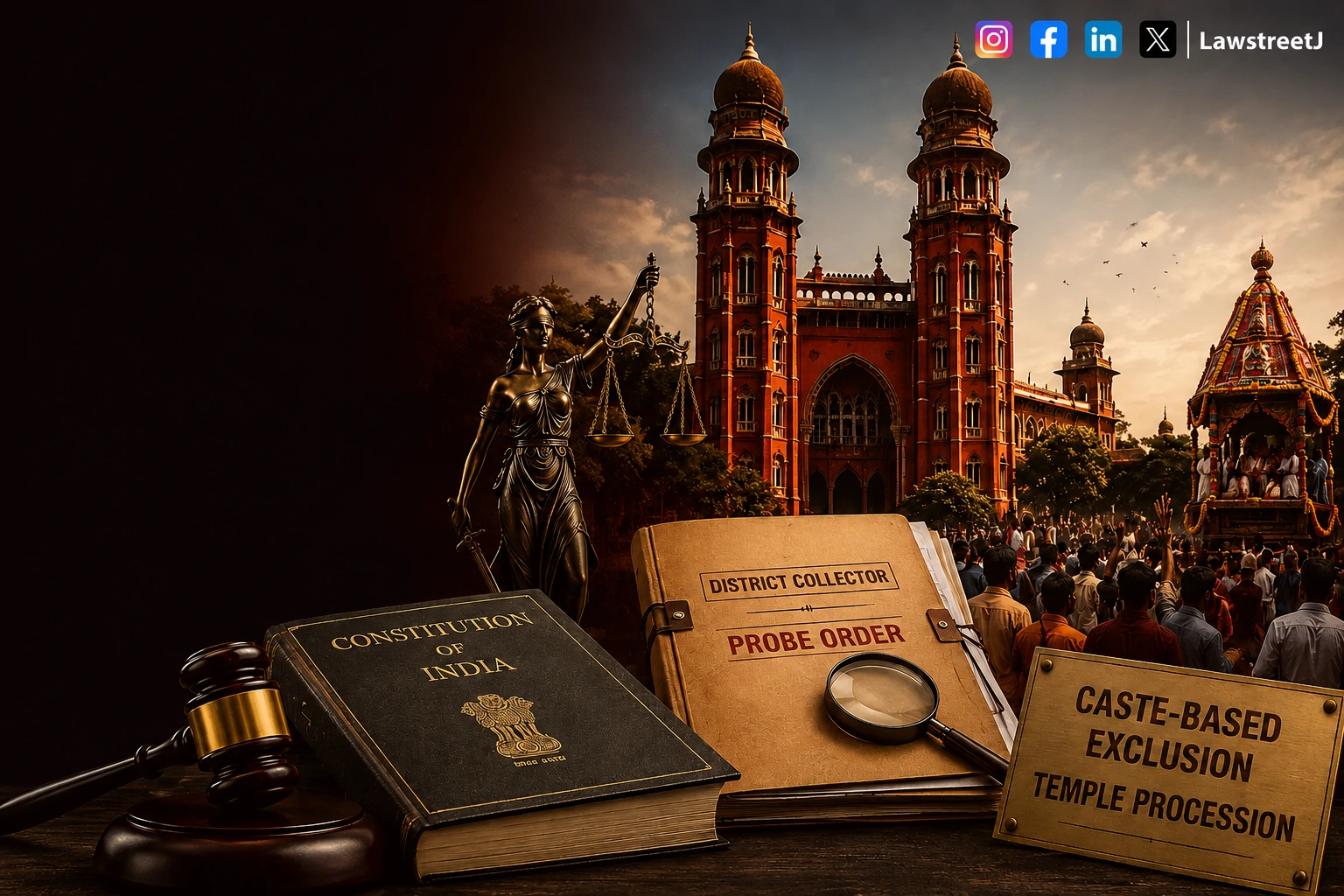
Madurai: The Madurai Bench of the Madras High Court has held that no custom or practice can be sustained if it has the effect of excluding a section of citizens from a public religious festival on the basis of caste, and has directed the District Collector, Dindigul, to conduct a comprehensive enquiry into allegations that a village temple procession was deliberately kept out of a street inhabited by members of the Devendra Kula Vellalar community.
Justice L. Victoria Gowri was hearing a writ petition filed by one Bakiyaraj, a resident of North Street, Muthalapuram Village, Nilakottai Taluk, Dindigul District, seeking a mandamus directing authorities to ensure that the ceremonial wooden chest procession of the Arulmighu Ayiram Aruval Kottai Karuppasamy Temple, carried during the Tamil month of Thai, be permitted to enter his street, and to constitute a festival committee including members of his community.
The petitioner contended that the temple deity was worshipped by the entire village irrespective of caste, but that for several years the procession had been deliberately prevented from entering North Street on the ground that its entry would render the festival impure. He further alleged that members of his community were discouraged from participating in temple administration, prevented from making offerings, and excluded from festival-related decision-making.
The private respondents denied any caste-based discrimination, contending that the procession route was an ancient customary one that had never included North Street, that all communities were free to worship at the temple, and that judicial alteration of long-standing custom would disturb communal harmony. The official respondents assured the court that all devotees, irrespective of caste, would be permitted to worship and participate in religious activities in accordance with law.
Examining the constitutional framework, the High Court held that Article 17 abolishes untouchability in all its forms and that the prohibition is absolute, not subject to custom, usage or social acceptance, while Article 25's guarantee of religious freedom is itself subject to public order, morality and the other provisions of Part III. The court observed, "Constitutional courts are duty-bound to ensure that no practice, custom, usage or social arrangement results in a disability founded upon caste." The court further noted that a deity worshipped by an entire village belongs to the whole village, and that faith cannot be compartmentalised street-wise on caste lines.
At the same time, the court noted that disputed questions relating to historical routes and customary practices could not ordinarily be conclusively adjudicated in writ proceedings on affidavits alone, and that the matter required an independent administrative assessment.
Constitutional courts cannot remain passive spectators when issues touching upon equality, dignity and fraternity are brought before them.
The court held that the District Collector, being best equipped to conduct a field inspection and engage with all stakeholders, should undertake the exercise of ascertaining the facts and evolving an inclusive mechanism consistent with constitutional values.
Disposing of the writ petition, the High Court directed the District Collector, Dindigul District, to conduct a comprehensive enquiry into the petitioner's grievances, convene a meeting of all stakeholders, undertake a field inspection through an officer not below the rank of Revenue Divisional Officer, and ascertain the historical procession route, whether the petitioner's community had been excluded from the festival, whether any caste-based discrimination existed, and whether extending the route to include North Street was feasible. The court directed that if such inclusion was found feasible and would advance constitutional values without causing insurmountable administrative difficulties, appropriate arrangements be made, and that the Superintendent of Police, Dindigul, provide adequate protection during all future festival events. The District Collector was directed to complete the exercise and pass a reasoned order within twelve weeks.
The court further directed that no devotee be denied entry into the temple, participation in worship, or involvement in lawful religious activities on the ground of caste, and that any act amounting to untouchability or caste discrimination be dealt with strictly in accordance with law.
Appearances: Mr. S. Vellaichamy, Advocate appeared for the petitioner. Mr. K. Saravanan, Counsel for Government of Tamil Nadu (Crl. side), appeared for respondents 1, 3 and 4, Mr. D. Rajaboopathy, Counsel for State of Tamil Nadu (Crl. side), appeared for respondents 2 and 5, and Mr. K. Kevin Karan, Advocate appeared for respondents 6 to 9.
Case Title: Bakiyaraj versus The District Collector, Dindigul & Ors.



![Madras High Court Directs Tamil Nadu Government to Ensure Quota for Transgenders in Local Body Elections [Read Order]](/secure/uploads/2023/08/lj_2507_7a03d113-08b1-4670-b6fb-9058aee481d0.jpg)