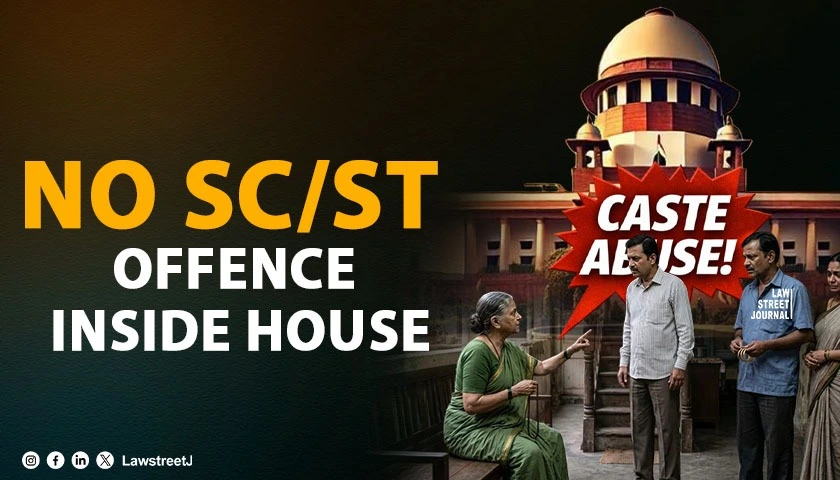
New Delhi: The Supreme Court of India has held that an offence under Sections 3(1)(r) and 3(1)(s) of the Scheduled Castes and Scheduled Tribes (Prevention of Atrocities) Act, 1989 cannot be made out unless the alleged casteist abuse or intimidation took place “in a place within public view”, and that a residential house does not satisfy this requirement merely because witnesses who are friends of the complainant were present.
A Division Bench comprising Justice Prashant Kumar Mishra and Justice N.V. Anjaria delivered the judgment while allowing a criminal appeal filed by the accused, setting aside the orders of the trial court framing charges as well as the order of the Delhi High Court dismissing the revision petition filed by the accused against such framing of charges.
The background of the case involved a family dispute over properties of the parties’ late father situated at Hari Nagar and Ramesh Nagar, New Delhi. The complainant and the accused were family members, and the accused included the spouses and brothers of the complainant’s siblings. A First Information Report was registered in January 2021 wherein the complainant alleged that on 28 January 2021, the accused were trying to break open the lock of his house when one of the accused, belonging to an upper caste, hurled caste-based slurs including words such as “chura”, “chamar”, “harijan”, and “dirty drain” against him and his wife. It was further alleged that the accused threatened to kill him and to falsely implicate him in a molestation case. The complainant also stated that such conduct had been ongoing for over a year.
The trial court framed charges against one of the accused for offences under Sections 3(1)(r) and 3(1)(s) of the SC/ST Act, and against all the accused under Section 506 read with Section 34 of the Indian Penal Code. The Delhi High Court upheld the framing of charges, observing that the stage of charge framing does not require a mini trial and that witness statements corroborated the complainant’s allegations.
Before the Supreme Court, the accused contended that the essential ingredient of the offences under the SC/ST Act, namely that the incident must have occurred “in a place within public view”, was conspicuously absent from the FIR and the charge-sheet. The Court examined the statutory provisions and surveyed its earlier decisions on the meaning of this phrase.
The Court referred to its decision in Swaran Singh v. State, wherein it had clarified the distinction between the expression “a place within public view” and the expression “public place”. It was explained that a place could be private yet still be within public view, for instance, a lawn outside a house that is visible from the road. However, if the offence is committed inside a building and is not visible to the public, the requirement is not met. The Court also referred to Hitesh Verma v. State of Uttarakhand, where the offence was held not to have been made out because the incident occurred within the four walls of the informant’s house and no member of the public was present. Additionally, it relied on Karuppudayar v. State, which distilled the settled position that a place is “within public view” only if members of the public can witness or hear the utterance, and that an incident occurring within four walls where no member of the public is present cannot satisfy this requirement.
Applying these principles to the facts of the present case, the Court found that the FIR was silent on whether any independent member of the public was present during the alleged incident. The place of occurrence mentioned in the FIR as well as the charge-sheet was a residential address at Ramesh Nagar, New Delhi. The two witnesses named by the complainant were his friends, and their statements did not establish that they had actually witnessed the incident of casteist abuse. One witness stated that he had accompanied the complainant to take a photograph of the locked door, while the other stated that the accused interjected when the complainant attempted to open the lock. Neither statement demonstrated that the alleged casteist abuse occurred at a place exposed to public view.
The Court emphasised that general and vague allegations about the accused having habitually used abusive language over the preceding year, without specifying any instance in public view, could not constitute an offence under the SC/ST Act. The FIR did not indicate that any independent member of the public was present during any of the alleged prior incidents either. The Court held that a residential house does not transform into “a place within public view” merely by virtue of the presence of the complainant’s own friends.
The Court also underscored the importance of the FIR as the first and most credible account of events, observing that what is absent in the FIR at the outset cannot be cured through subsequent embellishments. Relying on the principle laid down in State of Haryana v. Bhajan Lal, the Court reiterated that if the contents of the FIR, taken at face value, do not make out the necessary ingredients of the offence, the FIR and the proceedings founded on it deserve to be quashed.
On the charge of criminal intimidation under Section 506 read with Section 34 of the IPC, the Court found that the averments in the complaint did not disclose that the threats were made with the intent to cause “alarm” to the complainant, which is an essential ingredient of the offence. The Court further held that the charge under Section 506 IPC appeared to have been coupled with the SC/ST Act offences, which themselves were not made out. As regards Section 34 IPC, the Court found no material to suggest that the accused shared a common intention to commit a criminal act.
Accordingly, the Supreme Court set aside the judgment and orders of the Delhi High Court as well as both trial court orders pertaining to the framing of charges. The FIR and the charge-sheet filed against the accused for offences under Sections 3(1)(r) and 3(1)(s) of the SC/ST Act and under Section 506 read with Section 34 of the IPC were quashed. The appeal was allowed.
Case Title: Gunjan @ Girija Kumari and Others v. State (NCT of Delhi) and Another, Criminal Appeal No. 2446 of 2026