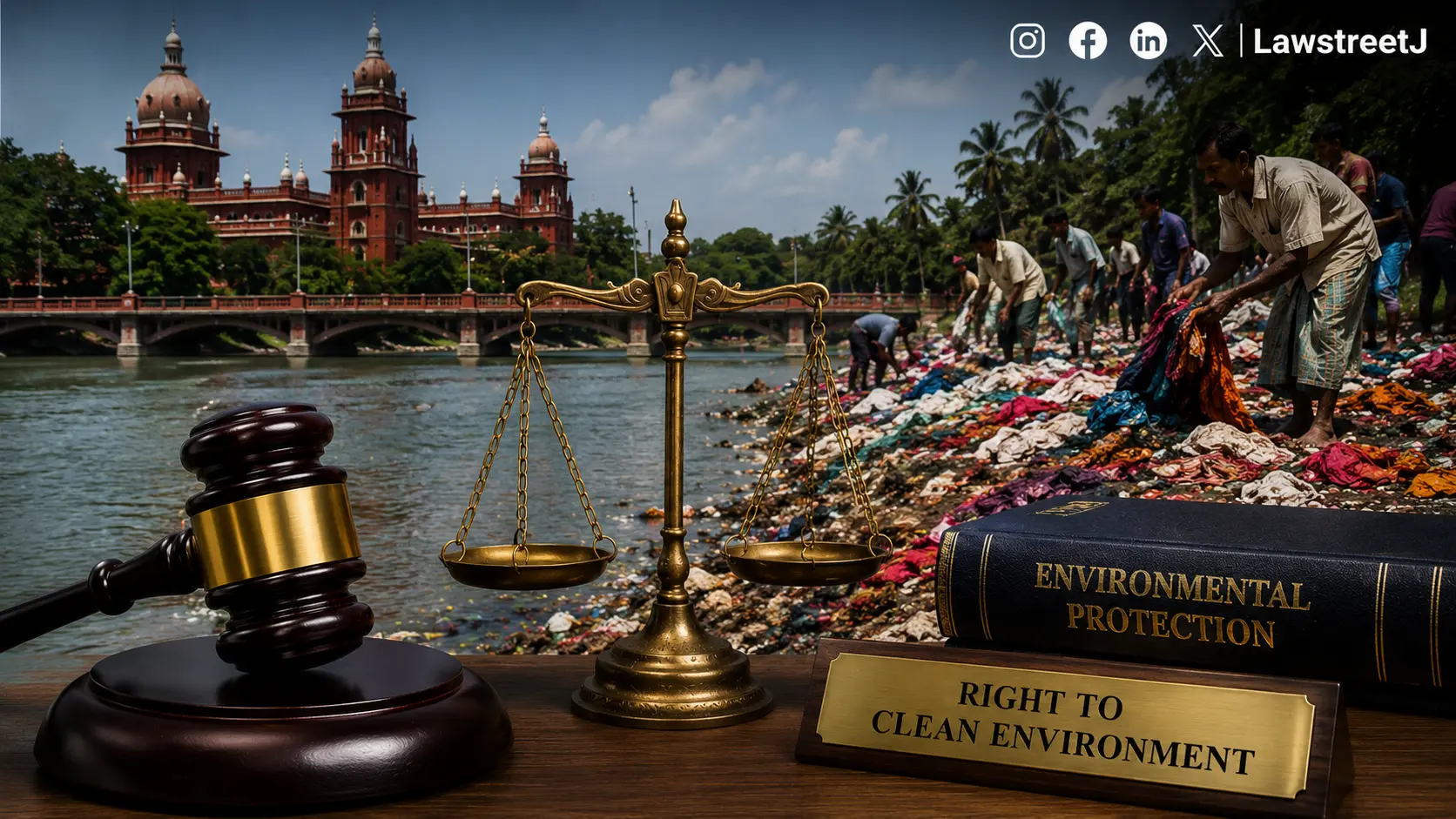
Madurai: The Madurai Bench of the Madras High Court, comprising Justice G.R. Swaminathan and Justice B. Pugalendhi, has observed that no person has the right to pollute a water body even in the name of religion, while dealing with large-scale dumping of used clothes and other articles into the Thamirabarani river during rituals performed for the deceased.
The observation was made in a writ petition originally filed by one Sivanupandian challenging an eviction notice issued under the Land Encroachment Act, 1905, in respect of a mandapam. The court had earlier disposed of a connected writ petition on 30.09.2024, granting the petitioner liberty to file an appeal before the District Collector, Tirunelveli, and directing that the appeal be decided within four months. Since the appeal remained undecided and a reminder was issued by the second respondent on 23.06.2026, the petitioner approached the court again.
While the court noted that the present writ petition may itself not be maintainable since the impugned proceedings were consequential in nature, it proceeded to take note of a larger issue brought to its attention by the second respondent, the Assistant Executive Engineer (WRO), Upper Thamiraparani Sub-Division. It was submitted that thousands of devotees gather at the bathing ghats of the Thamirabarani from Papanasam onwards to perform obsequies, a ritual that involves discarding used and unused garments, towels, slippers and other articles associated with the deceased, with the numbers swelling on occasions such as Aadi Amavasai.
The court also had a personal interaction with an activist, Thiru Moorthy, who has been working to clean the river by removing discarded articles with the help of a community known as "Aripukarargal." He informed the court that whenever temple authorities attempted to stop the dumping at one point on the river, devotees simply shifted their activity elsewhere along the bank, from Gnanapalayam to Thalayanai, and that not less than a tonne of used garments is dumped into the river every day.
Recording its appreciation for the activist's work, the court held that the practice cannot be allowed to continue, citing Section 36 of the Tamil Nadu Public Health Act, 1939, and Section 24 of the Water (Prevention and Control of Pollution) Act, 1974, which prohibit the fouling of streams. The bench observed:
“No one has the right to pollute a water body even in the name of religion.”
The court took note of the ecological consequences of the practice, including the threat posed to the Indian Black Turtle and the Indian Flapshell Turtle found in the Thamirabarani, both species with lifespans exceeding a hundred years, which become entangled in discarded clothes and suffocate. It also referred to data from a booklet on the river's pollution, which recorded that over 86 to 90 tonnes of clothes, along with plastic waste, glass bottles, sanitary waste and other debris, were removed from the river over a three-week period in May 2026.
The bench relied on the Supreme Court's shift from an anthropocentric to an eco-centric approach in T.N. Godavarman Thirumulpad v. Union of India, (2012) 3 SCC 277, and reiterated that the right to enjoy pollution-free water is a fundamental right under Article 21 of the Constitution, as recognised in Subash Kumar v. State of Bihar, (1991) 1 SCC 598. It also referred to M.C. Mehta v. Union of India, 2024 SCC OnLine SC 3366, where the Supreme Court had observed that no religion encourages any activity that causes pollution.
At the same time, the court was conscious that an order in a matter of this nature would touch upon the religious beliefs and sentiments of a large section of the public, and that being a matter with in rem consequences, it would not be appropriate to pass final directions without hearing the affected stakeholders. The bench observed that believers must be permitted to continue what is spiritually meaningful to them, so long as it causes no harm to ecology or infringes upon the rights of others, noting that Article 25 of the Constitution subjects the freedom to practise religion to considerations of public health. It observed:
“Believers can do what is spiritually beneficial to them provided it has no adverse implication for ecology and does not violate the rights of the other members of the society.”
The court also invoked the fundamental duties under Article 51A(g) and 51A(h) of the Constitution, which require citizens to protect the natural environment and develop scientific temper, while clarifying that it was not inclined to dismiss the practice outright as mere superstition. It took note of a proposal to construct a tank near the river bank that could be used for performing the rituals instead, allowing for the collected waste to be cleared daily.
The District Collector, Tirunelveli, has been directed to make a public announcement regarding the orders proposed to be passed on 16.07.2026, so as to enable any religious body or activist to intervene and make submissions. The District Administration has also been directed to place before the court a set of proposals offering a permanent solution to the problem. The matter has been listed for further hearing on 16.07.2026.
Appearances: Mr. Ramasamy S, for the Petitioner; Mr. M. Kannan, Government Advocate, for Respondent Nos. 1 and 2; M/s. V.R. Shanmuganathan and N. Sharmiya, for Respondent No. 3.
Case Title: Sivanupandian v. The District Collector, Tirunelveli District and Others, WP(MD) No. 18560 of 2026



![Madras High Court Directs Tamil Nadu Government to Ensure Quota for Transgenders in Local Body Elections [Read Order]](/secure/uploads/2023/08/lj_2507_7a03d113-08b1-4670-b6fb-9058aee481d0.jpg)