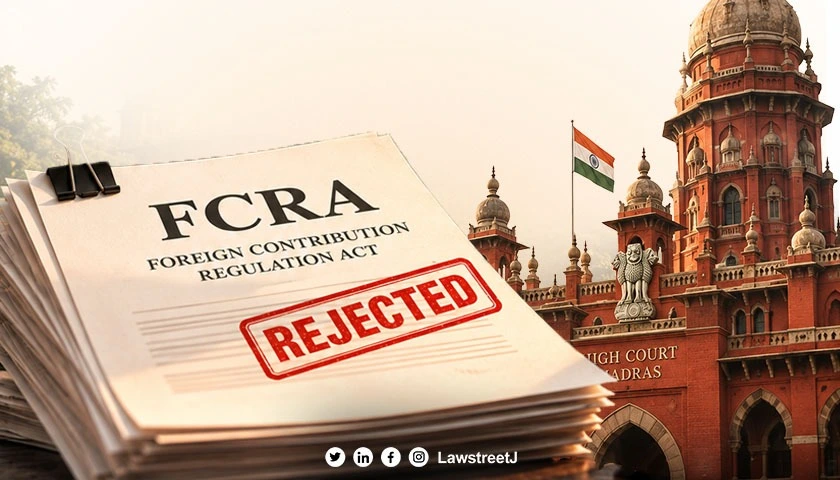
Madurai: The Madurai Bench of the Madras High Court has upheld the rejection of an application for registration under the Foreign Contribution (Regulation) Act, 2010 by a Zen meditation trust in Kodaikanal. It held that the trust, by its own showing, is a religious organisation but did not correctly disclose its nature. The court held that there is no right as such to receive foreign contribution; it is at best a privilege.
A Division Bench of Justice G.R. Swaminathan and Justice M.D. Sumathi delivered the judgment on 06.10.2026 in CMA(MD) No. 1057 of 2026, an appeal by Kanzeon Public Charitable Trust under Section 31(2) of the FCRA against the Central Government's rejection order. The trust was founded in 2021 and is registered under Sections 12AB and 80G of the Income Tax Act, 1961. Its application dated 18.06.2025 was rejected by the Deputy Director (FCRA), Ministry of Home Affairs. The judgment was authored by Justice Swaminathan.
On maintainability, the court first dealt with whether such appeals are heard by a Single Judge or a Division Bench. Since Section 31(3) deems an appeal under the section to be an appeal from an original decree, it fell under Rule 2(5)(a) of the Appellate Side Rules, but the order is not capable of monetary valuation. Considering that appeals under special statutes are listed before the Division Bench, and that the Calcutta High Court does the same, it held that an appeal under Section 31(2) of the FCRA must be heard by a Division Bench.
The trust argued that it runs a Zen Meditation Centre, that its activities cannot be labelled as religious, and that the matter is covered by Arsha Vidya Parampara Trust v. Union of India, 2025 SCC OnLine Mad 13781. It also relied on CIT v. Dawoodi Bohra Jamat, (2014) 16 SCC 222, CIT v. Rajneesh Foundation, CIT v. Patanjali Yogpeeth, Radhasoami Satsang v. CIT and Lloyd Electric v. State of Himachal Pradesh. The Central Government's Senior Standing Counsel defended the order as well reasoned and said the policy is to check the inflow of foreign funds that may be used for conversion and other activities that harm the secular fabric of the country.
The court noted that the trust's founder is an ordained Christian priest, and that it examined the trust's website. It observed that under Rule 9 of the FCR Rules, 2011, Form FC-3A requires an applicant to state whether it is religious, cultural, economic, educational or social, and, if religious, whether Hindu, Sikh, Muslim, Christian, Buddhist or others. The trust claims to subscribe to Zen Buddhist philosophy, and the court said it was not for it to doubt whether that claim is genuine. But on its own showing the appellant is a religious organisation, since Zen is a variant of Mahayana Buddhism and, applying Commissioner, HR&CE v. Shirur Mutt, every Buddhist school falls under the broad umbrella of Buddhism. As the application did not correctly identify its nature as religious, it was rightly negatived.
The court said the trust "need not have been so coy", as Section 12 of the FCRA bars only an unregistered religious organisation from accepting foreign contribution, and an organisation with a definite religious programme can apply. It said that "one has to make a clean breast of everything" and that this is "no game of hide and seek". It also held that where the statute envisages frank disclosure, any misrepresentation entails rejection of the application itself, relying on State v. M. Kurian, (2001) 4 SCC 290.
Drawing a distinction between religious organisations and cultural or educational entities, the Bench held that an organisation primarily engaged in the systematic teaching of Vedanta, the Bhagavad Gita, the Upanishads, Yoga and allied Indian Knowledge Systems through structured classes, residential courses, publications, research and preservation of manuscripts cannot be classified as religious institutions. It said they fall under education or culture, and noted that the National Education Policy, 2020 provides for including them in the curriculum. The FCRA framework, it said, should operate in tandem with the policy, and should not be an obstacle to the diaspora supporting cultural activities in India.
On the wider scheme, the court relied on Noel Harper v. Union of India, (2023) 3 SCC 544, which held that there is no vested right, much less an absolute right, to accept foreign donation. It observed that foreign contribution may influence national polity and social order, and that India is "a salad bowl" and not a melting pot. It said that if foreign funds are freely allowed to facilitate conversion, national sovereignty would be imperilled. The Bench observed that Section 12(4)(a)(ii) refers to conversion and applies to all religious organisations, so that even a Hindu organisation engaged in Ghar Wapsi cannot be registered. It expressly added that it does not accuse the appellant of having any such agenda.
Holding that considerable leeway and unfettered discretion should be given to the authority in granting or refusing registration under Sections 11 and 12, it said that the rejection can be interfered with only if the discretion is perversely exercised, relevant material is ignored, or there is non-application of mind. It expressly approved the ratio of Arsha Vidya Parampara Trust.
Summing up, the court held that an applicant must correctly disclose its nature, failing which the application will be rejected. Even if all details are in order, the authority remains at liberty to refuse. It said that organisations upholding India's civilisational heritage must be classified as educational or cultural, and those engaged in worship and rituals as religious. Religious organisations whose activities do not affect the nation's secular fabric and social amity are entitled to registration, but organisations engaged in converting people from one faith to another shall be denied it. The court sustained the rejection order, dismissed the appeal, and made no order as to costs.
Appearances:
For the Appellant: Mr. G. Baskar, Advocate.
For the Respondent: Mr. G. Thalaimutharasu, Central Government Senior Standing Counsel.
Case Title: Kanzeon Public Charitable Trust vs. Union of India, CMA(MD) No. 1057 of 2026



![Madras High Court Directs Tamil Nadu Government to Ensure Quota for Transgenders in Local Body Elections [Read Order]](/secure/uploads/2023/08/lj_2507_7a03d113-08b1-4670-b6fb-9058aee481d0.jpg)