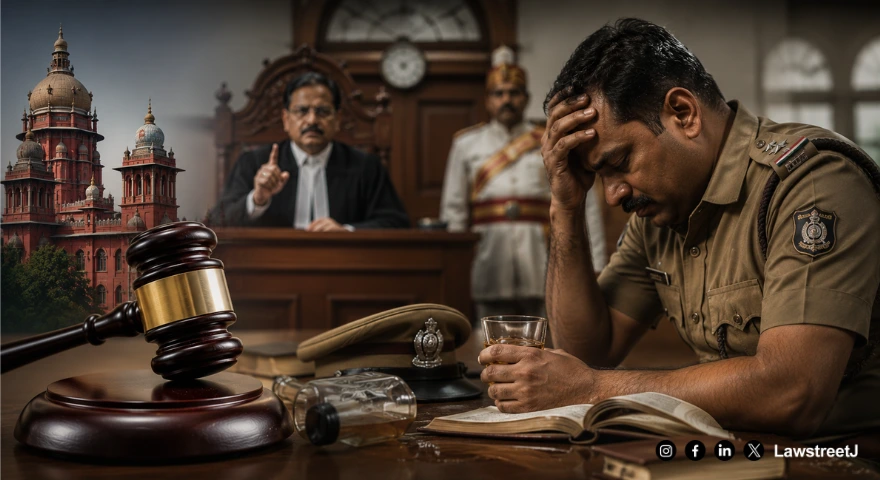
Madras: The Madras High Court has restored disciplinary action against a police officer who was found drunk while deposing as a witness before a Judicial Magistrate, holding that the absence of blood and urine tests does not defeat a finding of misconduct in departmental proceedings, which rest on preponderance of probabilities rather than strict proof.
A Division Bench of Justice S.M. Subramaniam and Justice N. Senthilkumar was hearing a writ appeal filed by the Director General of Police, the Deputy Inspector General of Police, Villupuram Range, and the Superintendent of Police, Cuddalore District, against a single judge's order that had set aside disciplinary action against a Special Sub-Inspector of Police. The respondent, while serving as a Head Constable, had appeared before the Judicial Magistrate, Thirukoilur, on 25.11.2014 to give evidence in a criminal case. The Magistrate found him in a drunken state, with incoherent speech and an alcoholic smell, and directed that he be sent for medical examination. The respondent cooperated with the examination, raised no objection, and was issued a Certificate of Drunkenness by the Medical Officer, although blood and urine tests were not conducted.
The incident was reported by the Magistrate to the Superintendent of Police and was subsequently reported in the newspapers. Departmental proceedings were initiated, and the respondent was placed under suspension and issued a charge memorandum under the Tamil Nadu Police Subordinate Service (Discipline and Appeal) Rules, 1955. A domestic enquiry found the charges proved, and the Disciplinary Authority imposed the punishment of compulsory retirement. On appeal, this was modified to postponement of the respondent's next increment for three years with cumulative effect, a modification that was upheld in revision. Nearly four years later, the respondent challenged the modified punishment before the High Court, and the writ Court set it aside solely on the ground that blood and urine tests had not been conducted.
Before the Division Bench, the respondent's counsel relied on judicial precedent to argue that drunkenness cannot be established without blood and urine tests, and that the writ Court's order was accordingly consistent with settled law. The Government Counsel countered that the Medical Officer had examined the respondent immediately on the Magistrate's complaint and issued a Drunkenness Certificate, that the respondent had raised no objection and had cooperated voluntarily, and that in a departmental proceeding, absence of blood and urine tests need not be fatal to the finding of misconduct.
The Bench agreed with the State. It held that unlike a criminal prosecution, which requires strict proof, a departmental charge needs only to be established on preponderance of probabilities, and that “preponderance of probabilities is sufficient to punish a Government employee” under the Discipline and Appeal Rules. The Court found that the Drunkenness Certificate issued by the Medical Officer, marked as Ex-P.6 and never disputed by the respondent, was sufficient to prove the charge, particularly since the incident had occurred in open court in the presence of the Judicial Magistrate, who had personally observed the respondent's condition and directed his medical examination. The Bench noted that the Sub-Inspector of Police and a Constable had accompanied the respondent for the examination and that he had cooperated throughout without raising any objection, circumstances which, in the Court's view, left no reason to disbelieve the misconduct.
The Bench also took note of the disciplinary history of the matter, observing that the Superintendent of Police, as Disciplinary Authority, had relied on Ex-P.6 in imposing the original penalty of compulsory retirement, a punishment the Appellate Authority had already tempered by substituting the postponement of increments for three years, allowing the respondent, who had by then completed over 30 years of service, to resume duty. The Court held that this indifferent attitude of attending court in a drunken state had to be viewed seriously, since such conduct degraded the image of the police force and, if left unchecked, could not be permitted to recur.
The Court emphasised that police officials and other professional witnesses are expected to maintain decorum and depose truthfully, and that “any misconduct committed inside a Court Hall cannot, under any circumstances, be tolerated.”
Noting that police personnel attending court frequently appear without proper uniform or discipline, the Bench directed the Director General of Police to issue, within four weeks, a circular to all police personnel across the State requiring them to wear proper uniform and maintain absolute integrity and devotion to duty while deposing before courts, failing which disciplinary action would follow. The Registry was directed to communicate the judgment to the Director General of Police for this purpose, and the circular, once issued, is to be circulated to all courts in the State through the Registrar (Judicial).
The writ appeal was accordingly allowed, the order dated 20.09.2023 passed in the writ petition was set aside, and the modified punishment of postponement of increment for three years with cumulative effect stood restored. The connected miscellaneous petition was closed, with no order as to costs.
Case Title: Director General of Police and Others vs. V. Arumuram, W.A. No.1850 of 2026



![Madras High Court Directs Tamil Nadu Government to Ensure Quota for Transgenders in Local Body Elections [Read Order]](/secure/uploads/2023/08/lj_2507_7a03d113-08b1-4670-b6fb-9058aee481d0.jpg)