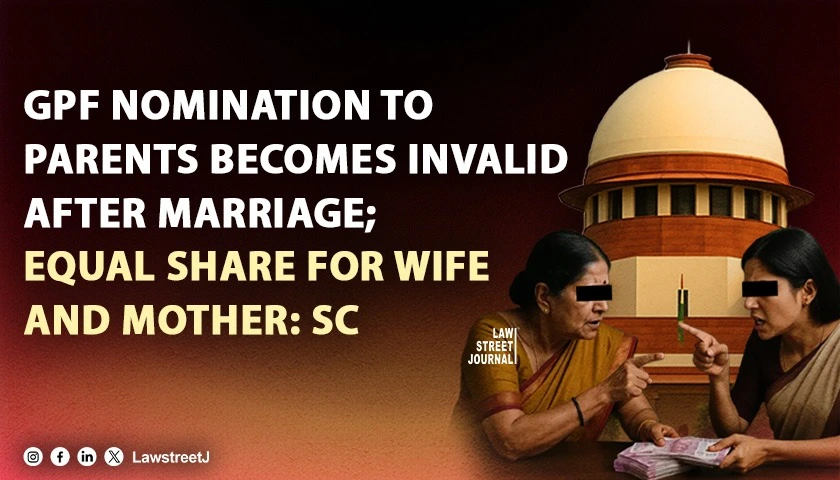
New Delhi: The Supreme Court has held that when a government employee nominates a parent for General Provident Fund (GPF) benefits, but the nomination form expressly states that it will become invalid upon the employee acquiring a family through marriage, such nomination automatically ceases to be valid after marriage—even if it is not formally cancelled. In such circumstances, the GPF amount must be distributed equally among all eligible family members.
The Bench of Justice Sanjay Karol and Justice Nongmeikapam Kotiswar Singh delivered the judgment while allowing an appeal filed by Smt. Bolla Malathi, widow of a deceased Defence Accounts Department employee, challenging the Bombay High Court’s decision that had awarded the entire GPF amount to the employee’s mother.
The dispute arose between the wife and mother of deceased Bolla Mohan over the release of his GPF accumulation. When he joined service on February 29, 2000, he nominated his mother as the beneficiary for GPF, the Central Government Employees Group Insurance Scheme (CGEIS), and Death-cum-Retirement Gratuity (DCRG). After marrying the appellant on June 20, 2003, he filed new nominations in her favor for CGEIS and DCRG benefits, but did not alter the GPF nomination, which continued to name his mother. He passed away on July 4, 2021.
The appellant received all other service-related benefits amounting to ₹60 lakh. However, when she applied for release of the GPF amount on September 9, 2021, the authorities declined her request on the ground that the mother remained the nominee on record.
The Central Administrative Tribunal (CAT), Mumbai Bench, examined Rule 33 of the General Provident Fund (Central Services) Rules, 1960, which governs distribution of GPF amounts upon a subscriber’s death. The CAT noted that although the mother’s nomination was initially valid, it became invalid once the subscriber acquired a family through marriage. Since no valid nomination subsisted at the time of death, the GPF amount had to be distributed equally among the family members. Accordingly, both the wife and the mother were held entitled to 50% each.
On appeal, the Bombay High Court reversed this finding. The High Court held that Rules 5(5) and 5(6) do not contemplate automatic cancellation of a nomination merely because a specified contingency occurs. Since the deceased neither sent written notice cancelling the earlier nomination nor made a fresh one for the GPF in favour of his wife, the High Court concluded that the mother continued to be the sole valid nominee. The Court further held that Rule 33(i)(a) therefore applied, entitling the nominee (mother) to the entire GPF amount. Any claim of succession by the wife, it observed, would lie only in appropriate civil proceedings.
Before the Supreme Court, the appellant relied on the original nomination form, which explicitly stated that the nomination would become “ineffective/invalid” upon acquisition of a family, and on Note 2 to Rule 476(5) of the Official Manual, which states that when a nomination becomes invalid, the fund is payable to all eligible family members in equal shares. The mother, however, argued that the deceased’s intention was evident—he deliberately nominated his wife only for CGEIS and DCRG benefits and not for the GPF.
The Supreme Court considered Rule 33 of the GPF Rules, which distinguishes between cases where a valid nomination exists and where none does. The Court also referred to Note 2 to Rule 476(V), which clarifies that if a nomination becomes invalid due to marriage or other reasons, the fund must be distributed equally among family members.
The Court observed that although the Rules do not use the expression “auto-cancellation,” they clearly provide for situations where a previously valid nomination ceases to subsist. The explicit condition in the nomination form—rendering it invalid upon marriage—operated automatically. Thus, even though the employee did not formally modify the nomination, it could not be treated as valid once he married in 2003.
The Court emphasized that while authorities are not required to prompt subscribers to update nominations, the Rules ensure that in cases where subscribers fail to make timely changes, the distribution of funds follows a just and uniform mechanism.
Reinforcing the settled legal position on nominations, the Court cited Sarbati Devi v. Usha Devi, holding that nomination does not confer beneficial interest but merely indicates who may receive the amount initially. Similarly, Shakti Yezdani v. Jayanand Jayant Salgaonkar reiterates that nomination does not override succession rights.
Allowing the appeal, the Supreme Court set aside the Bombay High Court judgment and restored the CAT’s order, directing equal distribution between the wife and mother. As the wife had already received her 50% share, the Court ordered release of the remaining amount deposited with the Bombay High Court Registrar to the mother within two weeks of application.
Case Title: Smt. Bolla Malathi v. B. Suguna & Ors., Civil Appeal No. 14604 of 2025 (arising from SLP (C) No. 8303 of 2025)