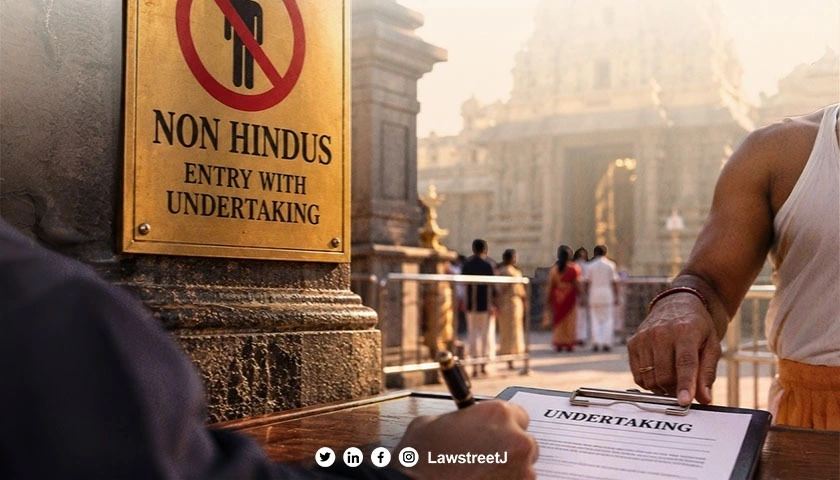
Madurai: The Madurai Bench of the Madras High Court has held that trustees of Agamic temples in Tamil Nadu must uphold Agamic injunctions by not permitting non-Hindus who do not sign the prescribed undertaking to cross the flag-pole (Kodimaram), and that even entry into the temple premises cannot be permitted for non-Hindus who sport their religious markers and do not subscribe their reverence for the deity.
A Division Bench of Justice G.R. Swaminathan and Dr. Justice P. Murugan was hearing a writ petition by Thangam Venkatesh, a Hindu, seeking a mandamus to the HR&CE Department to enforce the Tamil Nadu Temple Entry Authorisation Act, 1947 and Sections 23 and 24(4) of the Tamil Nadu HR&CE Act, 1959, by inquiring into violations on his complaint dated 17.10.2026 and preventing persons bearing other religious symbols and non-adherents from entering restricted sanctums and mandapams. The Additional Advocate General, P.V. Balasubramanian, submitted that the procedure laid down in the relevant laws and rules was being followed and would continue to be followed.
Opening with the question, “Can non-Hindus enter the precincts of an Agamic temple?”, the Bench observed that the issue was “no longer res integra”, having been answered by two single Judges, Justice T. Ramaprasada Rao in 1972 and Justice S. Srimathy in 2024, but said it would render an authoritative pronouncement in view of recent developments.
The Court applied the expanded definition of “temple” in Section 2(1) of the 1947 Act, which includes subsidiary shrines and mandapams. It noted that Article 25 throws open Hindu religious institutions to all classes of Hindus, subject to the usages of particular temples, and that in Agamic temples the sanctum sanctorum is beyond the bounds of all Hindus except Shivacharyas, Dhikshidhars, Bhattars or those who discharge priestly roles.
The Bench endorsed Kalyan Dass v. State of Tamil Nadu (1972), which struck down Rule 4A that sought to admit non-Hindus into temple premises as ultra vires the parent Act, though it disapproved one reason there about music near mosques as contrary to precedent.
It also recalled D. Senthilkumar v. Government of Tamil Nadu (2024), which required boards barring non-Hindus beyond the Kodimaram, an undertaking of faith in the deity and adherence to temple customs from any non-Hindu seeking to visit, and entries in a register. That Court had said a temple is not a picnic or tourist spot.
Turning to recent events, the Bench noted “egregious breaches”, citing the entry of Madurai Central MLA Mr. Badrudeen Mustafa into the Meenakshi temple, and taking judicial notice that a Minister, a Christian by faith, entered the Thiruchendur temple without the undertaking. By contrast, Chief Minister Joseph Vijay, also a Christian, worshipped Goddess Meenakshi after signing it; he was not asked to convert but only to affirm reverence for the deity, which the Court called an “inclusive approach”. It also took judicial notice of a video from the Arunachaleswarar temple at Thiruvannamalai showing persons in skull caps pushing their way in over devotees’ protests while HR&CE staff stood by.
Observing that political followers and displays of religious markers for “optics” drive such entries, the Bench held:
“We hold that usages and customs of temple cannot kneel down before such display of Chamchagiri and optics.”
The Court clarified that the judgment is confined to Agamic temples. It said Lord Ayyappa has devotees across religions and Shirdi Sai Baba is also beyond religion, so they are outside its scope. It further held that Agamic injunctions barring certain classes of Hindus from crossing the flag-pole “can no longer pass muster” as the Constitution ranks paramount, but that those injunctions “will hold good in respect of non-Hindus who do not sign the undertaking”.
Relying on Gopala Moopanar (1914), Sankaralinga Nadan (Privy Council, 1908), which cast a duty on trustees to maintain customary usage, Venkataramana Devaru (1957) and Seshammal (1972) on preserving the image from pollution and defilement, the Court said trustees are bound to prevent entry of persons whose presence defiles the sanctity of the temple, and that these decisions apply to non-Hindus.
It added that Section 24(4) of the HR&CE Act states that nothing in Section 24 authorises a non-Hindu to enter the premises concerned, and Section 24(3) requires officers to respect religious usage when exercising the right of entry.
Allowing the writ petition without costs, the Court held:
“The petitioner herein is a Hindu. He is entitled to insist that the trustees of the various Agamic temples in Tamil Nadu uphold the Agamic injunctions by not permitting non-Hindus who do not sign the undertaking from crossing the flag-pole. If such entry is permitted, it would defile the sanctity of the temple. We intend to go a step further. Even entry into the temple premises, cannot be permitted for non-Hindus who sport their religious markers and who do not subscribe their reverence for the deity concerned. This subscription must be in the format prescribed by the institution concerned.”
The Bench said it derived inspiration for this from Kalyan Dass, where the entire temple precincts were held sacrosanct, and from the statutory definition in the 1947 Act.
Appearances:
For the Petitioner: Mr. G. Aravinthsamy, Advocate.
For the Respondents: Mr. P.V. Balasubramanian, Additional Advocate General, assisted by Mr. M.P. Senthil, Government Pleader.
Case Title: Thangam Venkatesh vs. The State of Tamil Nadu & Ors., WP(MD) No. 30452 of 2026