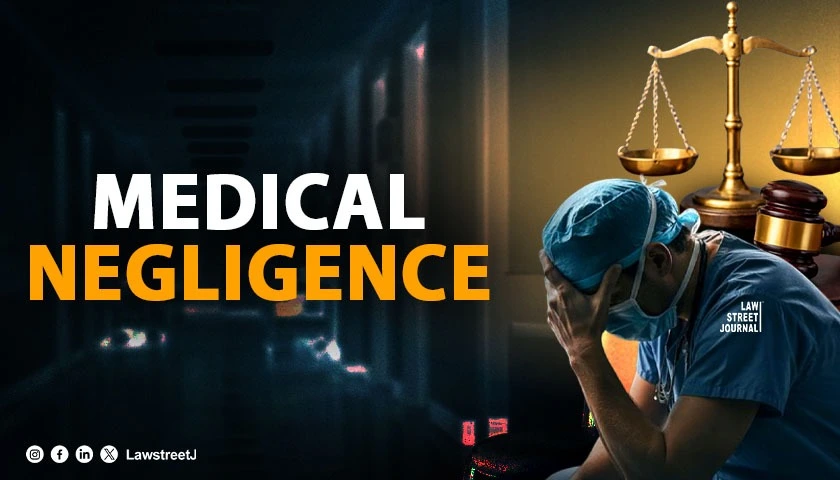
New Delhi: The Supreme Court of India has quashed criminal proceedings against a senior anaesthetist who was prosecuted for the post-operative death of a patient, holding that an off-duty doctor cannot be held criminally liable for a procedural error committed by a nurse and that her complete exoneration by the consumer forum on merits rendered the continuation of criminal prosecution an abuse of the process of law.
A Bench of Justice Pankaj Mithal and Justice Prasanna B. Varale allowed the appeal by setting aside the order passed by the High Court of Kerala and quashed C.C. No. 501/2008 pending before the Judicial Magistrate First Class-I, Kannur, discharging the appellant from all allegations.
The case arose from the death of K.P. Muralidhar, who had been admitted to Dhanalakshmi Hospital, Kannur, for piles surgery. The appellant, a senior anaesthetist, administered anaesthesia during the procedure. According to the prosecution, after the surgery, the patient’s condition deteriorated in the post-operative ward, and despite being on call, the appellant allegedly instructed a nurse over the phone to administer sensorcaine instead of personally attending to the patient. The patient later collapsed and died in the early hours of 30 May 2002. The post-mortem report attributed the death to acute coronary insufficiency caused by an 80% blockage of the left coronary artery.
The case witnessed a prolonged procedural journey. Initially, the FIR was registered only against the surgeon, with no allegations against the appellant. Although a chargesheet was filed in 2004, it was subsequently quashed by the Kerala High Court. Thereafter, a four-member expert committee, constituted pursuant to the High Court’s directions, submitted a report in July 2008 attributing the death to gross negligence by the hospital staff, leading to the filing of a second chargesheet. The appellant’s discharge pleas were rejected successively by the Magistrate, the Sessions Court, and the High Court, which ultimately left all issues open to be decided during trial.
Before the Supreme Court, Senior Advocate Mr. R. Basant, appearing for the appellant, raised several distinct grounds for quashing. He pointed out that Nurse Rosamma had given three mutually inconsistent and contradictory statements, attributing the instruction to administer sensorcaine first to the surgeon, then to the surgeon consulting the appellant by phone, and finally to the appellant being physically present in the ward. The Court accepted this submission, observing that there was “absolutely no material having any evidentiary value against the appellant” and that the expert panel itself reflected this fundamental inconsistency.
On the question of criminal negligence, the Court applied the standard laid down by the Supreme Court in Jacob Mathew v. State of Punjab, (2005) 6 SCC 1, which holds that a rash and negligent act for the purpose of Section 304-A IPC must be of such a nature that no medical professional in his ordinary senses and prudence would have done or failed to do.
The Court held that the appellant had completed her duty hours and left the hospital only after ensuring that the patient was stable. When the patient’s condition deteriorated later in the evening, other doctors, including an on-duty anaesthesiologist, were available at the hospital. The Bench observed that the appellant had merely prescribed sensorcaine, which is an admittedly appropriate analgesic, over a telephonic SOS request, and that reliance on the hospital staff to administer routine post-operative care could not amount to gross negligence. It further held that the nurse’s failure to correctly administer the injection into the epidural space was beyond the appellant’s physical control and therefore could not attract criminal liability.
The Court also identified a direct causal break in the chain of causation required under Section 304-A IPC. The post-mortem report established that the deceased had an asymptomatic 80% blockage of the coronary artery, a condition unknown before his death. The immediate cause of death was acute coronary insufficiency. The Court held that fastening criminal liability on an off-duty anaesthetist for a latent, undisclosed cardiac condition stretched the doctrine of proximate cause beyond permissible limits.
On the expert panel, the Court noted that the panel did not include an anaesthetist, which rendered it inherently incompetent to evaluate the technical nuances of epidural anaesthesia and catheter management. The Jacob Mathew guidelines require that the investigating officer obtain an independent medical opinion, preferably from a doctor qualified in the specific branch of medical practice involved. The absence of such expertise from the panel constituted a violation of the protective safeguards designed to prevent harassment of medical professionals.
The Court also placed significant reliance on the appellant’s categorical exoneration by the consumer forum. The District Consumer Disputes Redressal Forum, Kannur, after evaluating the evidence on record, held the hospital, the surgeon, and the nurse liable for deficiency in service, but expressly found that the appellant had not instructed the nurse to administer the injection and consequently fastened no liability upon her. Significantly, when the deceased’s family challenged the order before the Kerala State Consumer Redressal Commission, the appeal was confined only to enhancement of compensation, leaving the appellant’s exoneration unchallenged and thereby final.
The Court further relied upon the principles laid down in Radheyshyam Kejriwal v. State of West Bengal, wherein it was held that where a person is exonerated on merits in civil proceedings, and the allegations are found to be wholly unsustainable, continuation of criminal proceedings on the same facts would be impermissible. Reliance was also placed on Videocon Industries Ltd. v. State of Maharashtra and Prem Raj v. Poonamma Menon to reiterate the same principle. Applying the aforesaid ratio, the Court held that since the consumer forum had conclusively found, on merits, that the appellant had issued no instructions to the nurse, permitting the criminal prosecution to continue would amount to a gross abuse of the process of law.
The appeal was accordingly allowed. The order of the Kerala High Court in Crl. M.C. No. 6415 of 2018 was set aside. C.C. No. 501/2008 pending before the Judicial Magistrate First Class-I, Kannur, was quashed, and the appellant was discharged from all offences alleged against her.
Senior Advocate Mr. R. Basant appeared for the appellant. Learned counsel for the State of Kerala appeared for Respondent No. 1.
Case Title: Supriya Kumari M.C. v. State of Kerala & Ors., Criminal Appeal arising out of SLP (Crl.) No. 124 of 2025, (2026 INSC 537).