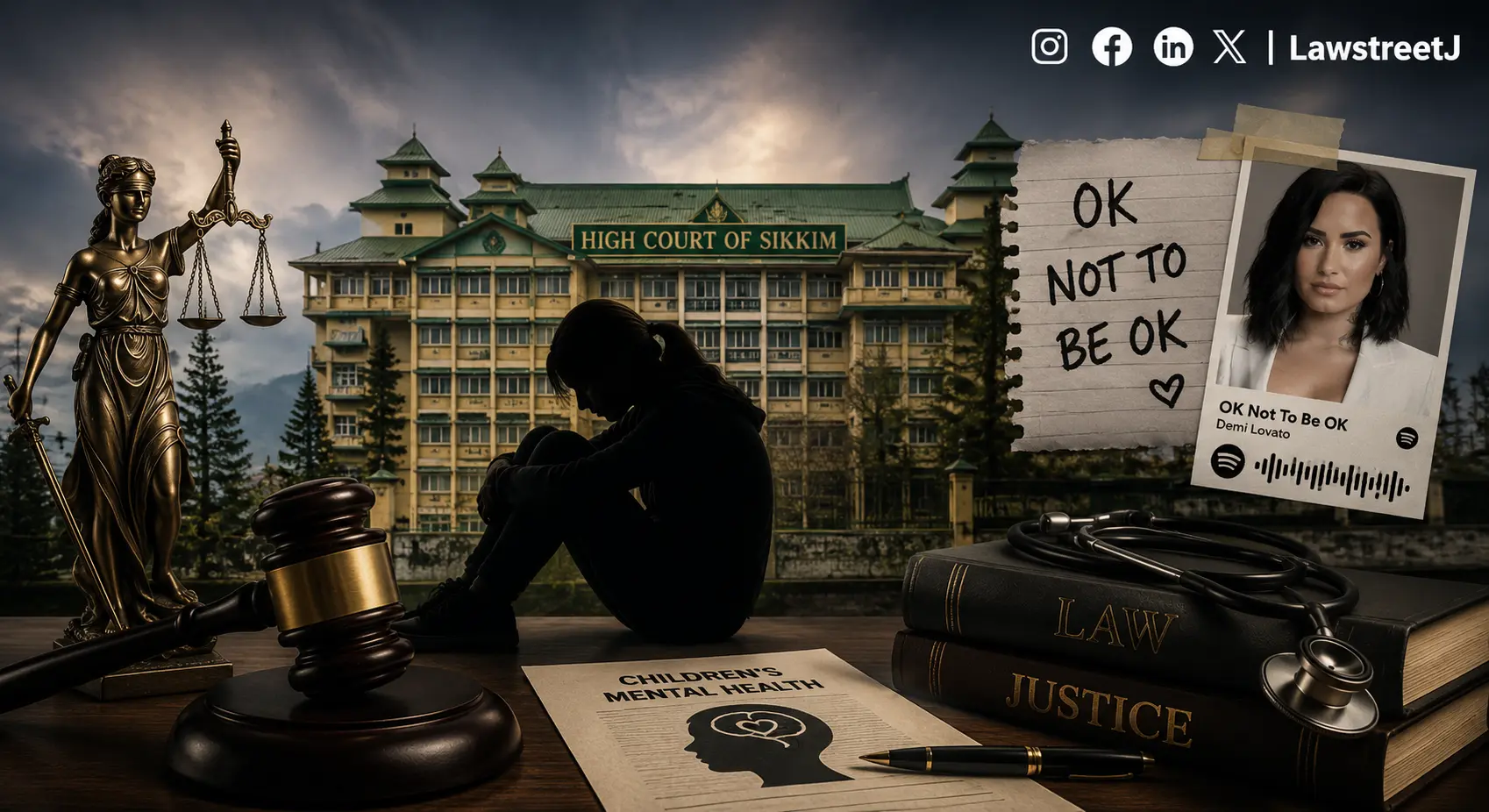
Gangtok: The High Court of Sikkim, in a judgment opening with lines from Demi Lovato and Marshmello's 2020 song "OK Not To Be OK," has upheld the conviction of a 42-year-old man for sexually assaulting and abetting the suicide of a 16-year-old schoolgirl in West Sikkim, while modifying a part of his sentence.
A Division Bench of Chief Justice A. Muhamed Mustaque and Justice Bhaskar Raj Pradhan was hearing an appeal against a judgment of the Special Judge (POCSO), West Sikkim at Gyalshing, which had convicted the appellant, Chewang Sherpa, under the Protection of Children from Sexual Offences Act, 2012 and the Indian Penal Code, 1860.
According to the prosecution's case, the victim, a Class XII student, left home on 20 August 2021 to submit her school papers amid a Covid-related lockdown. On her way back, she boarded a taxi that the appellant had reserved, and the two alighted together near a waiting shed. Later that afternoon, after returning home, the victim asked her father to watch a film on her phone, retreated to her room, and was found hanging from the ceiling beam by her school sweater when her father came looking for her. A notebook containing a suicide note in her handwriting was recovered from her room.
The Special Judge had convicted the appellant of sexual assault under Section 8 of the POCSO Act, abetment of suicide under Section 306 of the IPC, wrongful restraint under Section 341 of the IPC, and sexual harassment under Section 354A(2) of the IPC, while acquitting him of the rape charge though it had been framed. He was sentenced to a cumulative term running concurrently, with the substantive sentence being ten years' rigorous imprisonment for abetment of suicide.
Before the High Court, counsel for the appellant argued that the investigation was faulty and that the prosecution had failed to prove either the victim's age or the authorship of the suicide note. Reliance was placed on the cross-examination of the forensic expert from RFSL Saramsa, who had conceded that certain exhibit markings did not correspond to the exhibits his office had received, which the defence contended undermined the handwriting comparison linking the suicide note to the victim.
On the question of age, the Bench examined the victim's birth certificate along with the depositions of her parents, the registrar of births and deaths, the medical officer who had issued the certificate, hospital records, and the school admission register, all of which consistently recorded her date of birth as 21 May 2004. The Court held that the finding that the victim was a child within the meaning of Section 2(1)(d) of the POCSO Act could not be disturbed.
On the forensic expert's admission during cross-examination, the Bench found the anomaly curious but not fatal to the prosecution's case. It noted that the expert had, in his examination-in-chief, clearly identified and compared the two notebooks, and that the seizure of both documents had been independently and consistently proved through the investigating officers and seizure witnesses, including the victim's brother, who identified the handwriting as hers. The Court concluded that the two sets of handwriting were of the same person.
The Bench went on to hold that the chain of circumstances was complete and consistent, relying on what it described as a last-seen link established through the taxi driver's testimony, which placed the appellant and the victim together shortly before the incident. It treated the victim's suicide note, written on the very day of the incident just before her death, as her dying declaration under Section 32 of the Indian Evidence Act, 1872.
The suicide note described in detail how the appellant had allegedly chased and cornered the victim near an ICDS centre after they took shelter from the rain, restrained her, and subjected her to unwelcome physical contact. The Court found this account corroborated by an abrasion noted on the victim's body during the inquest, a bruise recorded in the autopsy report, and an injury noted on the appellant's own person the following day.
“We have no hesitation to hold that the acts of the appellant compelled her to commit suicide,”
the Bench recorded, adding that the appellant's conduct was so despicable, humiliating and intolerable that the victim felt a deep sense of defilement and was driven to end her life.
“There are no gaps in each of the circumstances proved by the prosecution to create doubt in our mind,”
the Bench observed, holding that the evidence led by the prosecution excluded every reasonable hypothesis of the appellant's innocence.
While affirming the conviction and sentence under Section 306 IPC for abetment of suicide, the Bench held that the conviction under Section 354A(2) of the IPC required reconsideration in light of Section 42 of the POCSO Act and Section 71 of the IPC, and accordingly set aside the sentence imposed under that provision. The remaining sentences were directed to continue running concurrently, and the compensation awarded to the victim's parents by the trial court was upheld.
In an epilogue to the judgment, the Bench recorded its concern that the appellant had an earlier conviction from 2011 under Section 458 of the IPC, for which he had served a prison term, and had gone on to commit what the Court called a more heinous offence.
“We express our concern about the effectiveness of the rehabilitation scheme in the State Central Prison at Rongyek,”
the Bench remarked, before turning to a broader observation on children's mental health. It noted that it had chosen not to reproduce the victim's laments from her suicide note out of restraint, but recorded its unease in unambiguous terms:
“The mental health of a child, and in this case a girl child, is a matter of serious concern,”
the Court observed, calling upon the State to adopt a structured, periodically evaluated plan to safeguard the mental health of children across both rural and urban Sikkim, and describing a child's healthy mind as paramount to the State's and the country's growth.
The appeal was accordingly partly allowed.
Appearances: Mr. Thupden Youngda, Advocate (Legal Aid Counsel) for the appellant; Mr. S.K. Chettri, Additional Public Prosecutor with Mr. Sujan Sunwar, Assistant Public Prosecutor for the respondent.
Case Title: Chewang Sherpa vs. State of Sikkim


!['Can't Enter into a Fishing Enquiry Based On Conjectures': Sikkim High Court Dismisses Plea Alleging Misappropriation of Covid-19 Funds [READ ORDER]](/secure/uploads/2021/06/lj_8739_Sikkim_High_Court.jpg)
![Sikkim High Court Announces Menstrual Leave for Female Employees [Read Order]](/secure/uploads/2024/05/lj_5902_b04a0317-5014-42ea-ae28-2dc35893580c.webp)
![Sikkim HC allows revision petition, Condones delay in filing criminal appeal, Emphasizes justice over technicalities [Read Judgement]](/secure/uploads/2024/06/lj_8117_Sikkim_HC_Justice_Over_Technicalities.webp)
![Reporting an FIR Is Not a Media Trial: Sikkim High Court Dismisses Writ Seeking Gag on Press Coverage of Criminal Case [Read Judgment]](/secure/uploads/2026/04/lj_4401_Reporting_an_FIR_Is_Not_a.webp)