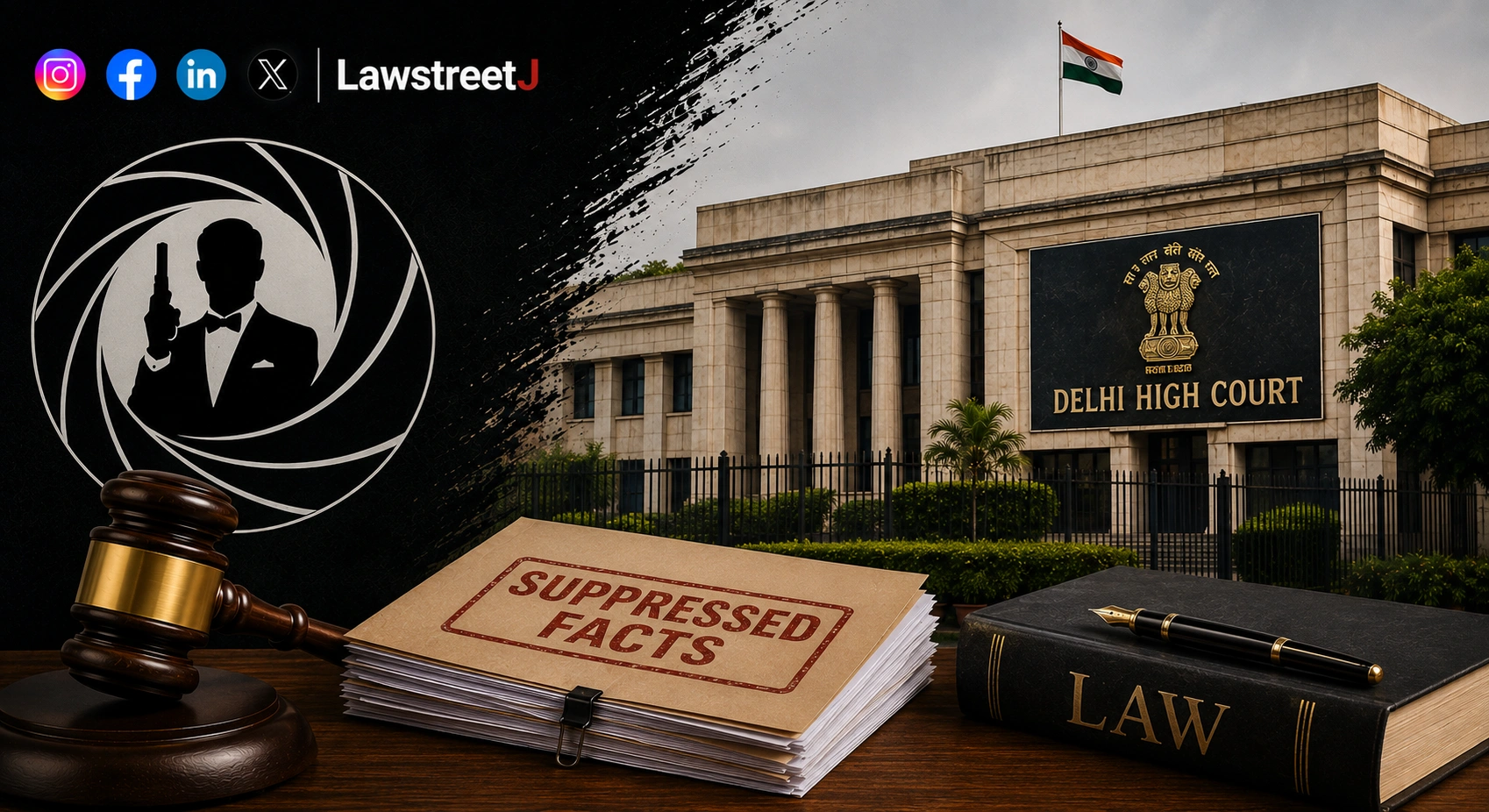
New Delhi: The Delhi High Court has vacated an ex-parte ad-interim injunction granted in favour of Celagenex Research (India) Pvt. Ltd. against Nugenesys Pharmaceuticals Pvt. Ltd. and its director in a trademark infringement suit, holding that the respondent had wilfully suppressed material facts regarding its prior knowledge of the appellants' adoption of the impugned mark while seeking ex-parte relief.
A Division Bench of Justice V. Kameswar Rao and Justice Manmeet Pritam Singh Arora was hearing an appeal filed under Section 13(1A) of the Commercial Courts Act, 2015, read with Order XLIII Rule 1(r) of the Code of Civil Procedure, 1908, challenging an ex-parte order passed by a Single Judge in a commercial suit filed by Celagenex Research.
The dispute arose between two nutraceutical companies. Appellant No. 2, who had served as Founding Director, Vice President and Chief Financial Officer of the respondent company holding 99% of its founding shareholding, resigned on 09.10.2024 after five years of service, having personally signed the power of attorney for the respondent's registered mark 'NUREWIRE'. Following his resignation, Appellant No. 1 was incorporated and later renamed Nugenesys Pharmaceuticals Pvt. Ltd., which applied for registration of the mark 'RewireX' on 06.03.2025 and commercially launched products under it in March 2026.
The respondent instituted the underlying suit claiming that it learnt of the appellants' use of the impugned mark only in the first week of May, 2026. However, it emerged that the respondent had in fact issued a cease-and-desist notice to the appellants as early as 29.10.2025 and had filed a formal objection to the appellants' trademark application before the Registrar of Trade Marks on 27.01.2026, neither of which was disclosed or pleaded in the plaint. Relying on this non-disclosure, the appellants argued that no ex-parte ad-interim injunction ought to have been granted, that the Single Judge was misled into dispensing with advance notice and pre-institution mediation under Section 12A of the Act of 2015, and that the mandatory requirement under Order XXXIX Rule 3 CPC to record reasons for proceeding ex-parte had not been complied with.
Counsel for the respondent conceded that omitting to plead the cease-and-desist notice in the plaint was an “oversight,” but argued that it had no bearing on the cause of action since the appellants had commenced actual use of the mark only in March 2026. The Court rejected this explanation, holding that the plaint's assertion of first knowledge in May 2026 repeated in the synopsis, list of dates, and Statement of Truth was intended to project a false sense of urgency and thereby secure an ex-parte injunction and appointment of a Local Commissioner that may not otherwise have been granted.
Tracing the doctrine of full disclosure to the 1917 English decision in R. v. Kensington Income Tax Commissioner and its subsequent affirmation by the Supreme Court in Oswal Fats and Oils Ltd. v. Additional Commissioner and Amar Singh v. Union of India, the Bench reiterated that a litigant seeking ex-parte equitable relief is bound by utmost good faith, and that suppression of material facts disentitles a party not merely to the interim order obtained but to the interim application itself.
Significantly, the Court also noted a recurring pattern of similar non-disclosure across at least three suits filed by the same filing counsel for the respondent's group, in which cease-and-desist notices and prior objections had likewise been omitted from the pleadings to misrepresent the date on which the cause of action arose.
Invoking a well-known line from Ian Fleming's James Bond novel Goldfinger, the Bench observed that “Once is happenstance. Twice is coincidence. Three times is enemy action.” It held that a repeated event was no longer random but a deliberate act, and that the pattern before it could not be attributed to inadvertence.
The Court further observed that the appellants' products were manufactured under a valid FSSAI licence and were not shown to be sub-standard or a risk to public health, and that any injury to the respondent, if it ultimately succeeded at trial, could be compensated in damages.
Holding that the Single Judge's discretion under Order XXXIX Rule 3 CPC had been influenced by the suppression, the Bench vacated the impugned order dated 20.05.2026, dismissed the connected interim injunction application, and directed release of the products seized under Superdari.
The respondent was further directed to deposit costs of Rs. 2,00,000/- with the Delhi High Court Legal Services Committee within two weeks, on the ground that it, having signed the Statement of Truth, was equally responsible for the suppression as its counsel.
The appeal was accordingly allowed, and the pending applications were disposed of.
Appearances:
For the Appellants: Mr. Amar Shankar, Advocate.
For the Respondent: Mr. Sachin Gupta, Mr. Rajat Jain, Mr. Rohit Pradhan, Mr. Prashansa and Ms. Mahima, Advocates.
Case Title: Nugenesys Pharmaceuticals Pvt. Ltd. and Anr. vs. Celagenex Research (India) Pvt. Ltd., FAO(OS) (COMM) 167/2026, CM APPL. 43226/2026


![Delhi High Court Sets Aside Arbitral Tribunal's Award Against NHAI in Highway Project Delay Case [Read Judgment]](/secure/uploads/2023/07/lj_9605_23374c2e-392c-4491-a2fe-f2f12fc5272f.jpg)
![Delhi Court Rejects Stay Request in Defamation Case Against Rajasthan CM Ashok Gehlot [Read Order]](/secure/uploads/2023/08/lj_5208_80de1ddc-d76a-4f7f-b180-408e3ae14fb4.jpg)