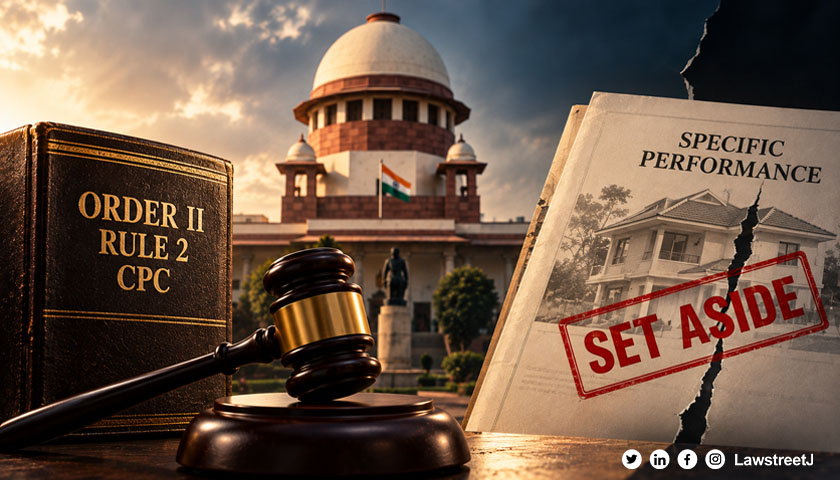
New Delhi: The Supreme Court has set aside concurrent decrees granting specific performance of an alleged oral agreement to sell land, holding that the fresh suit was barred by Order II Rule 2 of the Code of Civil Procedure, 1908, since the relief had been omitted from an earlier injunction suit filed without leave, and that, in any event, the plaintiff had failed to prove a concluded contract.
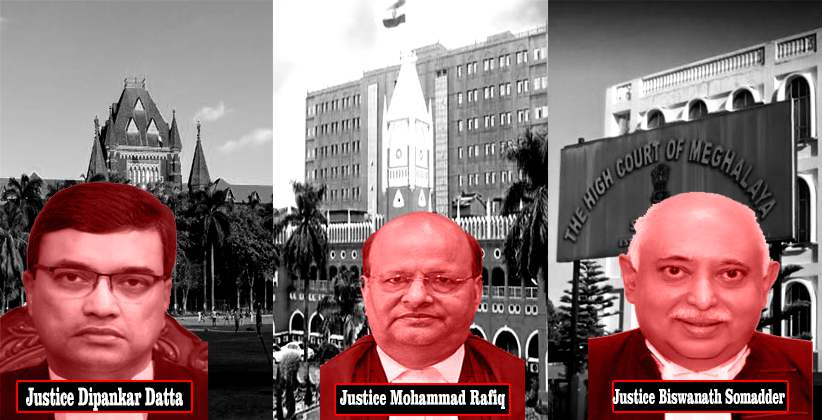
A Bench of Justice J.B. Pardiwala and Justice K. Vinod Chandran was hearing an appeal by Bombay Garage Ahmedabad Limited and others against the decree passed in favour of J P Iscon Private Ltd. and another, which the Trial Court had granted and the High Court had affirmed.
The plaintiff had first sued for a permanent injunction restraining the company from alienating the property, changing its nature or constructing on it. That plaint pleaded three meetings, an increase in the price from Rs.18.51 crore to Rs.20.50 crore, a cheque of Rs.5 crore handed over on 11.01.2007, a letter dated 25.11.2006 forwarding the property documents, and a refusal by the defendants on 08.05.2007. The suit was withdrawn on a pursis citing ongoing settlement talks and seeking to file afresh. A second suit, this time for specific performance, followed and was decreed.
For the appellants, Senior Advocate Mihir Thakore argued that no leave had been taken in the first suit, so the second suit stood relinquished under Order II Rule 2. He also submitted that no concluded contract existed, that the pleadings were inconsistent and had been amended years later, and that the negotiations were with the son-in-law of the person in charge of the company, who had no authority. Senior Advocate Deven Parikh, for the plaintiff-respondents, contended that liberty to sue afresh had to be inferred from the pursis, that Order XXIII Rule 1(3) governed the situation, and that the evasive answers of the defence witnesses justified an adverse inference.
The Court acknowledged that a suit for specific performance can rest on an oral agreement, as held in Brij Mohan v. Sugra Begum and K. Nanjappa v. R.A. Hameed, but stressed that a heavy burden lies on the plaintiff to prove a concluded contract, with strict proof being the norm and mere inference impermissible.
On maintainability, the Bench relied on the Constitution Bench decision in Gurbux Singh v. Bhooralal, which requires the defendant to show that the second suit arises from the same cause of action, that the plaintiff was entitled to more than one relief, and that a relief was omitted without leave of the court. It declined to follow the three-Judge Bench decision in Gurinderpal v. Jagmittar Singh, which had inferred liberty from a withdrawal, terming that inference impermissible and contrary to the Constitution Bench. Decisions such as Virgo Industries and Vurimi Pullarao, where the bar applied, and Inbasagaran, Rathnavati, Sucha Singh Sodhi and Cuddalore Powergen, where it did not, were examined to conclude that the application of Order II Rule 2 turns on the facts of each case.
Applying this, the Court found that the first plaint itself recorded a clear refusal on 08.05.2007, so the relief of specific performance was available and entitled at that time, yet it was neither claimed nor was leave sought when that suit was instituted. The liberty sought at the time of withdrawal, the Bench held, does not cure the absence of leave at institution. Order XXIII Rule 1(3), it added, permits a fresh suit on the same subject-matter and not a new relief, and the plaintiff, who could have sought amendment of the first suit, had not done so.
Though this sufficed to dispose of the appeal, the Court examined the merits "for completeness" and found the plaintiff's case wanting. The first plaint spoke of three meetings, the second initially of only two, and an amendment later introduced a differently described meeting. The Bench noted that the pleadings showed no date for executing the sale agreement, and that the Rs.5 crore cheque, allegedly given as advance, was nowhere stated to have been presented for encashment, which itself indicated that no contract had been concluded. Underscoring the importance of pleadings in such cases, the Court observed that "Trite is the principle that there can be no proof offered without pleadings.", adding that small discrepancies in pleadings assume massive proportions in a civil suit, especially when an oral contract is sought to be established.
Turning to the evidence, the Court held that PW1's interested testimony lacked corroboration. PW2, a former Minister and later Governor, had not been pleaded as present at any meeting, and his account of a telephonic assent by the ninth defendant was hearsay. His office carried no special weight, since there is no presumption that a person of political standing would speak only the truth. PW3 had no direct knowledge. The Bench further held that the evasiveness of the defence witnesses could not, by itself, prove the plaintiff's case, and that the letter of 25.11.2006 merely transmitted documents. It added that the sixth defendant, who was the son-in-law of the ninth defendant, held no authority to bind the company merely by that relationship.
Holding the concurrent findings to be perverse, the Court allowed the appeal, set aside the decrees of the Trial Court and the High Court, and dismissed the suit. Since the token advance of Rs.5,11,000 was itself not found to have been paid, no refund was ordered. The Bench left open the question of the ninth respondent's authority to deal with the company's assets, and directed the parties to bear their own costs.
Case Title: Bombay Garage Ahmedabad Limited & Ors. vs. J P Iscon Private Ltd. & Anr., Civil Appeal arising out of SLP (C) No. 25909 of 2024