Orissa: The Orissa High Court has dismissed both writ petitions filed by a father and his son against each other, arising from a common order passed by the Senior Citizens Tribunal under the Maintenance and Welfare of Parents and Senior Citizens Act, 2007 (MWPSC Act).
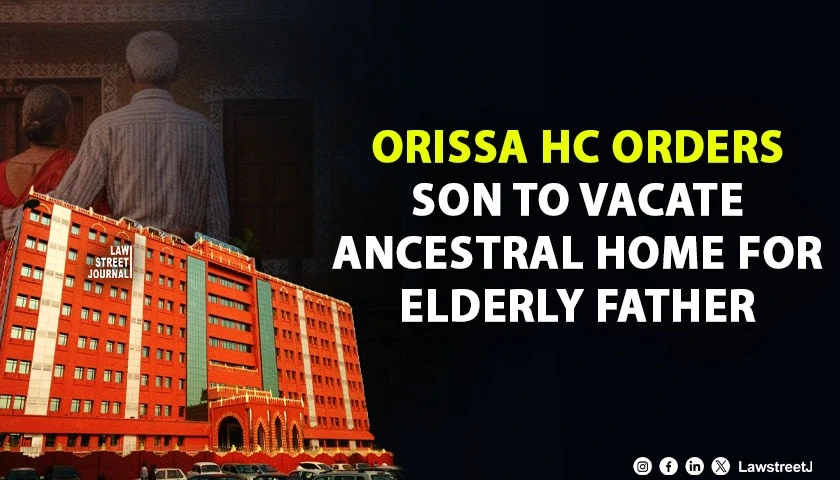
The Court of Justice Ananda Chandra Behera, in a common judgment pronounced on March 17, 2026, upheld the tribunal’s direction requiring the son to vacate the ground floor of the ancestral house at Baramunda, Bhubaneswar, and hand it over to his 86-year-old father for peaceful and dignified living.
The dispute involved Babaji Charan Sahoo, an 84-year-old retired government employee and pension holder, and his youngest son, Himanshu Sekhar Sahoo. Babaji Charan Sahoo had been residing with his youngest son in the family house at Baramunda, while his two elder sons had moved out with their own families. According to the father’s petition before the Senior Citizens Tribunal, he was forcibly made to leave his own parental house by his youngest son, after which he was compelled to take shelter first with his eldest son at Siripur, Bhubaneswar, and subsequently with his middle son at Pokhariput, Bhubaneswar.
On February 9, 2025, Babaji Charan Sahoo filed a petition before the Sub-Collector, Bhubaneswar-cum-Presiding Officer, Sub-Divisional Senior Citizens Tribunal, Bhubaneswar under the MWPSC Act, 2007, seeking protection of his life and property. He alleged torture and humiliation at the hands of Himanshu Sekhar Sahoo and further prayed for revocation of certain properties that he had purchased in his son’s name in various Mouzas, including Satyabhamapur, Lenkudi, Alarpur, Paikerapur, and Baramunda, so that they could be transferred back to his name.
The Sub-Collector, after considering the petition along with a report from the Inspector-in-Charge of the Airport Police Station regarding the allegations of torture and humiliation, passed an order on August 7, 2025, in Misc. Case Registration No. 02/2025. The tribunal directed that both the father and son should reside peacefully; that the son should cease abusing or threatening the father and accord him due respect; and that the son should vacate the ground floor of the Baramunda house and hand it over to the father by August 22, 2025. Regarding property revocation, the tribunal noted that a related Appeal Case No. 188/2024 was already pending before the Sub-Collector, Bhubaneswar, and accordingly refrained from making any order on that aspect.
Both parties were aggrieved by the tribunal’s order in different ways. The son, Himanshu Sekhar Sahoo, challenged the entire order by filing WP(C) No. 23193 of 2025, seeking its quashing. The father, Babaji Charan Sahoo, filed WP(C) No. 24893 of 2025, being partly dissatisfied with the order, primarily on the ground that the tribunal had not granted his prayer for revocation of the properties purchased in his son’s name. Since both petitions arose from the same impugned order, the High Court took them up together and disposed of them through a common judgment.
During the course of the hearing, counsel for the father relied on several judicial precedents, including the Supreme Court decision in Urmila Dixit v. Sunil Sharan Dixit (2025 INSC 20), Kamalakanta Mishra v. Addl. Collector and Others (2025 MANU/SCOR/72441/2025), Sheeja v. Maintenance Appellate Tribunal/District Collector, Thiruvananthapuram and Others (2018 (4) KLT), and Sundhari v. The Revenue Divisional Officer [WPC No. 20500 of 2016]. The High Court also referred to the Kerala High Court’s decision in Philomina v. The Appellate Tribunal (2021 (2) Civ.C.C. 806) and the Bombay High Court’s judgment in Mrs. Rajani B. Somkuwar v. Ms. Sarita Somkuwar and Another (2020 (2) CCC 100).
The High Court extensively discussed the nature and scope of the MWPSC Act, 2007, reiterating that the Act is a beneficial and benevolent legislation enacted primarily to secure social justice for parents and senior citizens. The Court emphasized that beneficial statutes must receive a liberal and purposive construction in consonance with their objectives, and that a literal approach should be avoided. It further highlighted the duty of tribunals and courts to discern legislative intent and adopt a purpose-oriented approach while interpreting and applying the provisions of the Act.
On the son’s writ petition, the Court found that the tribunal acted squarely within its mandate under the MWPSC Act by directing the son to vacate the ground floor of the ancestral house to enable his aged father to reside there with security and dignity. The Court noted that the record showed a two-storied pucca building on the ancestral property at Village Baramunda under Khata No. 487, Plot No. 760 in Mouza-Bhubaneswar Town, Unit No. 19, Baramunda, with the son and his family occupying the first floor and the father expressing a clear desire to reside on the ground floor to spend the remainder of his life in his parental home. The Court applied Rule 19 of the Orissa Maintenance of Parents and Senior Citizens Rules, 2009, which mandates that orders under the Act must enable senior citizens to live with security and dignity. Finding no grounds to interfere with the tribunal’s order, the Court dismissed WP(C) No. 23193 of 2025 filed by the son.
Regarding the father’s writ petition, the Court held that Section 16 of the MWPSC Act, 2007 provides a statutory appellate forum specifically for challenging orders passed by the Tribunal. Since the father was aggrieved by the tribunal’s partial order and wished to challenge the refusal to revoke the properties purchased in his son’s name, an efficacious remedy was available under the Act itself. Having failed to avail of that remedy and directly approaching the High Court via a writ petition, bypassing the statutory appellate forum, the father’s petition was held not to be entertainable under law. Accordingly, WP(C) No. 24893 of 2025 was also dismissed.
Hence, both writ petitions were dismissed on contest, leaving the tribunal’s order dated August 7, 2025, intact. The direction requiring the son to vacate the ground floor and hand it over to his elderly father for peaceful habitation thus stands. The father remains at liberty to pursue his grievances regarding property revocation through the appropriate statutory appellate forum under Section 16 of the MWPSC Act, 2007.
Appearances:
- For the Petitioner in WP(C) No. 23193 of 2025 (Son): Mr. B. Baug, Senior Advocate, assisted by Mr. M.R. Baug, Advocate.
- For Opposite Party No. 1 in WP(C) No. 23193 of 2025 / Petitioner in WP(C) No. 24893 of 2025 (Father): Mr. K. Badhei, Advocate.
- For the State (Opposite Party No. 2 / Opposite Party No. 1): Mr. G. Mohanty, Standing Counsel.
- For Opposite Party No. 4 in WP(C) No. 24893 of 2025 (Son): Mr. B. Baug, Senior Advocate, assisted by Mr. M.R. Baug, Advocate.
Case Title: Himanshu Sekhar Sahoo v. Babaji Charan Sahoo & Another and connected matter


![Orissa HC awards Rs 10 lakh to father who lost child to stray dog attack [Read Judgment]](/secure/uploads/2023/12/lj_3371_Stray_dog_menace.jpg)
![Orissa HC rules in favour of BJDs Lok Sabha MP Anubhav Mohanty in divorce plea [Read Judgment]](/secure/uploads/2024/01/lj_2524_Anubhav_Mohanty.jpg)
![Indian Courts this Week: Law Street Journal's Weekly Round-Up of SC & HCs [Jan 1 - Jan 6]](/secure/uploads/2024/01/lj_9050_WhatsApp_Image_2024-01-06_at_12.07.10_PM.jpeg)