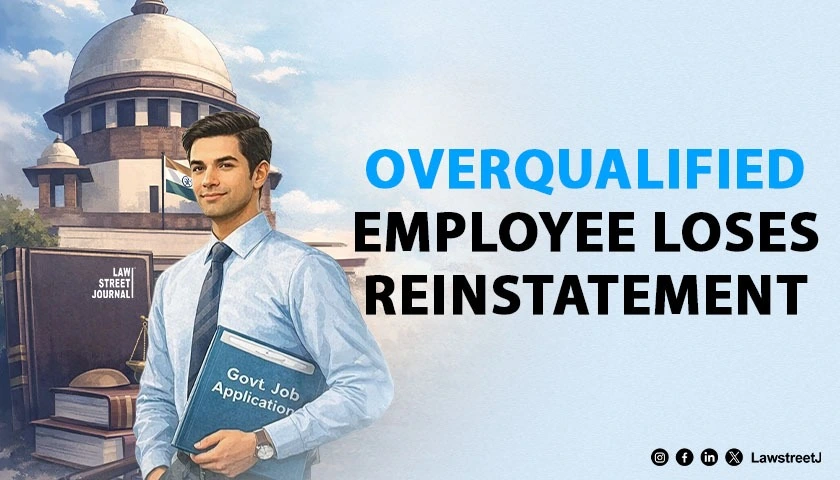
New Delhi: The Supreme Court on May 19, 2026 restored an order of dismissal passed against an employee who had concealed his graduate qualification to secure a post for which the prescribed maximum qualification was a pass in the 12th standard, holding that once it came to light that the employee was overqualified on the date of sponsorship, he ceased to be eligible for consideration and no subsequent action by the employer could create an enforceable right in his favour [General Manager (HR) and Another v. K. Poovarasan, 2026 INSC 581, Civil Appeal arising out of SLP (C) No. 6845 of 2026].
A Bench of Justice Ahsanuddin Amanullah and Justice R. Mahadevan set aside a Madras High Court Division Bench order that had affirmed the reinstatement of the respondent and restored the dismissal order dated October 30, 2018.
Background
The respondent, K. Poovarasan, was appointed as a Temporary Attender pursuant to his name being sponsored by the Employment Exchange. The requisition issued by the appellants to the Employment Exchange on October 20, 2009 stipulated that the candidate must have passed the 8th standard but must not have passed the Intermediate, 12th standard, or 10+2 examination. In the application submitted to the Employment Exchange, the respondent disclosed only that he had passed the 10th standard, despite being a graduate at the time.
After entering service, the respondent sought and obtained permission from the appellants to pursue a graduation course, thereby presenting himself as not yet holding a graduate degree at the time of appointment. Upon learning of the suppression, the appellants passed an order of dismissal dated October 30, 2018. The respondent challenged this order before the Madras High Court. A learned Single Judge set aside the dismissal and directed reinstatement with continuity of service and other consequential benefits, but without back wages, by order dated April 16, 2025. The Division Bench dismissed the appellants’ writ appeal by judgment dated September 9, 2025. Aggrieved, the appellants approached the Supreme Court.
Court’s Analysis
The Court held that the rationale behind prescribing an upper qualification limit is both reasonable and equitable, namely, to provide employment opportunities to persons who, owing to circumstances of life, could not pursue higher education. The State, as a model employer, is justified in reserving certain categories of posts for such persons so that they are not compelled to compete with more highly qualified candidates. Permitting a person with higher qualifications to secure such a post would necessarily deprive a genuinely eligible and deserving candidate of that opportunity.
The Court held that even assuming there was no deliberate attempt to mislead the authorities at the initial stage, the respondent was ineligible for consideration on the date his name was sponsored by the Employment Exchange, given that he possessed qualifications beyond the permissible limit. Any subsequent action taken by the appellants after the sponsorship could not create an enforceable right in his favour to continue in service.
The Court further held that the respondent’s omission in the attestation form to disclose all educational qualifications despite a clear requirement to do so raised serious doubts regarding his bona fides. The fact that he had disclosed only his 10th standard pass and had thereafter sought permission to pursue graduation from the appellants reinforced the inference that he was conscious that disclosure of his actual qualification would have rendered him ineligible.
The Court relied on Jomon K.K. v. Shajimon P. and Others, 2025 SCC OnLine SC 711, which had observed that the State as a model employer is obliged to ensure that posts are filled by candidates with the requisite qualifications, and that if an appointment is illegal, it is non est in the eyes of law, with principles of equity and sympathy having no role to play in such cases.
“Public employment must be made available to all eligible candidates in accordance with the prescribed qualifications,” the Court stated, while acknowledging its sympathy for the respondent, but holding that the settled position of law left no option but to interfere.
Case Details
Case Title: General Manager (HR) and Another v. K. Poovarasan
Citation: 2026 INSC 581; Civil Appeal arising out of SLP (C) No. 6845 of 2026
Court: Supreme Court of India
Bench: Justice Ahsanuddin Amanullah and Justice R. Mahadevan
Date of Order: May 19, 2026
Appearances:
For Appellants: AOR Rajesh Kumar Gautam; Advocates Anant Gautam, Vibhu Sharma, Likivi K. Jakhalu, Aman Gahlot, Rishi Chauhan and Azal Aekram.
For Respondent: AOR P.S. Sudheer; Advocates M. Vijayan, Justin Selvakumar, Rishi Maheshwari, Anne Mathew, Bharat Sood and Jashan Vir Singh.