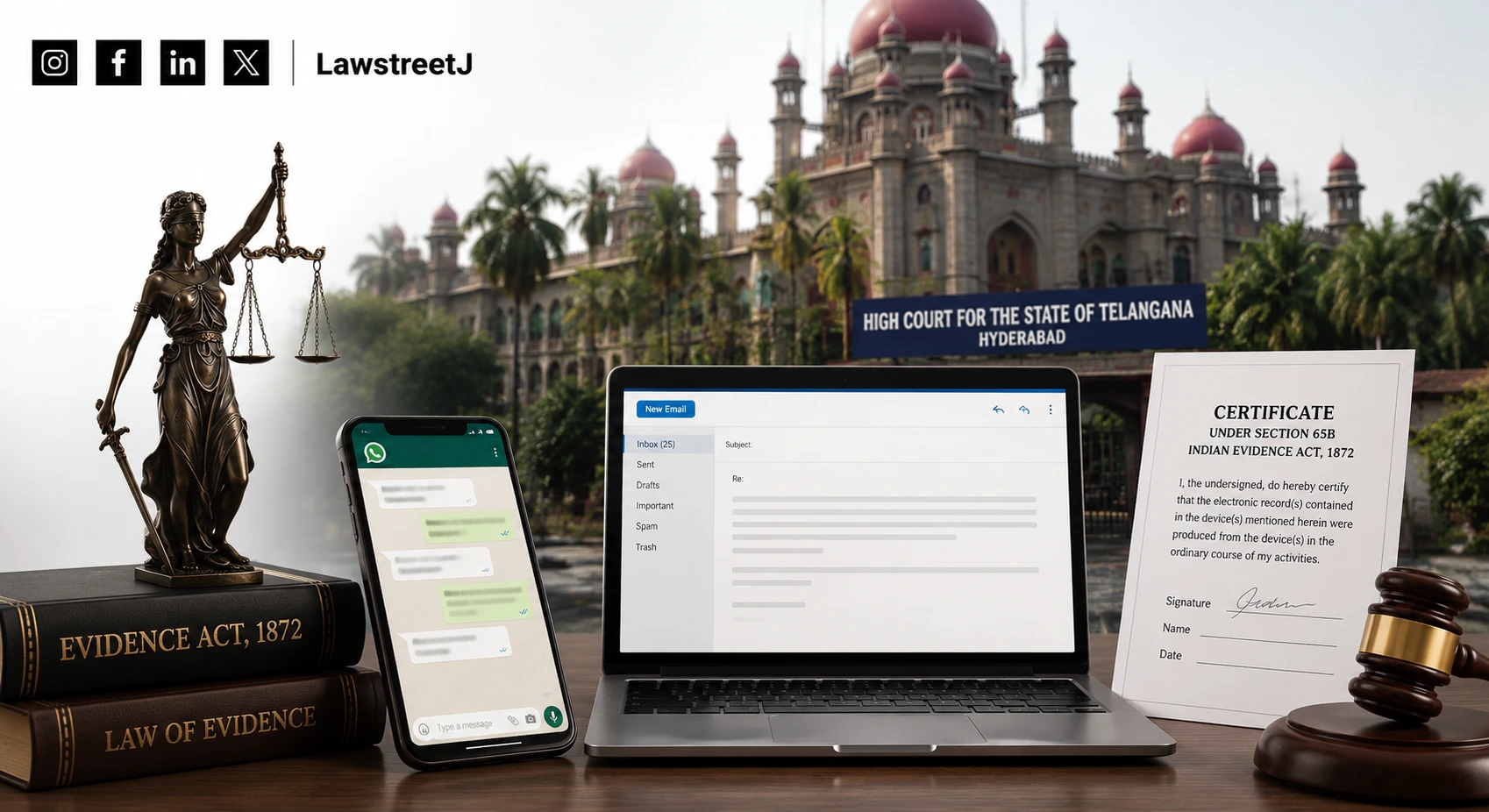
Telangana: The Telangana High Court has held that a party seeking to rely on emails and WhatsApp chats exchanged on their own personal device may furnish a self-certificate under Section 65B(4) of the Indian Evidence Act, 1872, and is not obliged to procure a certificate from an external or official authority.
Justice Renuka Yara was hearing a Civil Revision Petition under Article 227 of the Constitution filed by a defendant in a suit for recovery of an invested amount of Rs. 8,00,000/-, profits of Rs. 4,40,000/- and interest at 24% per annum, arising out of an order of the XVIII Additional Senior Civil Judge, City Civil Court, Hyderabad, dismissing his application under Order VIII Rule 1A(3) CPC to receive certain emails and WhatsApp chats exchanged between the parties, their tax consultant and the plaintiff's son. The suit itself arose from disputes over investment made by the plaintiff in the defendant's business under a partnership agreement.
The application for reception of documents was filed at the stage of the defendant's evidence, seeking to bring on record emails between the parties, emails involving the tax consultant relating to a draft business agreement, and WhatsApp chats between the parties and between the plaintiff's son and the defendant. The trial Court dismissed the application on the ground that the electronic evidence could not be received without production of the original device through which the emails originated and without a Section 65B(4) certificate from the concerned official authority. The plaintiff opposed the revision, contending that there was no foundation in the pleadings for the documents, that the WhatsApp messages were self-created after the suit was filed, and that the application itself was not maintainable for having invoked Order VIII Rule 1A(3) CPC instead of Section 65B.
The petitioner's counsel argued that the trial Court had misread paragraph 72 of the Supreme Court's ruling in Arjun Panditrao Khotkar v. Kailash Kushanrao Gorantyal, submitting that Section 65B(4) permits a certificate either from a person occupying a responsible official position or from the person managing the relevant activities, and that a certificate from an official authority is necessary only where the electronic evidence is public property, not where it is a private device such as a personal mobile phone.
The respondent's counsel, relying on Voruganti Narayana Rao v. Bodla Rammurthy and Kyatham Rajkumar v. Vaddepalli Rajamani, argued that documents not pleaded in the written statement cannot be received in evidence without foundation in the pleadings, and that the trial Court had correctly required strict compliance with Section 65B before admitting the electronic material. Reliance was also placed on Arjun Panditrao Khotkar to submit that Sections 65A and 65B are not a complete code and that, while the requirement of a certificate is procedural and can be relaxed by the Court in the interest of justice, it cannot be dispensed with altogether.
Examining the pleadings, the Court found that paragraph 7 of the written statement specifically referred to acknowledgment of amounts through emails and SMS exchanged between the parties, and that the list of documents filed along with the written statement already contained screenshots of the text messages, WhatsApp chats and emails sought to be received. The objection that there was no pleading foundation for the documents was accordingly rejected.
On the objection that the messages were exchanged after the suit was filed, the Court noted that the bulk of the emails and WhatsApp chats bore dates between November and December 2016, well before the suit came to be filed, and that only three WhatsApp messages fell in January 2017. The Court also accepted the petitioner's explanation for the delay in producing the documents, namely that he had hoped to confront the respondent with them during cross-examination and sought their formal reception only after the respondent refused to admit the conversations.
On the central question of the certificate, the Court held that Section 65B(4) gives an alternative course of action for receiving electronic evidence, one being a certificate from an official person and the other being a certificate from the manager in charge of the relevant activities. Since the petitioner's case was that the emails and WhatsApp chats originated from his own Blackberry device, he had the option of either producing the device itself or furnishing a self-certificate to the best of his knowledge, and the Court found that he had rightly exercised the latter option.
“Procedure is the handmaid of justice,” the Court observed while emphasising that technical hurdles ought not to come in the way of substantial justice, and held that the trial Court had erred in applying the ratio in Arjun Panditrao Khotkar to require a certificate from an official authority in respect of a personal device.
“The impugned order is liable to be set aside,” the Court held, allowing the Civil Revision Petition, setting aside the trial Court's order dated 17.08.2023, and consequently allowing the application to receive the emails and WhatsApp chats in evidence. The Court directed that there shall be no order as to costs.
Appearances:
For the Petitioner: Sri Baglekar Akash Kumar, Advocate.
For the Respondent: Sri M.A. Basith, Advocate.
Case Title: Md. Khalid vs. Mohammed Khaja Aijaz Ali, Civil Revision Petition No. 3890 of 2024


!['No common intention to kill,' SC alters conviction from murder to culpable homicide not amounting to murder [Read Judgment]](/secure/uploads/2024/02/lj_7197_f77c706e-b667-41fe-9c36-9e633e880b85.jpg)
![Remaining silent during an investigation is a fundamental right: Telangana HC [Read Judgment]](/secure/uploads/2024/04/lj_3728_c8f7ecd3-a0e9-44f7-85aa-f77b9dae3a49.webp)
.jpeg)