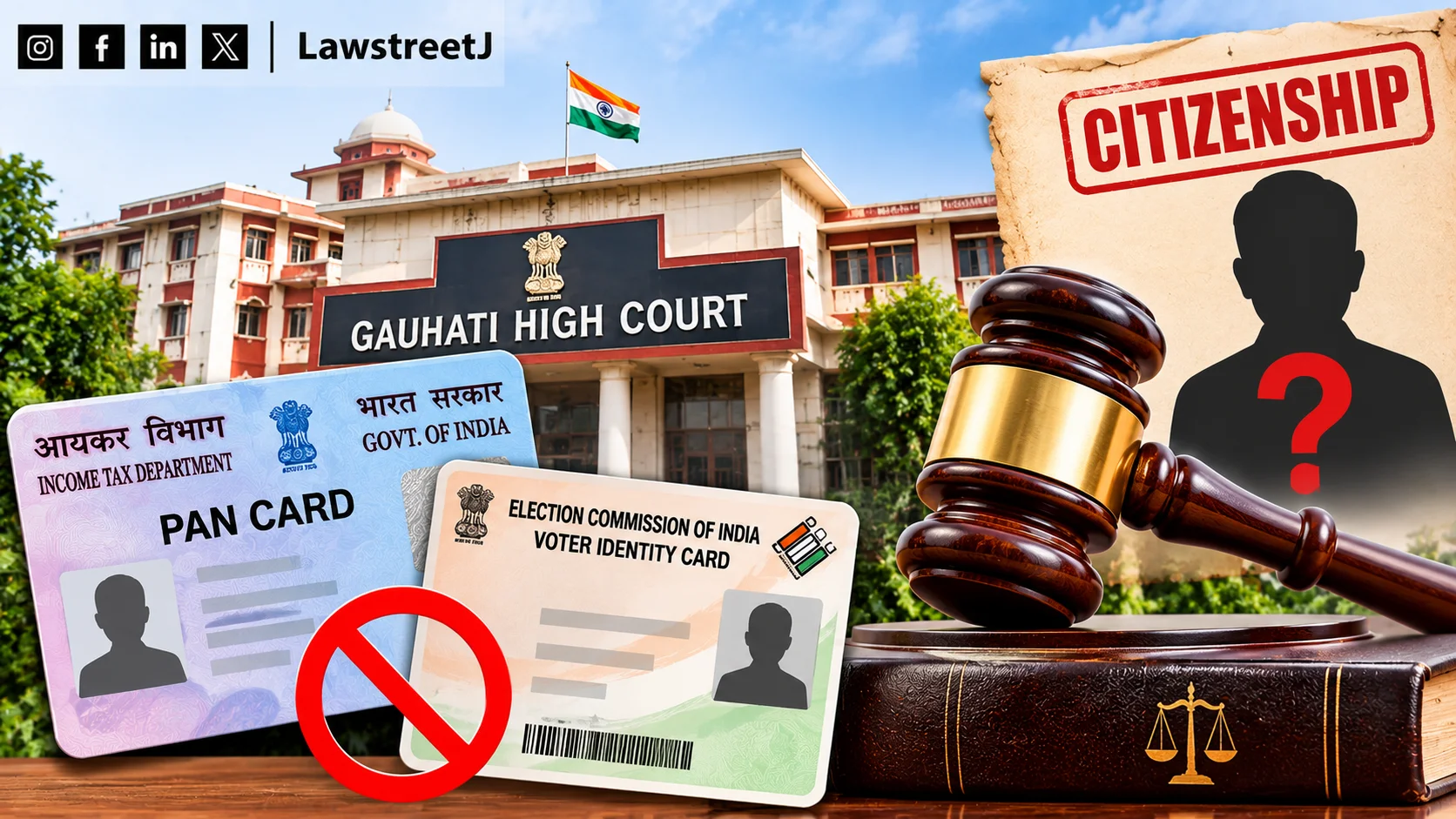
Guwahati: The Gauhati High Court has dismissed the writ petition of a woman declared a foreigner of the post-25.03.1971 stream by a Foreigners Tribunal in Darrang, Assam, holding that none of the documents she produced linked her to her projected father, and that her plea that she was misled by her counsel was an “after-thought” and her plea that she was not heard was “ex facie false”.
A Division Bench of Justice Kalyan Rai Surana and Justice Susmita Phukan Khaund delivered the judgment on 5 November 2026 in WP(C) 2459/2020, after reserving it on 2 September 2026, and revoked her interim bail granted on 18.04.2022.
The petitioner, Kulchan Begum, challenged the opinion dated 21.08.2018 of the Foreigners Tribunal (4th), Mangaldai, in F.T. 4th Case No. 149/SPR/2017, which arose from a reference first made in 2000 under the Illegal Migrants (Determination by Tribunals) Act, 1983, before the Supreme Court struck down that Act in Sarbananda Sonowal, after which it was registered under the Foreigners Act, 1946. The Court struck off the Tribunal from the array of parties, as it is not required to defend its orders.
The petitioner said that she was born on 25.04.1977, that her grandparents’ names were in the voter lists of 1966 and 1970, that her father, who was born in 1955, had been a ward councillor of the Guwahati Municipal Corporation and a candidate in the 2009 Lok Sabha and 2011 Assembly elections, and that she had used her grandfather’s legacy data for the NRC. She examined only herself, and exhibited documents such as a PAN card, voter lists of 1966, 1970, 1997 and 2018, a ration card, her father’s election-related cards and an NRC acknowledgement.
Before the High Court, she argued that she had wanted to examine her parents and others but had been wrongly advised by her counsel that her documents were enough, and that the Tribunal decided the matter without hearing her. The State’s counsel argued that her written statement lacked essential pleadings and that the Tribunal’s opinion was sound.
The Court said that it was not called upon to examine her counsel’s competence, but that the record showed that, after she filed her evidence, the case was adjourned on several dates and she never applied to examine further witnesses, who would not have needed a summons. The petition also contained no record of any wrong advice, and she had not complained to the Bar Council. It held that the plea was manufactured to fill the gap in her case.
On the claim that she was not heard, the Court noted that, as per the Tribunal’s order of 20.07.2018, it had heard her counsel and the Assistant Government Pleader before fixing the case for the final order on 21.08.2018. It held that the plea in the petition was “ex facie false” and aimed to mislead the Court, and that it would not have come to light had the entire order sheet not been perused.
On the evidence, the Court held that the petitioner had not disclosed her relationship with most persons in the 1966 and 1970 voter lists, that the name of her projected father appeared for the first time in 1997 when he was shown as 50 years old, and that the age gap between her and her projected mother, on those lists, made her stand doubtful. It also noted that, although she claimed to have been born and brought up in Guwahati to a politically active father, she had no birth certificate or formal education record, and that she had mentioned a sister in cross-examination whom she had not mentioned earlier.
The Court held that PAN cards and EPICs are issued on self-application and are not proof of citizenship, that the ration card, the 2018 voter list and the election-related cards of her projected father did not link her to him, that the NRC acknowledgement was a copy not proved by the original and was not an updated NRC, and that the certificate of an Area Sabha representative was not proof of parentage and its author was not examined. It said that the candidature and election of her projected father did not by themselves prove that she was his daughter.
The Court further observed that, under Section 6A(2) of the Citizenship Act, 1955, she had to prove the continuous residence in Assam of her grandparents and father, but there was no evidence of residence between 1970 and 1997. It held that none of the documents helped her discharge the burden under Section 9 of the Foreigners Act, 1946, dismissed the writ petition with no order as to costs, recalled the interim bail, and directed that the consequences of the Tribunal’s opinion would follow.
Appearances: For the Petitioner: Mr. S. Zaman, Advocate. For the Respondents: Mr. G. Pegu, CGC (No. 1); Mr. G. Sarma, Standing Counsel, FT, Border and NRC (Nos. 2, 5 and 7); Mr. P. Sarmah, Additional Senior Government Advocate (No. 4); Mr. A.I. Ali, Standing Counsel, Election Commission of India (No. 6).
Case Title: Kulchan Begum v. The Union of India and Others, WP(C) 2459/2020