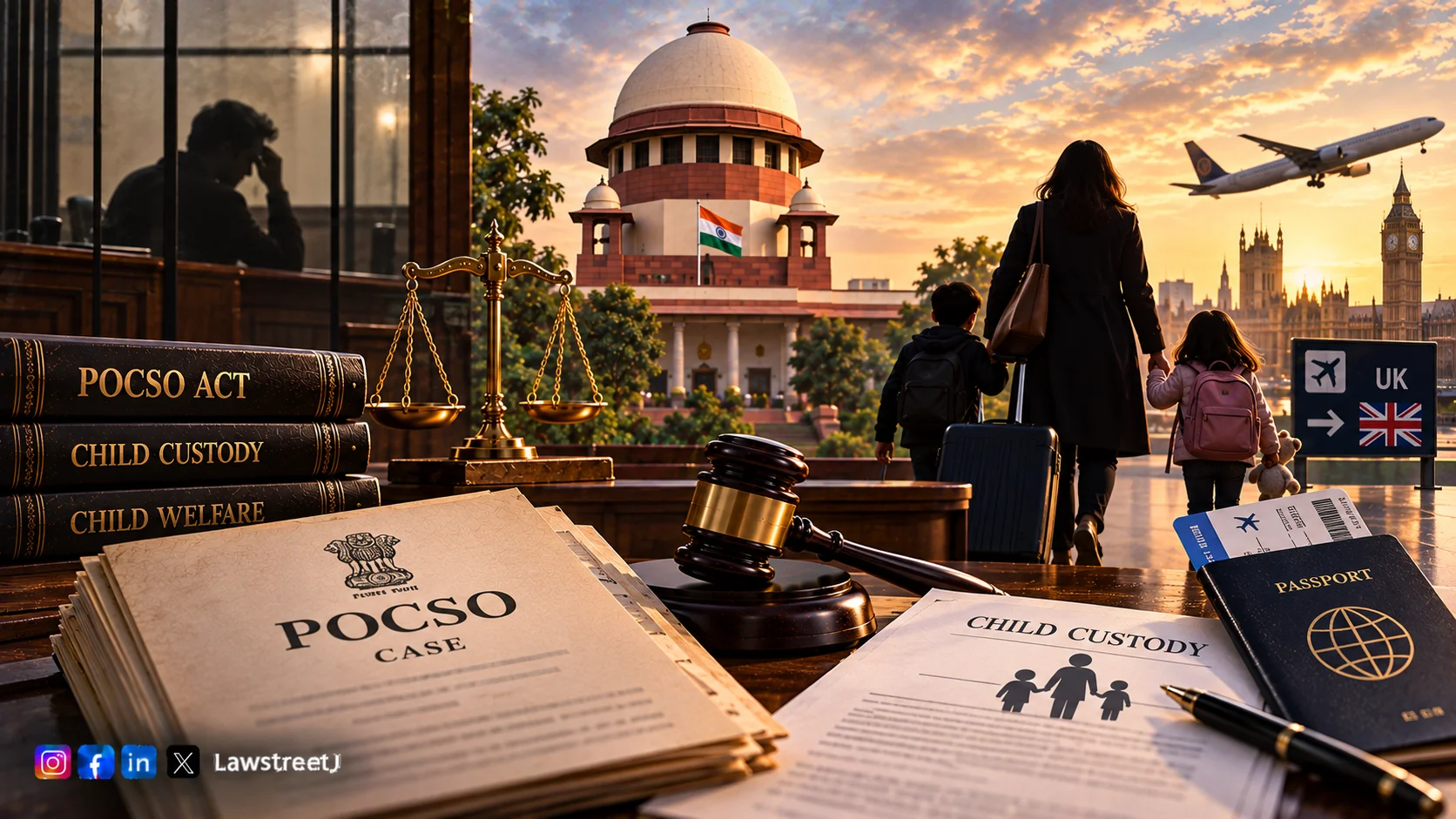
New Delhi: The Supreme Court has set aside concurrent findings of the Family Court, Patiala House Courts, New Delhi and the High Court of Delhi granting sole custody of two minor children to the father, holding that a parent facing a pending chargesheet under the Protection of Children from Sexual Offences Act, 2012 cannot, while such prosecution is pending, be considered entitled to custody, and has permitted the mother to relocate the children to the United Kingdom, where she is employed.
Justice Sandeep Mehta, delivering the order for the Bench also comprising Justice Vikram Nath, was hearing appeals filed by the mother against the judgment dated 23rd January, 2026 of the High Court of Delhi, which had dismissed her appeal and affirmed the judgment dated 1st July, 2024 of the Family Court declaring the father the sole custodian of the two minor children, son 'Master SSB', aged about 13, and daughter 'Ms. DW', aged about 7, while also rejecting the mother's application seeking permission to relocate the children to the United Kingdom.
The parties married in 2011, and the son was born in 2013. Relations deteriorated in 2018, when the mother, then four months pregnant, left the matrimonial home, leaving the son with the father; she regained custody of the son a few months later and has cared for him since, while the daughter, born in January 2019, has remained in her custody since birth. Multiple proceedings between the parties, including a habeas corpus petition and guardianship proceedings, culminated in this Court transferring all custody disputes to the Family Court at Delhi. The mother's applications for the children's passports and, later, for permission to relocate with the children to the United Kingdom, where she had secured a lecturer's position at the University of Hull, were rejected by the Family Court, which cited the contractual nature of her UK employment and a perceived risk of alienating the father.
During the pendency of these proceedings, the son, upon examination at NIMHANS, Bengaluru for aggressive behaviour, made a disclosure indicating past sexual abuse by the father, leading to registration of an FIR under the POCSO Act and, subsequently, a chargesheet against the father. The father's petition to quash this FIR remains pending before the High Court of Calcutta. Notwithstanding this, the Family Court, by its judgment dated 1st July, 2024, granted sole custody to the father, a finding the High Court affirmed, additionally observing that the abuse allegations appeared to be a motivated counterblast to the father's litigation.
During the pendency of the appeals before this Court, the Bench interacted with the parties and the children in chambers and, noting the son's pronounced reluctance to be with the father, stayed the operation of the impugned judgments. On a subsequent request by the father, the Court arranged supervised visitation during the summer vacation, with counsellors from the Family Court, Bengaluru and NIMHANS overseeing the sessions. The counsellors' reports, extracted in the order, recorded that both children, and the son in particular, consistently exhibited avoidance, distress and reluctance to engage with the father, notwithstanding his sustained efforts, and repeatedly expressed a preference to remain with the mother.
Mr. Zoheb Hossain, for the mother, submitted that her repeated changes of employment, far from reflecting a 'nomadic lifestyle' as characterised by the Courts below, were necessitated by numerous RTI applications and complaints filed against her by the father, and that the children's own expressed wishes and the counsellors' observations ought to weigh decisively in determining custody. He submitted that the disclosure of abuse leading to the chargesheet could not be brushed aside at the custody stage, and that the mother's substantially better financial position in the United Kingdom would serve the children's welfare.
Mr. Shyam Divan, for the father, submitted that financial disparity could not be the sole determinant of custody, that the father had lost his earlier well-paying employment on account of the mother's complaints, that this was a case of parental alienation engineered by the mother, and that relocation abroad would cause the children to lose their cultural roots. He also contended that the High Court's observations doubting the veracity of the POCSO FIR were justified and that the pendency of a chargesheet alone could not disentitle the father to custody.
Examining the record, the Court found that the mother's career movements were substantially attributable to the father's conduct rather than any indecisiveness on her part, and that his own admittedly modest income, compared to her considerably better financial standing, could not justify the custody findings against her. The Court held that the High Court's observations doubting the genuineness of the POCSO allegations were premature and improper given that the quashing petition was still pending before the High Court of Calcutta, and directed that those observations be expunged. Referring to the principles of participation, best interest, safety and non-waiver of rights under Section 3 of the Juvenile Justice (Care and Protection of Children) Act, 2015, the Court held that a child's safety and disclosure of abuse cannot be subordinated to a parent's claim for custody while criminal prosecution remains pending.
The Court observed: “We can quite visualise the plight of the children who have been deprived of the custody of both the parents because of the ongoing litigation continuing for more than 7 years.”
Holding that the father, so long as he faces prosecution under the POCSO Act, cannot be considered entitled to custody, and that continued denial of relocation would only deepen the children's parental alienation, the Court made absolute its earlier stay of the impugned judgments and permitted the mother, for the present, to take the children to the United Kingdom and enrol them in school there, subject to her filing an affidavit disclosing the schooling arrangements within six weeks and furnishing an undertaking to produce the children before any Court as directed. The Court clarified that the pending quashing petition before the High Court of Calcutta shall be decided independently, uninfluenced by any observations in the High Court's judgment or in this order, and listed the appeals for hearing in January, 2027.
Case Title: Debarati Bhunia Chakraborty vs. Suman Sankar Bhunia, Civil Appeal No(s). 12774-12775 of 2026 (arising out of SLP (Civil) No(s). 4306 and 1714 of 2026)