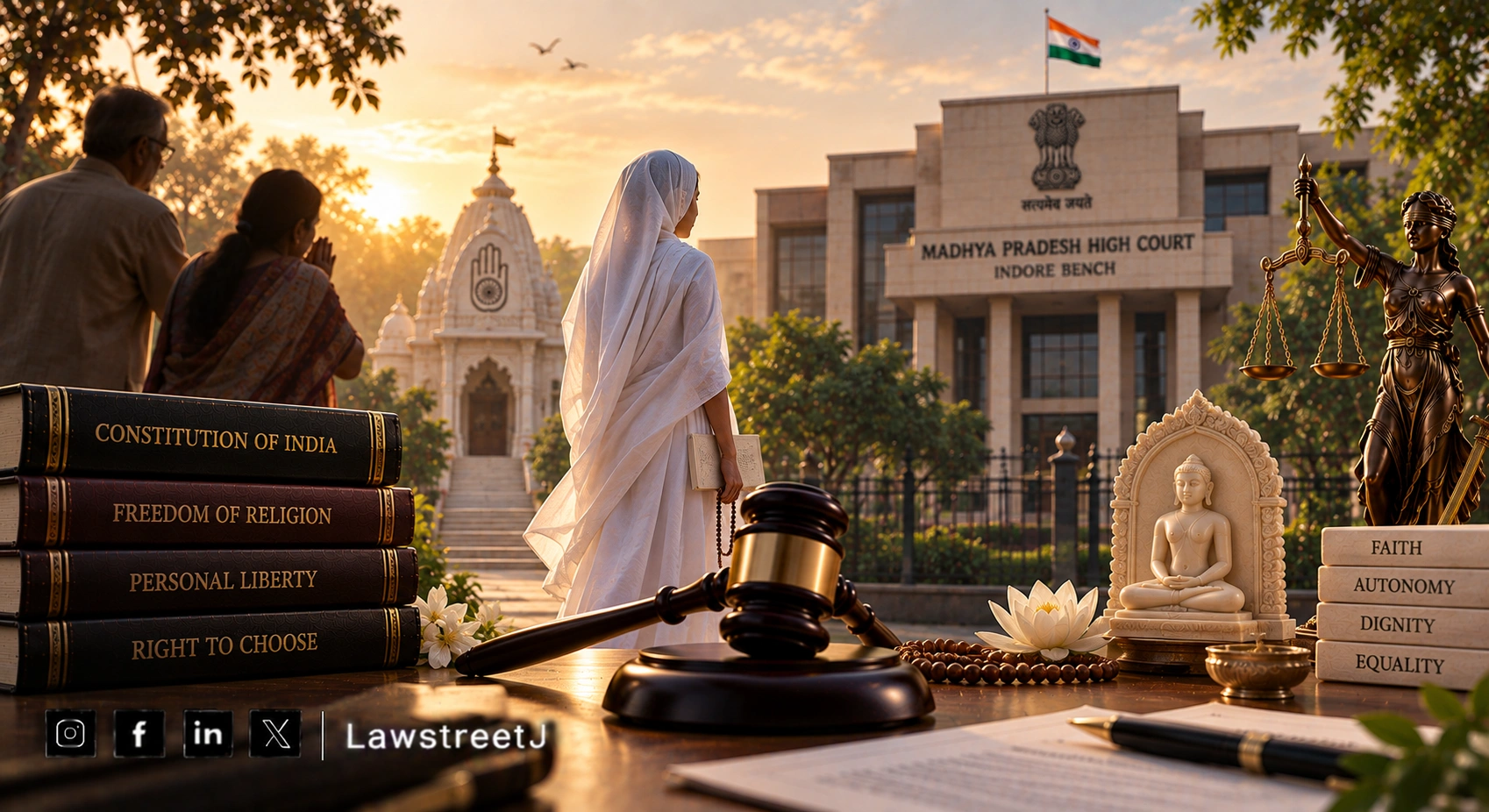
Indore: The Madhya Pradesh High Court, Indore Bench, has disposed of a writ petition filed by a twenty-year-old woman seeking police protection to pursue Diksha and practise Shwetambar Jain Dharma against alleged interference by her parents and relatives, holding that a major citizen is entitled to follow the religion of her choice and live her life as she wills, and directing the concerned police authorities to act against any coercive interference by her family.
Justice Sandeep N. Bhatt was hearing a writ petition filed under Article 226 of the Constitution seeking police protection for the petitioner's safety, liberty and freedom of movement, a direction restraining her parents and relatives from interfering with her practice of Jain religion and her decision to take Diksha, and a declaration that she, being a major, was entitled to exercise her fundamental rights under Articles 19, 21, 25 and 26 without hindrance.
Counsel for the petitioner submitted that she had chosen to follow Shwetambar Jain Dharma and pursue the religious path of Diksha, but her parents and relatives were harassing and opposing her religious choice. It was submitted that the petitioner apprehended interference with her freedom of conscience and religion and restriction of her movement and liberty, and that she had already submitted a pending representation to the Commissioner of Police, Indore, seeking protection.
The Court observed that the petitioner, being twenty years of age and a citizen of India, was entitled to follow religion in her own way and to live her life as per her will, and noted that she had decided to renounce worldly life and take Diksha to live as a Saadhvi, while her parents, out of attachment towards her, were seeking to prevent this.
Expressing equal sympathy towards both the petitioner and her parents, the Court held that, in view of the ratio laid down by the Supreme Court in Lata Singh v. State of U.P., AIR 2006 SC 2522, a major person aged above eighteen years is free to take her own decisions, and courts are required to protect the interest of such a person. The Court held that the petitioner, being a major, was entitled to protection of her family and other legal rights, and that any obstruction caused by anybody could not be permitted in the eye of law.
Accordingly, the Court directed the petitioner to approach the Superintendent of Police, the concerned police station, or the fourth respondent, by filing an application seeking assistance against any coercive method adopted by any person, including her parents. It directed that upon such application being filed, the concerned authority or the Station House Officer of the concerned police station shall look into the matter and take immediate action in accordance with the directions of the Supreme Court in Lata Singh (supra) and Shakti Vahini v. Union of India, (2018) 7 SCC 192.
With the aforesaid direction, the writ petition was disposed of.
Appearances:
For the Petitioner: Shri Ashish Joshi, Advocate.
For the State: Shri Garvit Jain, Panel Advocate.
Case Title: Tanisha vs. The State of Madhya Pradesh and Others, Writ Petition No. 48919 of 2025



![High Court Prohibits Compulsion of Hijab and Islamic Texts on Students of Different Faiths at Ganga Jamuna School [Watch Video]](/secure/uploads/2023/09/lj_5754_f71da9b5-c632-4d0b-94b8-6f36245eb157.jpg)
.jpeg)