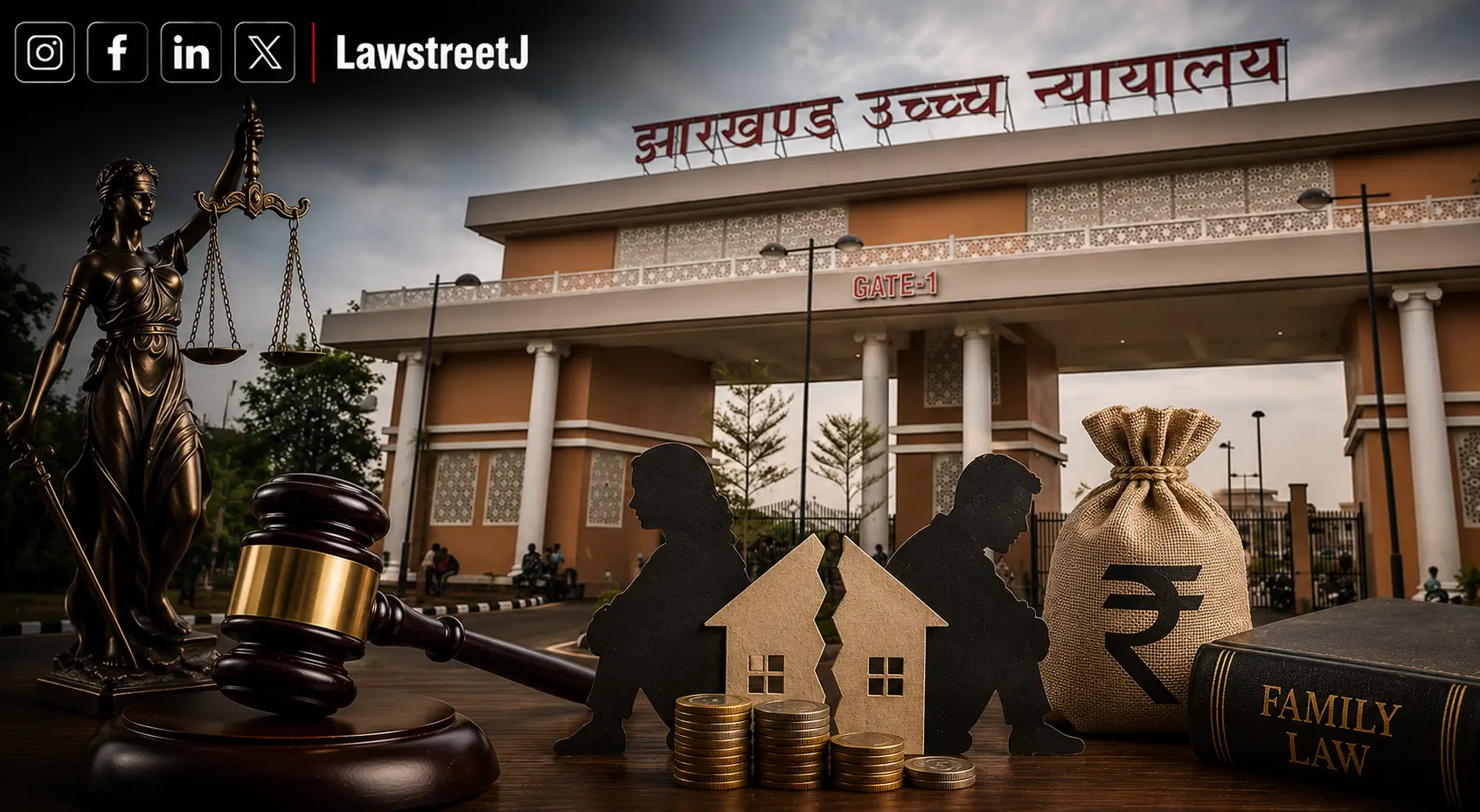
Ranchi: The Jharkhand High Court has held that while determining permanent alimony, courts must strike a balance between the dependent wife's financial security and the husband's ability to pay, observing that no fixed mathematical formula can determine the appropriate quantum.
While upholding a Family Court decree dissolving the marriage, the Division Bench directed the husband to pay Rs. 30 lakh as permanent alimony after noting that his remarriage during the pendency of the appeal had ruled out any possibility of reconciliation between the parties.
A Division Bench of Justice Sujit Narayan Prasad and Justice Sanjay Prasad delivered the judgment in First Appeal No. 201 of 2025, disposing of an appeal preferred by the wife against the order and judgment dated 22 November 2022 and decree signed on 6 December 2022 passed by the learned Principal Judge, Family Court, Latehar in Original Suit No. 28 of 2021, whereby the suit filed by the respondent-husband for dissolution of marriage on grounds of cruelty and desertion under Section 13(1)(i-a) and (i-b) of the Hindu Marriage Act, 1955 had been allowed.
The parties had been married in accordance with Adivasi (Oraon) custom. The respondent-husband filed the divorce suit on 23 July 2021, approximately four years after the marriage, on grounds of cruelty and desertion. The learned Family Court, after framing two issues and appreciating evidence adduced by both parties who examined five witnesses each, concluded that the husband had proved cruelty and desertion, and accordingly decreed the suit for divorce. The wife-appellant preferred the present appeal challenging the dissolution.
When the matter came up for hearing before the Division Bench on 23 April 2026, the Court noted that the respondent-husband had solemnised a second marriage during the pendency of the appeal, rendering reunion between the parties impossible. The Court accordingly confined the proceedings to the question of permanent alimony under Section 25 of the Hindu Marriage Act, 1955, and directed both parties to file affidavits disclosing their respective income, movable and immovable assets, in terms of the framework laid down by the Supreme Court in Rajnesh v. Neha & Anr., (2021) 2 SCC 324.
The appellant-wife, in her affidavit dated 10 June 2026, disclosed that she was unemployed and assisted her mother at a roadside vegetable stall, earning a seasonal income of Rs. 200 to 300 per day. She was 28 years of age. The respondent-husband, in his affidavit dated 25 June 2026, stated that he had remarried on 11 January 2025, more than two years after the divorce decree, and that his gross monthly salary as a Constable was Rs. 66,097/-, with a net take-home of Rs. 40,354/-.
He further disclosed that deductions from his salary included Rs. 21,883/- towards a home loan, Rs. 2,350/- towards ELI, Rs. 3,000/- towards PPF, and Rs. 18,000/- being directly paid to the appellant-wife as maintenance and arrears pursuant to an earlier court order. Counsel for both sides agreed not to contest the merits of the divorce decree and confined submissions to the quantum of permanent alimony.
The Court surveyed the settled legal framework governing permanent alimony under Section 25 of the Hindu Marriage Act. Referring to Vinny Parmvir Parmar v. Parmvir Parmar, (2011) 13 SCC 112, the Court noted that no arithmetic formula can be adopted for fixing permanent alimony, and that the quantum depends on the status of parties, their respective needs, the financial capacity of the husband, and the standard of living the wife was accustomed to during the marriage.
The Court also relied on Rajnesh v. Neha (supra), which had comprehensively laid down that the objective of permanent alimony is to ensure the dependent spouse is not reduced to destitution or vagrancy on account of the failure of the marriage, and not as a punishment to the other spouse. Factors such as the wife's educational qualifications, employment status, independent source of income, and whether she had sacrificed employment opportunities for the family were all held relevant.
The Court additionally referred to Kiran Jyot Maini v. Anish Pramod Patel, 2024 SCC OnLine SC 1724, Pravin Kumar Jain v. Anju Jain, 2024 SCC OnLine SC 3678, and the recent Supreme Court decision in Rakhi Sadhukhan v. Raja Sadhukhan, 2025 SCC OnLine SC 1259, which had enhanced alimony subject to a 5% increase every two years, to underscore the evolving judicial approach to securing the financial future of dependent spouses.
The Court also affirmed that the fact of a wife earning some amount cannot by itself be a ground to deny her maintenance if her income is insufficient to maintain the standard of living she enjoyed in the matrimonial home. Relying on Sunita Kachwaha & Ors. v. Anil Kachwaha, (2014) 16 SCC 715, and Manish Jain v. Akanksha Jain, (2017) 15 SCC 801, the Court reiterated that maintenance is not a matter of charity but of right, and that the financial position of the wife's parents is immaterial in determining the quantum.
On the facts, the Court noted that the appellant-wife was 28 years of age with no independent income, and that taking the life expectancy of a female in India at approximately 70 years, the permanent alimony was to sustain her for the next 42 years. The Court observed that the Family Court had already awarded maintenance of Rs. 10,000/- per month in Original Maintenance Case No. 9 of 2020, and that if capitalised over 42 years, the same would amount to approximately Rs. 50 lakh.
Noting the benchmark observed in Kalyan Dey Chowdhury v. Rita Dey Chowdhury Nee Nandy, (2017) 14 SCC 200, that approximately 25 per cent of the husband's net salary may serve as a reasonable reference point while disregarding voluntary expenditure such as EMIs on loans, the Court balanced the husband's financial capacity against the wife's legitimate entitlement.
The Court held that a lump sum of Rs. 30,00,000/- (Rupees Thirty Lakhs) would be just, fair and reasonable as permanent alimony, directed the amount to be paid in four equal instalments within 12 months from the date of the order, with the first instalment to be paid within two months.
The Court granted liberty to the appellant-wife to approach the court in accordance with law if the amount was not credited to her account as directed. The impugned judgment and decree of the Family Court dissolving the marriage were affirmed, subject to the payment of permanent alimony as directed.
Appearances: Mr. Aayush Ojha, Ms. Tanya Raj and Mr. Chiranjeev Mahto, Advocates appeared for the appellant. Mr. Zaid Ahmed, Advocate appeared for the respondent.
Case Title: [Appellant] v. [Respondent], First Appeal No. 201 of 2025


![Supreme Court Collegium approves new Chief Justices for five key High Courts in India [Read Recommendations]](/secure/uploads/2023/12/lj_8000_380d1135-6f3a-4988-a00a-4d5cd5901815.jpg)
!['Arbitrary, impermissible,' SC quashes HC's resolution raising aggregate cut off marks on district judges appointment [Read Judgment]](/secure/uploads/2024/02/lj_3605_Rule-for-Judge-Selection.webp)