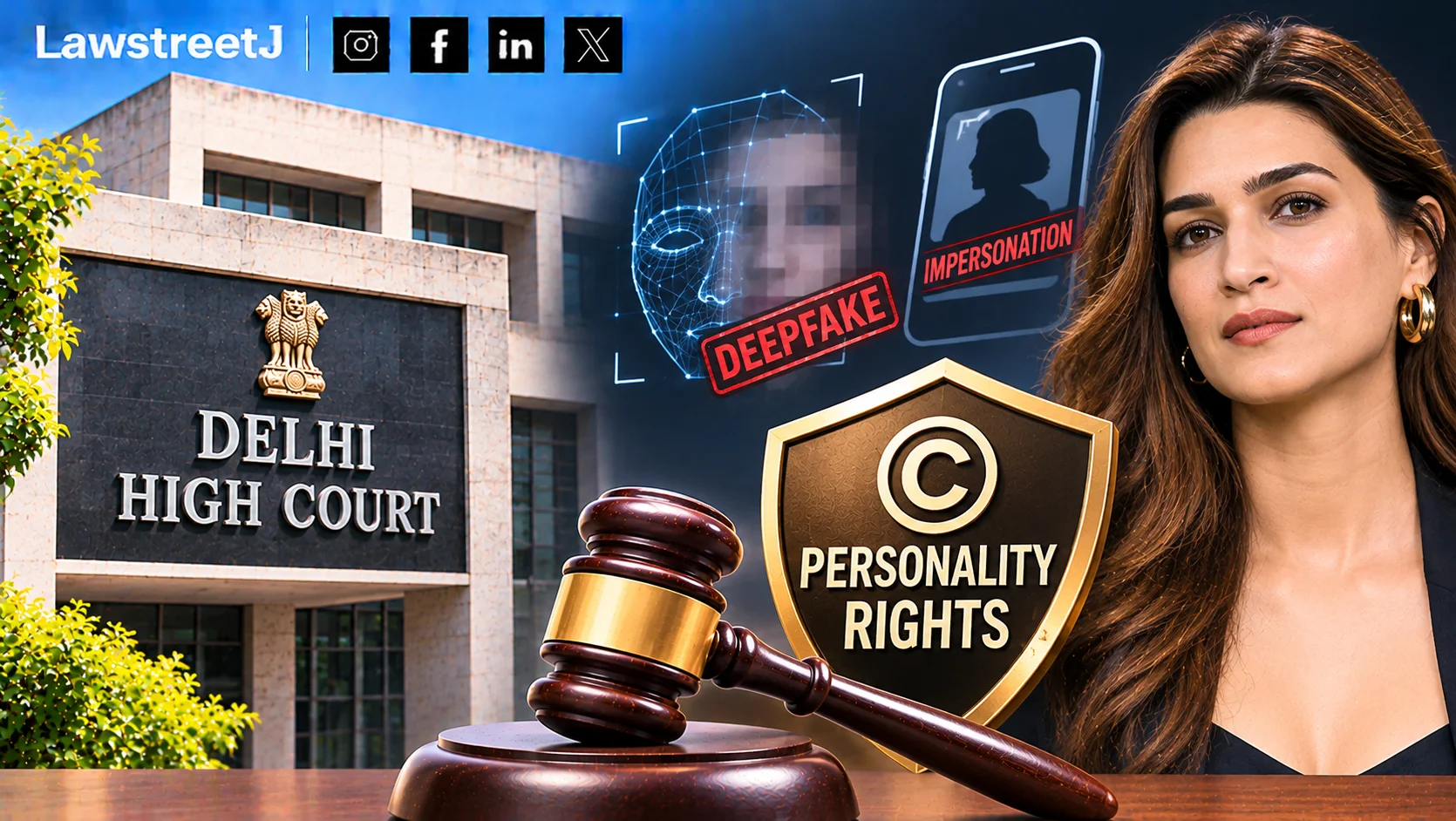
New Delhi: The Delhi High Court has granted limited ad-interim relief to actor Kriti Sanon against sexually explicit deepfakes, morphed images, impersonating accounts and AI chatbots presented as her, but has declined the omnibus restraint sought and observed that “personality rights” is not a single cause of action.
Justice Purushaindra Kumar Kaurav, by an order dated 29 October 2026 in CS(COMM) 1132/2026, confined the relief to identified URLs and specified categories of content, and clarified that news, review, criticism, satire, parody and fan expression are not restrained.
The suit has been filed by Kriti Sanon against BBE Marketing Inc and others. The plaintiff complains of five kinds of misuse of her name, image, likeness and voice: a defendant offering “bookings” for her appearances; accounts on YouTube, Facebook, X and Pinterest presenting themselves as her official presence or circulating AI-generated and morphed images, some sexually suggestive; sale of merchandise; AI chatbots and synthetic voice models presented as her, and prompt-based image generation; and pornographic deepfakes on listed websites. She wrote to the intermediaries on 27.08.2026, and only one responded. The relief pressed at present is confined to her right of publicity and right of privacy.
The Court said that the application raises questions going to the root of what is described as personality rights, and that it will be decided on merits after the contesting defendants are heard, so that what is made is only an ad interim arrangement. It noted that the uncertainty is of law as much as of fact, which counsels against an omnibus restraint, but that sexually explicit deepfakes, morphed images, impersonating accounts and chatbots presented as the plaintiff cause harm which cannot be undone later.
Observing that the plaint pleads “Personality Rights / Publicity Rights” as a single right flowing from privacy under Articles 19 and 21 and joins it with performers’ moral rights, passing off, dilution and tarnishment, the Court noted that no statute creates any such right. It noted that earlier Delhi High Court decisions, including Digital Collectibles v. Galactus Funware and Krishna Kishore Singh v. Sarla A. Saraogi, did not treat the right of publicity as a facet of privacy or as a right for celebrities alone.
Setting out its prima facie understanding, the Court said that “Personality rights” is not a single cause of action, but a description of several distinct claims that may arise when identity is used without consent, namely the right of publicity, passing off, privacy, defamation and, where their conditions are met, rights under the Trade Marks Act, 1999 and the Copyright Act, 1957. It said that privacy, dignity and reputation are personal interests that cannot be assigned, whereas publicity protects the commercial value of identity and can be licensed.
The Court held that each claim carries its own elements, defences and remedy, and that one label cannot lower the threshold for any of them. The rights are available to every individual, and fame bears only on commercial value and the loss caused by misuse. A plaintiff must therefore indicate, defendant-wise and content-wise, which claim is made and on what material, and interim relief must be correspondingly specific.
On intermediaries, the Court noted Section 79 of the IT Act and Shreya Singhal, and held that intermediaries are parties for compliance, not wrongdoers, so a direction to them must identify the material. A direction to remove “all other content”, as sought in prayer (x), would leave them to decide the very boundaries of the disputed right. It noted that the Amendment Rules of 2026, in force from 20.02.2026, bring “synthetically generated information” within the IT Rules framework and shorten the time for action to three hours on a court order and two hours on a complaint, and held that the plaintiff could not be faulted for approaching the Court after her notice went unanswered.
Prima facie, the Court found that the conduct of three defendants misrepresents an association with the plaintiff and, in two cases, impersonates her; that the AI-generated and morphed sexually suggestive content engages her privacy and dignity; that the chatbots, voice models and image generation appropriate the commercial value of her identity and affront her dignity; and that the pornographic deepfakes have no expressive value at all.
Until the next hearing, the Court directed the intermediary defendants to take down or disable access to the URLs listed in the plaintiff’s documents within the time under Rule 3(1)(d) of the IT Rules, and directed the blocking of listed websites by the two government defendants. It restrained the other named and John Doe defendants from uploading, hosting, generating or making available further impersonating material, sexually explicit or morphed content including AI-generated content, chatbots or voice models presented as the plaintiff, and merchandise of the kind placed on record. It also directed the intermediaries to furnish subscriber information and IP logs within three weeks.
The Court clarified that nothing in the order restrains news, review, criticism, commentary, satire, parody, caricature or fan expression outside the specified directions, and that its observations are prima facie and only for this interim arrangement.
The pleadings will be completed before the Joint Registrar on 21.12.2026, and the matter is listed before the Court on 10 December 2026.
Appearances: For the Plaintiff: Mr. Pravin Anand with Mr. Dhruv Anand, Mr. Ameet Naik, Mr. Dhananjay Khanna and Ms. Bhavya Verma, Advocates. For Defendant No. 3: Ms. Mamta Rani Jha with Mr. Rohan Ahuja, Ms. Shruttima Ehersa and Ms. Manisha Singh, Advocates. For Defendant No. 7: Ms. Amee Rana with Ms. Sana Banyal and Mr. Intisar Aslam, Advocates.
Case Title: Kriti Sanon v. BBE Marketing Inc and Others, CS(COMM) 1132/2026