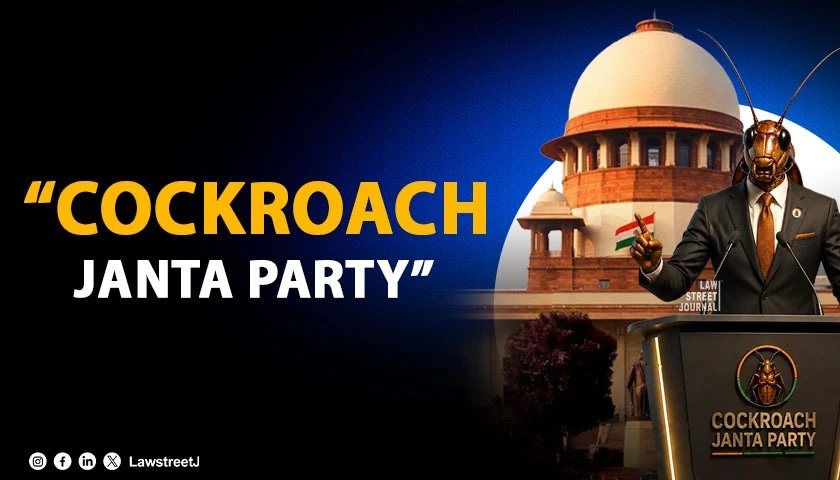
New Delhi: A petition has been filed in the Supreme Court seeking a CBI investigation into alleged fake advocates and fraudulent law degrees, as well as into the organised commercial exploitation of CJI Surya Kant’s “cockroach” courtroom remarks through monetised viral circulation and trademark commodification, with the petition expressly disclaiming any challenge to satire, democratic dissent, or free speech protected under Article 19(1)(a), and targeting instead what it characterises as algorithmically amplified digital distortion of oral judicial proceedings detached from their constitutional context.
A petition filed in the Supreme Court on May 24, 2026, has sought a Central Bureau of Investigation probe into two distinct but connected issues: first, the alleged presence of fake advocates and persons holding fraudulent law degrees practising before courts; and second, the activities of persons associated with the “Cockroach Janta Party,” a satirical political brand that emerged following remarks made by Chief Justice of India Surya Kant during proceedings on May 15. The petition has been filed by Advocate Raja Choudhary.
The plea draws its origin from the May 15 proceedings before the Supreme Court, during which concerns were raised about procedural misuse of courts, the conferment of Senior Advocate designation, and the broader deterioration of professional standards within the legal profession. During the course of those proceedings, CJI Surya Kant made remarks using a “cockroach” metaphor, which he subsequently clarified were directed at individuals entering the legal profession through forged qualifications and fake degrees, and not at unemployed young Indians generally. That clarification notwithstanding, the remarks were widely reported and mischaracterised across social media platforms before the correction could gain equivalent traction.
The “Cockroach Janta Party” emerged in the days following the May 15 hearing as a satirical online movement, reportedly started by one Abhijeet Dipke, a resident of Boston, USA. The collective quickly gained significant traction on Instagram and other social media platforms, attracting followers drawn to its commentary on unemployment, institutional accountability, and media freedom. It has since spawned petitions, merchandise, and organised online mobilisation efforts, making it one of the more unusual digital political formations to emerge from a courtroom remark.
The petition’s grievance is not with the satirical or political content of the movement as such. The plea has expressly clarified that it does not seek to curtail criticism of the judiciary, democratic dissent, satire, or free speech protected under Article 19(1)(a) of the Constitution. What it targets, instead, is what it characterises as a qualitatively different phenomenon: the organised commercial exploitation of spontaneous oral courtroom observations, including their selective clipping, meme-ification, mimicry, monetised circulation, trademark commercialisation, and algorithmically amplified digital commodification in a manner that detaches them entirely from their constitutional and procedural context.
The distinction the petition draws between protected satirical commentary and commercial exploitation of judicial speech raises genuinely difficult questions of law that the Supreme Court has not yet had occasion to address directly in the context of social media and viral digital content. The monetisation of clipped court recordings through platform algorithms, the creation of merchandise based on judicial remarks, and the use of courtroom audio or video fragments as raw material for online campaigns all occupy uncertain legal territory where free expression, contempt law, intellectual property, and the dignity of judicial institutions intersect.
The petition’s second strand, seeking a CBI probe into fake advocates and fraudulent law degrees, is more conventional in its legal framing but no less significant in its implications. The problem of persons practising as advocates without valid enrolment or on the basis of forged degrees has been a recurring concern for bar councils and courts across India. The petition seeks to use the occasion of the May 15 proceedings, in which CJI Surya Kant himself raised the issue of individuals entering professions through fraudulent means, as a basis for directing a centralised, CBI-led investigation rather than leaving the matter to fragmented action by State bar councils and local police.
CASE REFERENCE
Petition filed by: Advocate Raja Choudhary
Court: Supreme Court of India
Date of filing: May 24, 2026