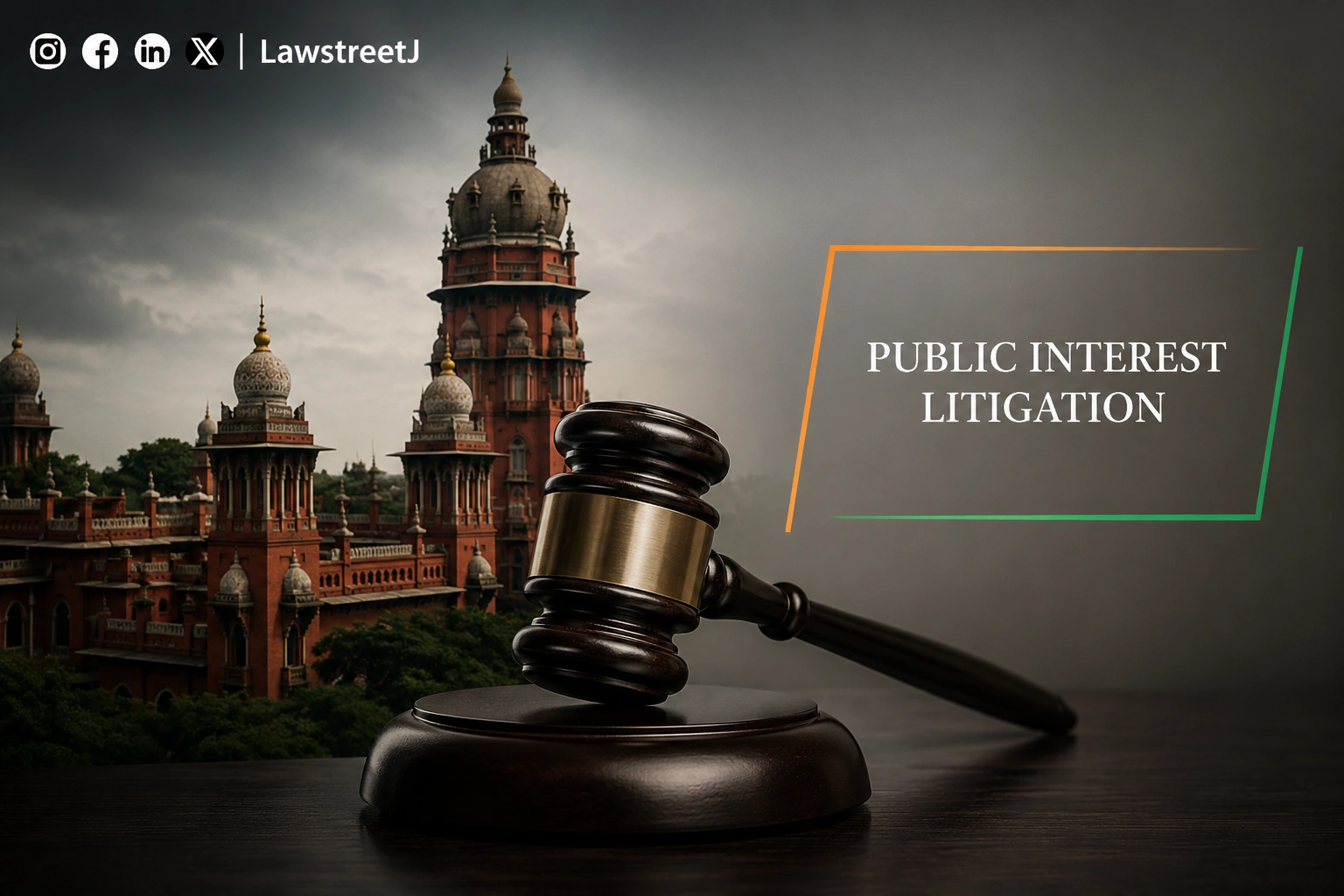
Chennai: The Madras High Court has dismissed a public interest litigation seeking an independent enquiry into the records relied upon by an engineering college for obtaining and continuing its accreditation, affiliation and autonomous status, holding that a PIL filed without a shred of independent research must be throttled at the threshold.
Chief Justice Sushrut Arvind Dharmadhikari and Justice G. Arul Murugan were hearing a writ petition filed by one D. Radhakrishnan under Article 226 of the Constitution of India, seeking a writ of mandamus directing the Union of India, the University Grants Commission, the National Assessment and Accreditation Council, the State of Tamil Nadu, Anna University and the Directorate of Technical Education to constitute an independent enquiry committee to examine allegations concerning the records submitted by Sri Venkateswara College of Engineering and Technology, the seventh respondent, for obtaining and continuing its accreditation, autonomous status, affiliation and other regulatory approvals.
The petitioner sought verification of the original records relied upon by the college and a direction that appropriate orders be passed within a time frame to be fixed by the Court.
The Court, describing the petition as one invoking its extraordinary jurisdiction "ostensibly under the nomenclature of a Public Interest Litigation", found on a comparison of the documents on record what it termed an irreconcilable variance striking at the core of the petitioner's grievance.
It noted that the legal prerequisite for a writ of mandamus is a prior demand for justice made to the authorities and its subsequent refusal. The petitioner's representation dated 29th April 2026, however, had sought the withdrawal of the autonomous status and accreditation conferred upon the college, whereas the prayer in the writ petition instead sought the constitution of an independent enquiry committee to investigate the college's records — a request the Court found to be for an entirely different purpose.
The Court observed that a petitioner "cannot seek one extreme punitive remedy before the statutory authorities and subsequently approach this court asking for an investigative mechanism under a completely transformed pretext."
The Bench further held that a person filing a public interest litigation ought to be a "diligent researcher, not a casual collector of unverified electronic media discourse." It noted that the petitioner had merely bundled newspaper clippings, YouTube references, and a First Information Report bearing Cr.No.4/2025 to build a narrative of widespread malpractice against the college, without conducting any independent research or verification before approaching the Court.
Observing that a criminal investigation into the matter was already underway and that it remained sub judice, the Court held that reliance purely on the investigation of the Directorate of Vigilance and Anti-Corruption, or on "digital gossip," did not satisfy the stringent threshold of "sufficient research" mandated for filing a public interest litigation. It added that rushing to file a PIL without independently verifying the foundational facts served only to sensationalize a pending legal process.
The Court concluded that "when a public interest litigation is filed without a shred of independent research, it must be throttled at the threshold," and accordingly dismissed the writ petition, without imposing costs.
Appearances: Mr. R. Shunmugasundaram, Senior Counsel, for M/s. A. Gopinath, appeared for the petitioner. Mr. K.S. Jeyaganeshan, Senior Panel Counsel, appeared for respondent No.1; Mrs. V. Sudha appeared for respondent No.2; Mr. Mohammed Fayaz Ali, Government Pleader, appeared for respondent No.4; and Mr. U. Baranidharan, Standing Counsel, appeared for respondent No.5.
Case Title: D. Radhakrishnan versus Union of India & Ors.


![Madras High Court Directs Tamil Nadu Government to Ensure Quota for Transgenders in Local Body Elections [Read Order]](/secure/uploads/2023/08/lj_2507_7a03d113-08b1-4670-b6fb-9058aee481d0.jpg)