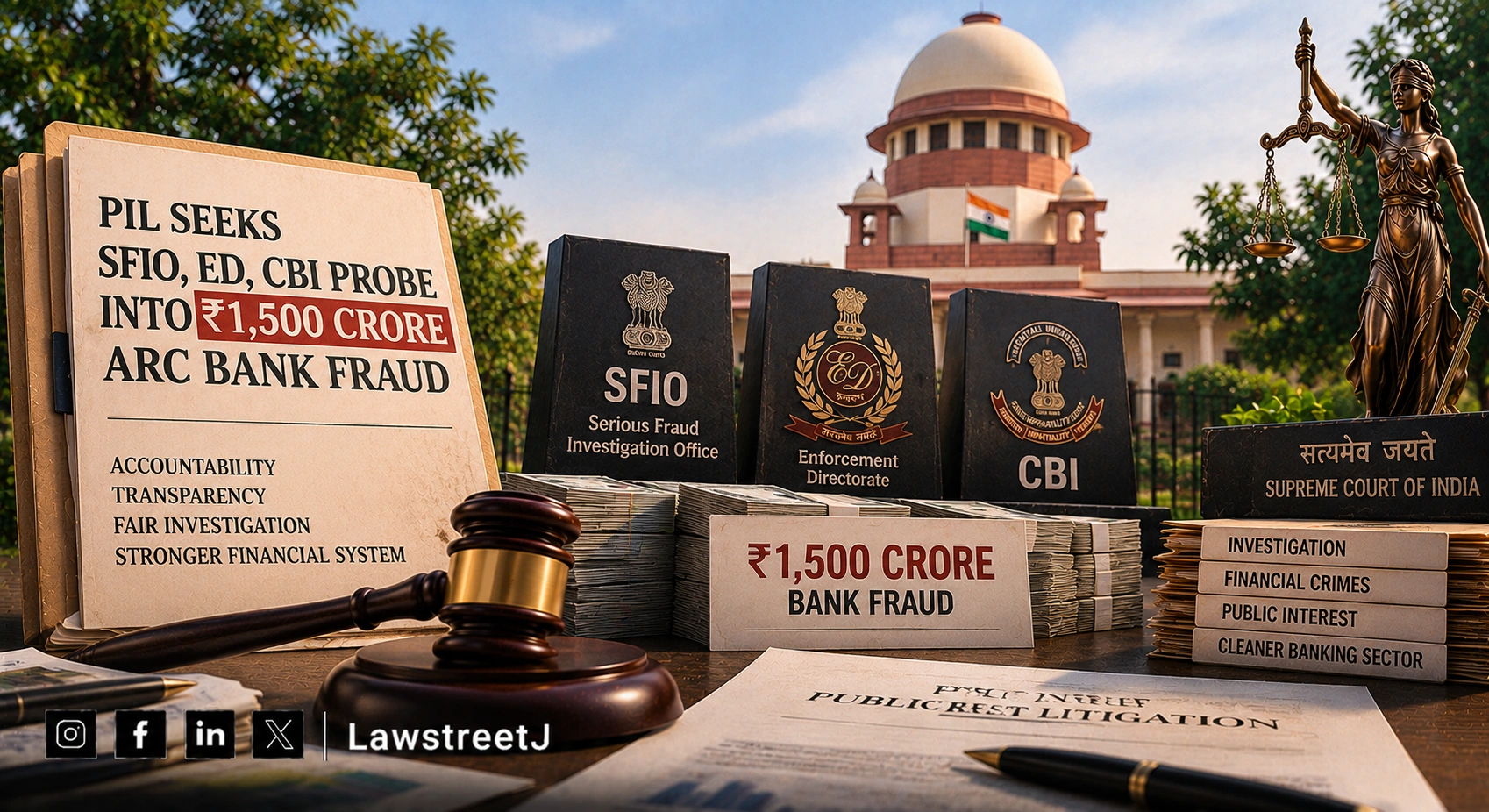
New Delhi: A Public Interest Litigation has been filed before the Supreme Court under Article 32 of the Constitution, seeking a coordinated investigation by the Reserve Bank of India, the Securities and Exchange Board of India, the Serious Fraud Investigation Office, the Enforcement Directorate and the CBI into what the petitioners describe as one of India's largest banking frauds, allegedly facilitated through the Asset Reconstruction Company (ARC) framework.
The petition, names the Union of India, the Reserve Bank of India, SEBI, the SFIO, the Enforcement Directorate, the CBI, State Bank of India, Canara Bank, Union Bank of India, Prudent ARC Limited, Phoenix ARC Private Limited, JKM Infra Projects Limited, its promoters Gaurav Jalan and Vaibhav Jalan, and Ernst & Young among the respondents.
According to the petition, JKM Infra Projects Limited, a Noida based infrastructure company controlled by the Jalan family, availed loans totalling Rs 912 crore between 2012 and 2015 from a consortium of seven banks led by State Bank of India, against collateral valued at only about Rs 60 to 72 crore. The company is alleged to have begun defaulting within a year of disbursement, with the account declared a non performing asset on 28.06.2016.
The petitioners rely on a forensic audit report submitted by Ernst & Young on 23.05.2018, which they say documented that over Rs 902 crore was routed to shell companies, struck off entities, non existent vendors and other red flag entities through fake invoices, forged work orders and undisclosed bank accounts, and concluded that the findings met every criterion for classifying the account as fraud under the RBI's Master Directions. The petition alleges that SBI nonetheless did not classify the account as fraud, instead appointing a second auditor whose report is said to have diluted the EY findings before the loan was auctioned to Prudent ARC Limited, the sole bidder, at a steep discount.
The petition further alleges that while JKM had received over Rs 130 crore from National Highways Authority of India work, the bank set the auction reserve price at Rs 120 crore, allowing Prudent ARC to acquire a debt of Rs 596.38 crore for that amount, and that company records reportedly reflected the settlement even before the formal one time settlement was concluded. During pending proceedings before the Debt Recovery Tribunal, the petitioners say the debt was further transferred to Phoenix ARC Private Limited in 2025 and settled for Rs 73.50 crore against an outstanding amount of Rs 1,537 crore under an agreement signed on 31.10.2025, a discount the petitioners describe as exceeding 95 per cent of the public money involved.
despite two FIRs being registered, an attempt by police to close one of them as a mere family dispute having been rejected by the Chief Judicial Magistrate with a direction to investigate the Ernst & Young findings, and repeated representations to the Enforcement Directorate, the Income Tax authorities, the RBI and the Ministry of Corporate Affairs, none of these agencies has taken coordinated or meaningful action to date.
The petitioners contend that this is not an isolated case, citing a CBDT press release dated 15.12.2021 based on search operations across multiple ARCs, which they say documented a similar pattern of asset reconstruction companies acquiring bad loans using borrowers' own siphoned funds and settling with the same borrower groups at a fraction of the outstanding value. They note that the RBI had to convene a meeting of all 27 registered ARCs to address what it called backdoor re-entry by defaulting promoters, and that Phoenix ARC itself was penalised by the RBI in March 2025 for non-compliance with its directions.
The petition raises several questions of law for the court's consideration, including whether the ARC framework under the SARFAESI Act, 2002 is being misused by corporate defaulters to reacquire their own distressed debt at deep discounts, whether the RBI has failed in its statutory duty to enforce its Master Directions on ARC settlements, whether the absence of criminal liability for ARC or bank officials who facilitate undervalued settlements represents a legislative gap, and whether public sector banks are obligated to classify accounts as fraud upon receiving forensic findings that meet the prescribed criteria.
The petitioners have sought a direction to the Union to constitute a judicial commission or expert committee, including officers of the RBI, SEBI, SFIO, ED and CBI, to investigate the alleged fraud, or alternatively a direction to the ED, SFIO and CBI to investigate the suspicious transactions identified in the forensic audit. They have also sought a direction to the RBI and SEBI to examine compliance with fraud classification and ARC settlement guidelines in the transaction, and a direction for civil, criminal and regulatory action against the individuals and entities alleged to be involved in the diversion of funds.
The PIL has been drawn by: Mr. Ashwini Kumar Upadhyay and Mr. Nikhil Upadhyay, Advocates and has been filed by Mr. Ashwani Kumar Dubey, Advocate-on-Record.
Case Title: Prateeksha and Others vs. Union of India and Others