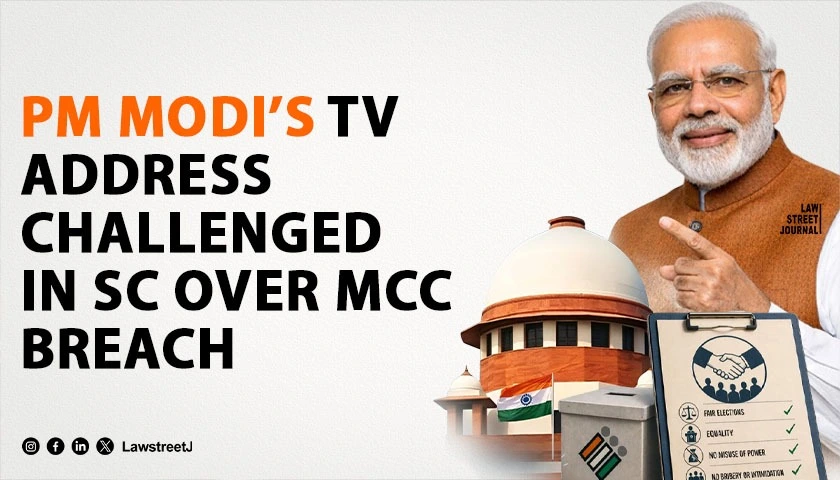
New Delhi: Congress leader and former Member of Parliament T.N. Prathapan has moved the Supreme Court, challenging the televised address delivered by Prime Minister Narendra Modi on April 18, 2026. The petition, filed through Advocate-on-Record Suvidutt M.S., alleges that the nationally broadcast speech constitutes a flagrant violation of the Model Code of Conduct (MCC) and the Representation of the People Act, 1951.
The plea specifically points to the alleged misuse of official mass media and government machinery for partisan electoral gain while the election code was in force.
The Prime Minister’s address followed the defeat of a significant legislative package in the Lok Sabha, which included the Constitution (131st Amendment) Bill. The Bill proposed expanding the Lok Sabha from 543 to 850 seats and implementing a 33 per cent reservation for women in legislatures. During the 30-minute broadcast, the Prime Minister criticised several opposition parties by name, including the Indian National Congress, the Trinamool Congress (TMC), the Dravida Munnetra Kazhagam (DMK), and the Samajwadi Party.
In his speech, the Prime Minister accused these opposition parties of “female foeticide” in Parliament by blocking the legislative measures. He urged the electorate to hold these parties accountable at the ballot box. The petitioner contends that such a partisan appeal, delivered via state-funded platforms like Doordarshan and Sansad TV, violates Section VII(4) of the MCC, which expressly prohibits the misuse of official mass media for partisan coverage or publicity to further the prospects of the party in power.
The petition further alleges that the broadcast amounts to a “corrupt practice” under Section 123(7) of the Representation of the People Act. This provision prohibits candidates or their agents from obtaining assistance from government servants or utilising government machinery to further electoral prospects. The plea argues that the Prime Minister, as the principal campaigner for the ruling party, used public resources to prejudice political opponents during an active election cycle.
T.N. Prathapan, who is currently contesting the Kerala Assembly elections from the Manaloor constituency, asserts that he is directly affected by the broadcast. He argues that the use of state-funded media to attack named opposition parties created a structural and irreversible distortion of the electoral playing field. The plea emphasises that free and fair elections form part of the “basic structure” of the Constitution and that the broadcast violated the petitioner’s fundamental rights under Articles 14 and 19(1)(a).
A central grievance in the writ petition is the alleged inaction of the Election Commission of India (ECI). Despite a formal representation submitted by the petitioner on April 19, 2026, the Commission reportedly failed to take any action or even acknowledge the complaint. The petition characterises this silence as an abdication of the Commission’s constitutional mandate under Article 324 to supervise and ensure the conduct of free and fair elections.
The petition seeks several directives from the apex court, including an order directing the ECI to issue a show-cause notice to the Prime Minister and the Bharatiya Janata Party (BJP). It also seeks the removal of the speech from all official, government-controlled digital and media platforms. Further, the petitioner has requested the Court to prescribe a strict timeline for the ECI to complete its inquiry and report its findings to the Court.
Beyond the Supreme Court petition, several political parties and civil society groups have approached the Election Commission. The Communist Party of India (CPI) and the Communist Party of India (Marxist) [CPI(M)] have filed separate complaints alleging misuse of public broadcasters. CPI(M) General Secretary M.A. Baby stated that the tone and substance of the address were “blatantly political” and designed to influence voters in poll-bound states like West Bengal and Tamil Nadu.
Additionally, a group of more than 700 citizens, including former civil servants, academics, and journalists, has written to the Chief Election Commissioner. Their complaint argues that the broadcast gave the ruling party an “undue advantage” and demands that the ECI provide equal airtime to opposition parties if the speech is not removed from official platforms.
Congress President Mallikarjun Kharge also criticised the address, describing it as a “travesty of democracy”. He alleged that the Prime Minister turned an official address into a political speech filled with “mudslinging and outright lies”. Kharge argued that the misuse of official machinery to attack opponents while the MCC is in force represents a failure of the constitutional process.
The Prime Minister, in his address, maintained that the defeat of the Bills was a “setback for women” and apologised for the government’s inability to pass the legislation. He claimed that the opposition had “crushed the dreams” of women by placing political interests above national interest. These remarks are now at the centre of the legal debate regarding the boundary between official governmental communication and partisan political campaigning during an election period.
Case title: T.N. Prathapan v. Election Commission of India & Anr.