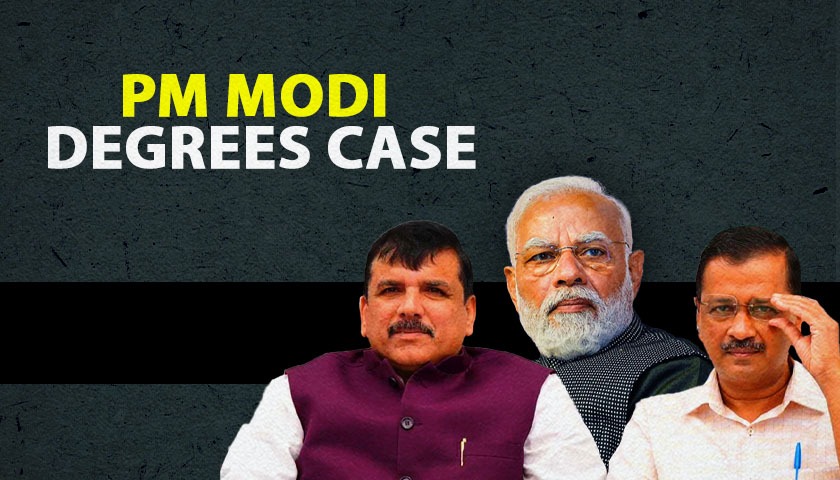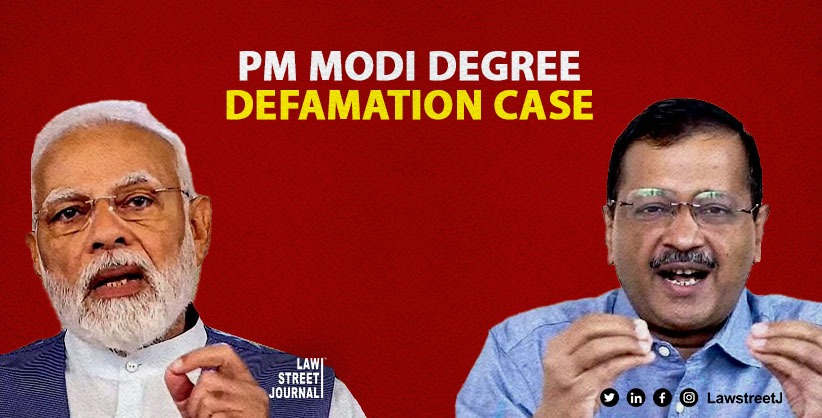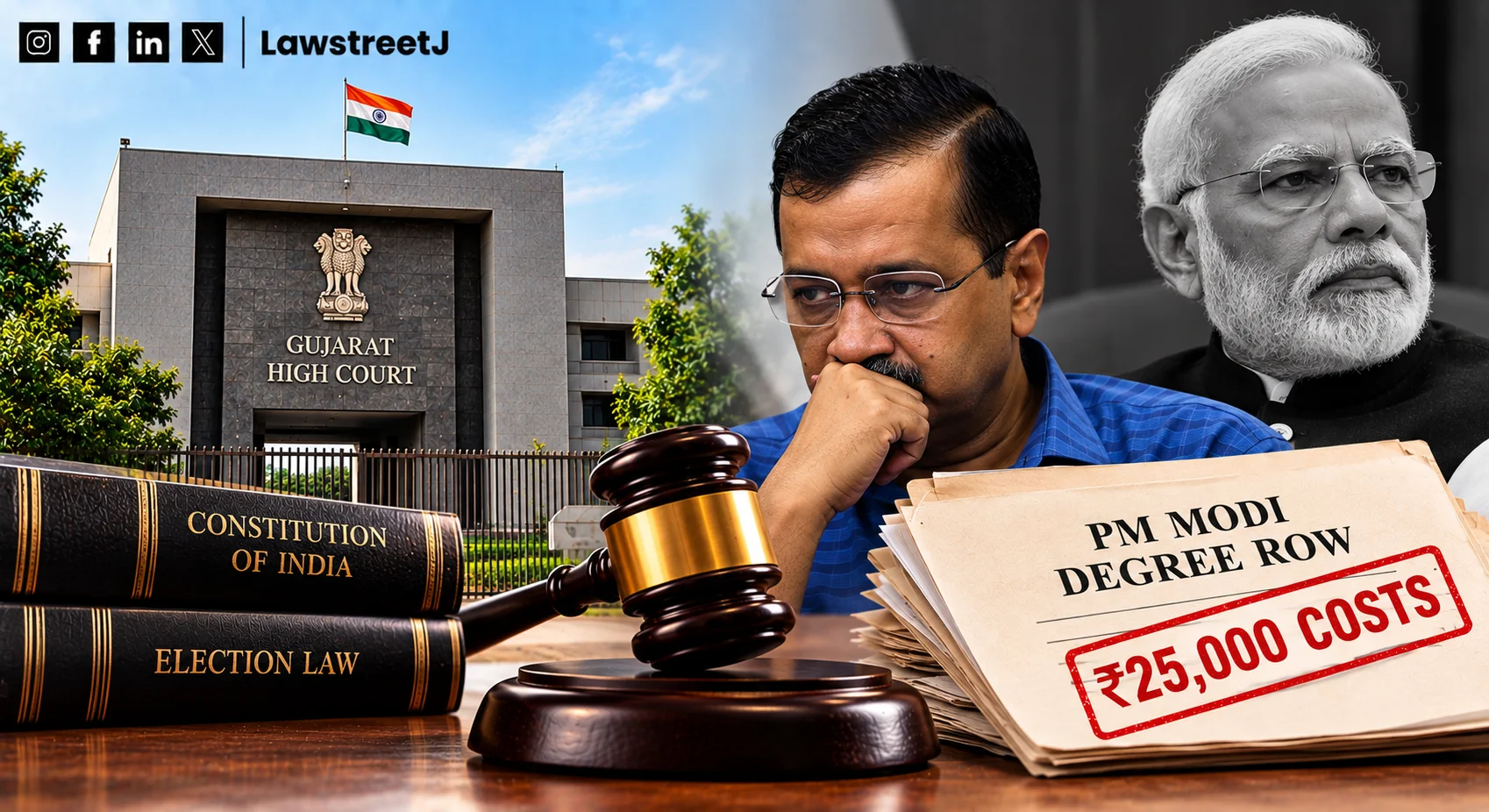
Ahmedabad: The Gujarat High Court has dismissed a Letters Patent Appeal filed by Arvind Kejriwal against a single judge's ruling that had quashed a Central Information Commission direction for disclosure of the educational degrees of Prime Minister Narendra Modi, holding that educational qualification documents are personal information exempt from disclosure under the Right to Information Act, 2005, and that the CIC had no jurisdiction to act without a proper application under Section 6(1).
A Division Bench of Chief Justice Sunita Agarwal and Justice D.N. Ray was hearing the appeal against the judgment dated 31.03.2023, by which the single judge allowed a writ petition filed by Gujarat University, quashed the CIC order dated 29.04.2016 passed in proceeding No. CIC/SA/C/2015/000275, and imposed costs of Rs. 25,000 on Kejriwal, who was respondent No. 2 before the writ court.
Senior Advocate Dr. Abhishek Manu Singhvi submitted that the appellant did not propose to challenge the merits of the judgment and confined his challenge to the observations in paragraphs 40 and 41 about his conduct, on the basis of which costs were imposed. It was argued that the observation that he had persisted with the matter was wholly incorrect, as he was merely a bystander who had filed no application, the CIC having acted suo motu, and that the present appeal was not being pursued on merits.
Advocate Mr. Vivek Jain, in rejoinder, submitted that once the University itself declared that it had uploaded the degree on its website on 09.05.2016, there was no cause of action for the University to approach the writ court. It was further submitted that in the review petition the appellant had only brought on record that the degree was not actually available on the website, a fact the University had admitted, and that the appellant had filed no response to the writ petition between 2016 and 2023.
Opposing the appeal, Solicitor General Mr. Tushar Mehta, appearing for the University, submitted that the appellant's letter dated 28.04.2016, written on his official letterhead, showed a motivated attempt to malign the Prime Minister and had triggered the CIC's suo motu action, which was wholly without jurisdiction. He also pointed to the review application filed on merits, and urged the court to decide the merits so as to render an authoritative pronouncement for the guidance of the CIC in future.
The court noted that the CIC order had been passed in a second appeal filed by a third party seeking information about the transportation request of Kejriwal's Electoral Photo Identity Card. When Kejriwal was asked for his views on disclosure of that information, he demanded information on the Prime Minister's educational qualifications, alleging that the CIC was obstructing it. The CIC treated this response as an RTI application by Kejriwal in his capacity as a citizen, and directed the PMO to furnish the number and year of the degrees, and the Public Information Officers of Delhi University and Gujarat University to search for and provide the information to him.
Declining to expunge the remarks or to condone the costs, the Bench held that it was unable to accept the appellant's submissions after examining the letter dated 28.04.2016 and the CIC order. It added that "statutory authorities and the Courts should not be treated as a public platform to ventilate the political vengeance," and that a political leader holding public office cannot use statutory proceedings for political motives.
Turning to the merits, the court answered first the question whether the CIC could take suo motu cognisance of an oral request made in another matter at the second appellate stage. Holding that the scheme of the Act requires a written application with the prescribed fee to the Public Information Officer under Section 6(1), the court ruled that there was no question of the CIC entertaining any such request, and that the CIC's course of action was completely outside the scope of the RTI Act. The court further observed that the Act cannot be used as a tool to ventilate personal grudges or political vendetta against an individual, even one holding public office.
On the exemptions, the court relied on the Supreme Court's decisions in CBSE v. Aditya Bandopadhyay, Institute of Chartered Accountants of India v. Shaunak H. Satya, Reserve Bank of India v. Jayantilal N. Mistry, the Constitution Bench ruling in CPIO, Supreme Court of India v. Subhash Chandra Agarwal, and K.S. Puttaswamy v. Union of India. It held that educational qualification documents such as a marksheet or degree fall within the ambit of personal information, exempt under Section 8(1)(j), and that such information is held by universities in a fiduciary capacity on behalf of their students, exempt under Section 8(1)(e), subject in both cases to the larger public interest test.
The court also noted that Section 8(1)(j) has since been substituted through the Digital Personal Data Protection Act, 2023, giving absolute exemption to personal information, which it found to be in line with the right to privacy under Article 21 of the Constitution. Even under the unamended provision, it held, both exemptions were satisfied.
On public interest, the court held that no public interest, much less larger public interest, would require seeking information on the educational qualification of the Prime Minister, whose qualification has no bearing on his election to the constitutional post. It observed that the CIC had recorded no satisfaction on the requirements of either exemption, and that the fact that the degree information was said to be in the public domain had no relevance for obligations under the RTI Act.
Rejecting public curiosity as a ground for disclosure, the court observed that disclosure "should have been left to the discretion of the individual concerned," and that even a public servant cannot be compelled to disclose personal information merely because he holds public office, unless a legal obligation exists on him or on the public authority holding the information.
Balancing the right to privacy against the right to seek information, the Bench concluded that the information directed to be disclosed was exempt personal information under Section 8(1)(e) and (j) and that the University could not be asked to disclose it. Holding that the writ court's decision was liable to be confirmed both on the ground of the CIC's absolute lack of jurisdiction and on the ground of exemption, the court dismissed the appeal with no further order as to costs, and disposed of the pending Civil Application for stay.
Appearances:
For the Appellant: Dr. Abhishek Manu Singhvi, Senior Advocate, with Mr. Vivek Jain, Ms. Aayushi A. Shah, Mr. Amit Bhandari, Mr. Mohd. Irshad and Dr. Aum M. Kotwal, Advocates.
For Respondent No. 1: Mr. Tushar Mehta, Solicitor General of India, with Ms. Manisha Luvkumar, Additional Advocate General, Mr. Rajat Nair, Mr. Aman Mehta and Ms. Dharmishta Raval, Advocates.
Case Title: Arvind Kejriwal, The Chief Minister (Govt. NCT of Delhi) vs. Gujarat University & Ors., R/Letters Patent Appeal No. 796 of 2026 in R/Special Civil Application No. 9476 of 2016


![Supreme Court Affirms Women's Right to Reproductive Choices as Central to Human Dignity [Read Order]](/secure/uploads/2023/08/lj_5007_Right_to_Reproductive.jpg)