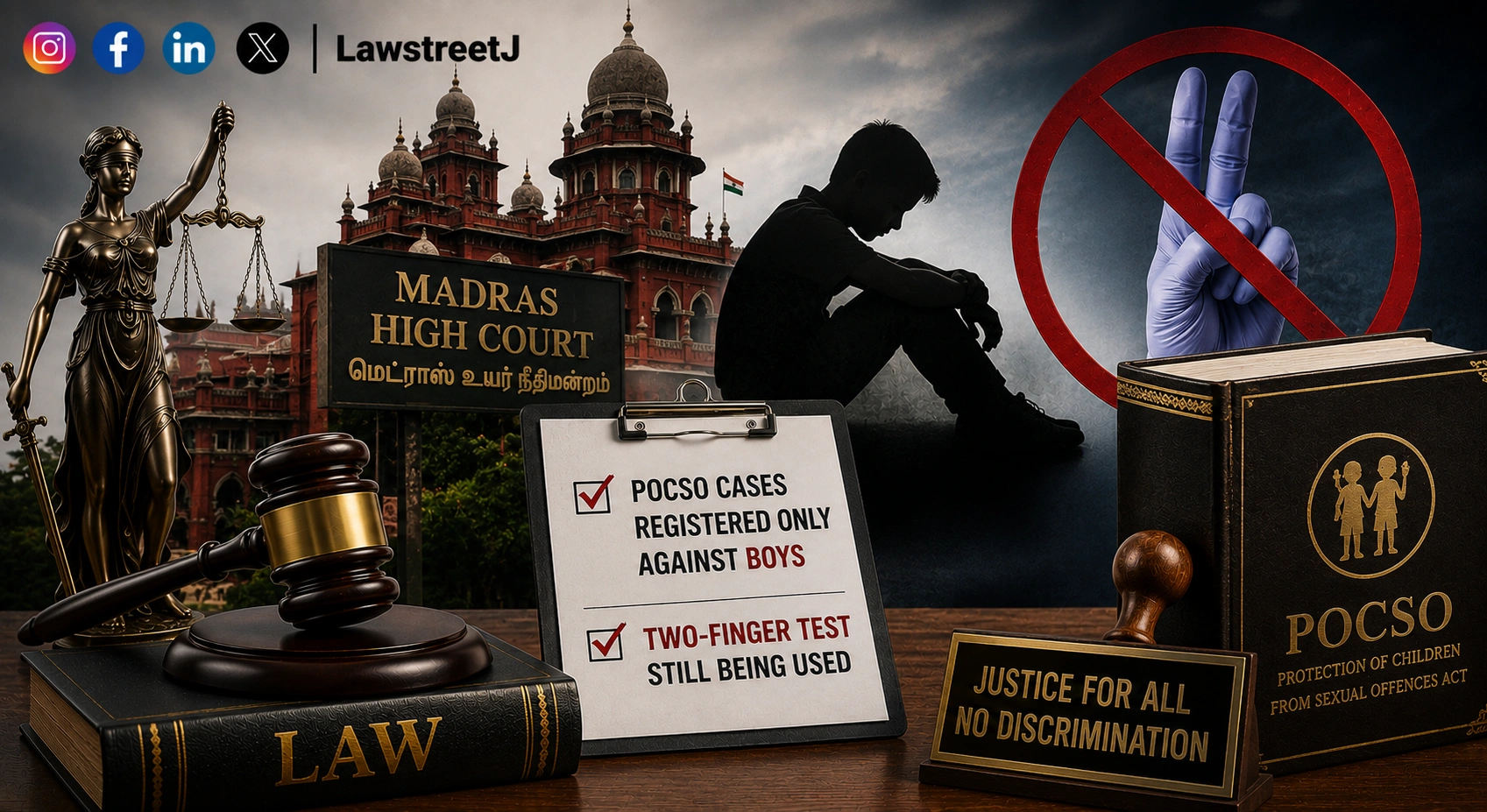
Chennai: The Madras High Court has flagged the practice of registering POCSO cases only against minor boys in consensual relationships between adolescents, observing that such an approach is inconsistent with the gender-neutral framework of the POCSO Act, 2012.
The Bench noted that the practice places the male child and his family at a disproportionate disadvantage, while the same conduct between two minors results in criminal proceedings against only one of them. The Court observed that this not only burdens the Juvenile Justice Boards but also raises concerns of unequal treatment in the implementation of child-protection laws.
The Court accordingly suggested that where a girl's parents or guardians insist on registration of an FIR, the police should inform them that the male child has the same legal position and should similarly inform his parents or guardians, while directing the State to examine wider systemic gaps in the implementation of the POCSO Act.
Background
The writ petition, filed pro bono publico by S. Venkatesh, an advocate under voluntary suspension, sought a mandamus directing the State of Tamil Nadu to prefer a curative petition before the Supreme Court in Criminal Appeal Nos. 3633-3634 of 2024, arising from a case involving the murder of a child. The Sessions Court, Mahila Court, Chengalpet had convicted the accused and imposed the death penalty in February 2017, a sentence confirmed by the Madras High Court on 10.07.2018, before the Supreme Court acquitted the accused on 08.10.2025.
The petitioner's case was that the Supreme Court had, by an order dated 08.04.2019, initially limited notice only to the question of sentence without finding fault with the conviction, but that this order was later recalled on noticing that the High Court had granted a certificate of leave to appeal on 10.07.2018, enabling the accused to challenge the conviction itself. The petitioner stated that a Right to Information application to the Court's Public Information Officer had drawn a response that no certificate to file an appeal had been granted, prompting him to make a representation to the State on 08.01.2026 pointing out this alleged error and calling for a curative petition, which drew no response.
Arguments
When the matter came up for admission, the Bench suo motu impleaded the Director General of Police, the Commissioner of Police, Avadi, and the Inspector of Police, T-14 Mangadu, as respondents 2 to 4, having noticed that parties with a stake in the litigation had not been arrayed. Counsel for respondents 2 to 4, Mr. C.R. Malarvannan, produced the Division Bench's order dated 10.07.2017 in Crl.A.No.234 of 2018 and R.T.No.1 of 2018 to show that leave to appeal to the Supreme Court had in fact been granted, arguing that the very foundation of the writ petition did not exist, adding that the State was serious about prosecuting offences against children and had itself taken a policy decision to prefer a curative petition. This position was echoed by Mr. M. Guruprasad, appearing for the first respondent.
Analysis
The Bench held that a writ of Mandamus could be issued only to compel performance of a statutory or public duty, and that a decision to file an appeal, review or curative petition was a discretionary act of the executive that no Mandamus could dictate, observing that a citizen or third party does not possess a vested legal right to force the State to litigate or prefer an appeal if it chooses not to do so. Having examined the web copy of the order dated 10.07.2018, the Bench was satisfied that leave to appeal to the Supreme Court had indeed been granted, holding that the RTI reply the petitioner relied upon had not furnished the correct information, and recording the State's own submission that it had separately decided to file a curative petition.
Beyond disposing of the writ petition, the Bench devoted a substantial part of its order to systemic gaps in the implementation of the POCSO Act across Tamil Nadu, organised stakeholder-wise across the police, healthcare system, courts, e-courts infrastructure, care and support mechanisms, Juvenile Justice Boards, and infrastructural facilities.
Among the gaps identified under the police category, the Bench noted that "FIRs registered only against the male child, despite POCSO being gender and sex-neutral," observing that this practice unduly criminalises adolescent relationships and burdens Juvenile Justice Boards, unfairly criminalising the male child and drawing his family into proceedings while the treatment of the two families remains unequal for the same relationship. The Bench recommended that, where a girl's parents or guardians insist on an FIR, the police must inform them that the male child has the same option and inform his parents or guardians accordingly.
The order also flagged FIRs being registered even for non-heinous offences against minor boys carrying under seven years' imprisonment for adults, contrary to Rule 11(3) of the Tamil Nadu JJ Rules, alongside further gaps including non-supply of free FIR copies to children in conflict with law, non-compliance with procedural safeguards during apprehension, mechanical detention in observation homes, breaches of confidentiality, barriers to healthcare access including delayed medical termination of pregnancy, continued use of discredited potency tests, delayed recording of child witness testimony beyond the statutory thirty-day window, non-functional e-courts features, unredacted judgments exposing survivors' identities, and the absence of Child Witness Deposition Rooms in five of Tamil Nadu's twenty-three districts.
Conclusion
The Bench directed the Chief Secretary, Government of Tamil Nadu, to constitute a committee comprising Secretaries of the concerned departments to examine the suggestions set out in the order, and directed that the government's response be filed before the Registry within four months. It placed on record its appreciation for the assistance rendered to the Court by Ms. Deepika Murali, Advocate for Tulir, an organisation working on child rights. Recording the State's submission on the curative petition, the Bench disposed of the writ petition with no order as to costs.
Appearances:
For Petitioner: Mr. S.N. Ravichandran, Advocate.
For Respondents: Mr. L.S.M. Hasan Fizal, Additional Government Pleader, and Mr. M. Guruprasad for the first respondent; Mr. C.R. Malarvannan, Additional Public Prosecutor, for respondents 2 to 4.
Case Title: S.Venkatesh vs. The State of Tamil Nadu and others, WP No. 18454 of 2026



![Madras High Court Directs Tamil Nadu Government to Ensure Quota for Transgenders in Local Body Elections [Read Order]](/secure/uploads/2023/08/lj_2507_7a03d113-08b1-4670-b6fb-9058aee481d0.jpg)