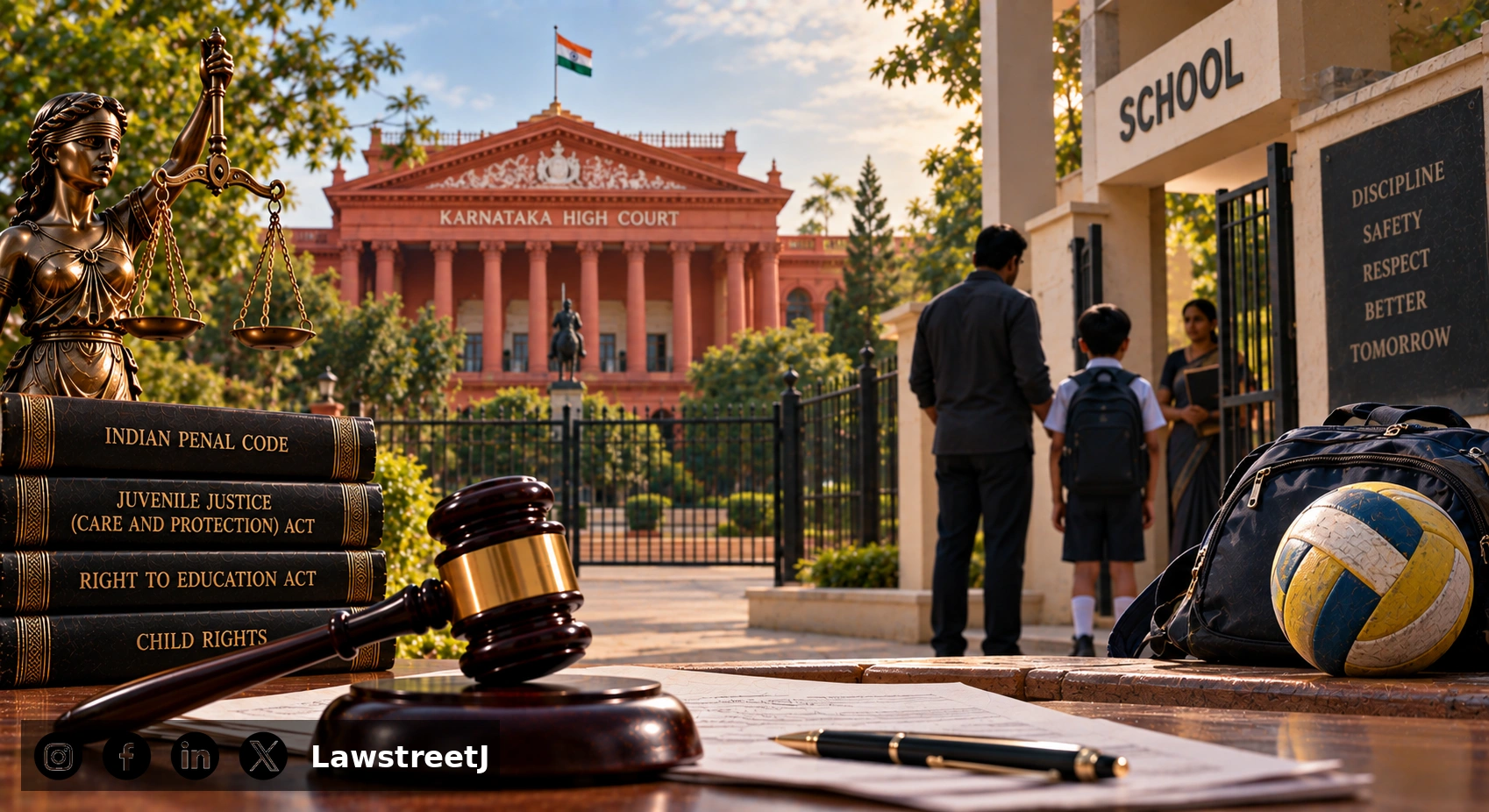
Bengaluru: The Karnataka High Court has dismissed a criminal appeal filed by the father of a deceased minor boy against the acquittal of a couple accused of abetting his suicide under Section 305 read with Section 34 of the IPC, holding that the prosecution had failed to prove any positive act of instigation proximate to the boy's death and that mere allegations of harassment could not sustain a conviction for abetment of suicide.
The Division Bench of Justice H.P. Sandesh and Justice B. Pramod, was hearing an appeal under Section 372 of the Cr.P.C. filed by the complainant against the judgment passed by the Additional City Civil and Sessions Judge, Children's Court (Special), Bengaluru, in Spl. C.C. No.1271 of 2019, acquitting respondent nos.2 and 3 of the offence of abetment of suicide of his minor son.
The prosecution's case was that on 01.02.2019, the deceased minor was playing volleyball outside his house when the ball accidentally landed in the accused's shop and broke a glass pane. When the boy asked for the ball back, the accused allegedly refused, scolded him, threatened to inform his father, and one of the accused dragged him from the shop to his house. It was alleged that, distressed by this treatment, the boy went inside and hanged himself with a thread. A charge sheet was filed, and at trial the prosecution examined 20 witnesses and marked 22 exhibits and three material objects, while the accused, examined under Section 313 Cr.P.C., denied the incriminating evidence.
The Trial Court had noted that there were no eyewitnesses to the incident, that the father (PW.1) admitted he learnt of the alleged conversation between the accused and the boy only four days after the incident, and that the mother (PW.2) admitted she did not know the contents of her own complaint and had signed it only on the say of the police. Neighbours examined as witnesses stated only that the child was crying, without knowing what led him to take the extreme step, and the mahazar witness turned hostile regarding recovery of the material objects and CCTV footage. The Trial Court held that the prosecution had failed to establish the ingredients of Section 107 IPC necessary to sustain a charge under Section 305, since mere allegations of harassment, without a positive act proximate to the death, were insufficient to prove abetment.
Counsel for the appellant contended that the Trial Court had ignored the oral and documentary evidence of PW.1 to PW.20 as well as CCTV footage, and had not properly appreciated the evidence of PW.4, PW.5, PW.7 and PW.8, a contention supported by the learned HCGP for the State. The High Court, however, on examining the record, found that PW.7 and PW.8 had both deposed that when the accused spoke to the boy, they told him to bring his father and only then would the ball be returned, but denied that there was any quarrel or that any injury was caused to the boy. The mother, PW.2, had further admitted in her evidence that the accused did not abet her son to commit suicide.
The Court held that “merely because the accused refused to give back his ball and directed him to bring his father cannot be taken as an abetment to commit suicide”, observing that the ingredients of mens rea could not be assumed but had to be vital and conspicuous, that there was no evidence of continuous physical or mental torture, and that none of the prosecution witnesses had deposed specifically to the words allegedly uttered by the accused.
Relying on the Supreme Court's decisions in Mariano Anto Bruno and another v. Inspector of Police, M. Arjunan v. State, and Ramesh v. State of Karnataka of this Court, the Bench reiterated that abetment of suicide under Sections 305/306 IPC requires proof of direct or indirect acts of incitement, with a positive action proximate to the time of occurrence, and that mere insulting or abusive language, without evidence suggesting an intention to instigate suicide, does not satisfy the ingredients of Section 107 IPC.
Applying the principle in Mallappa and others v. State of Karnataka, (2024) 3 SCC 544, that an acquittal can be reversed only where the evidence is cogent, convincing and free from reasonable doubt, and only if perversity is found, the Court held that the Trial Court had rightly found inconsistencies and contradictions in the prosecution evidence and declined to interfere with the acquittal. The appeal was accordingly dismissed.
Appearances:
For the Appellant: Sri Puttaraju B., Advocate.
For Respondent No.1/State: Sri Suhas Gowda M., High Court Government Pleader.
Case Title: Sri Gnanashekar M. v. State of Karnataka and Others, Criminal Appeal No.361 of 2025 (A)


![Karnataka High Court: Cabinet Rank Status Not Equivalent to Ministerial Position [Read Order]](/secure/uploads/2023/09/lj_2318_fc1b99b7-aeed-472b-836e-33750bedb394.jpg)


![Woman living in adultery cannot claim maintenance: Karnataka High Court [Read Order]](/secure/uploads/2023/10/lj_3083_Women_living.jpg)