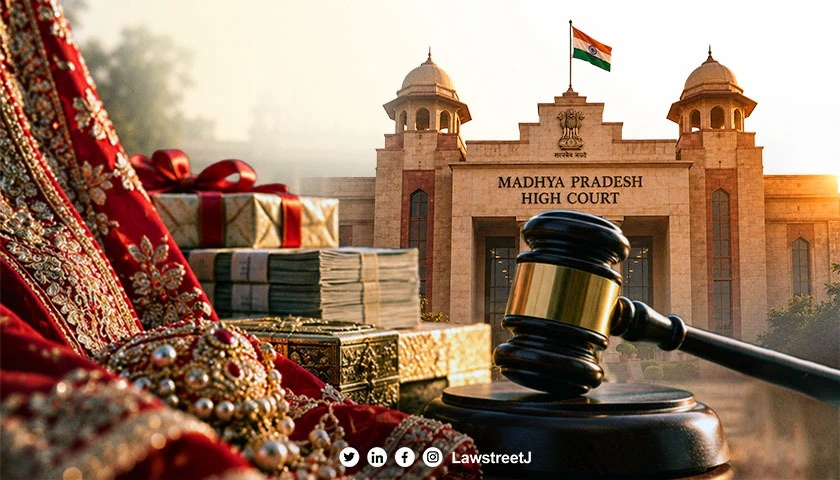
Indore: The Madhya Pradesh High Court (Indore Bench) has set aside a Sessions Court judgment that acquitted a husband and his father of cruelty and dowry demand, holding that a demand for dowry made after marriage is punishable and that no prior agreement or documentary proof of the demand is needed.
Restoring the husband’s conviction under Section 498-A IPC and Section 4 of the Dowry Prohibition Act, Justice Alok Awasthi held that the appellate court had isolated peripheral discrepancies and ignored the core evidence of a repeated post-marriage demand.
The appeal, was filed against the judgment dated of the XXth Additional Sessions Judge, Indore. That court had reversed the 03.04.2017 judgment of the Judicial Magistrate First Class, which convicted, them under Section 498-A IPC and Section 4 of the Dowry Act and sentenced them to one year’s rigorous imprisonment with Rs. 1,000 fine each, while acquitting them of Sections 506 Part II and 406 IPC.
According to the FIR of 06.08.2007, the complainant’s parents had given jewellery, household articles and Rs. 17 lakh at the marriage, but the in-laws had expected Rs. 25 lakh and harassed her to bring the balance Rs. 8 lakh. She alleged that she was beaten and thrown out of the house. Her father, mother, brother and Manoj Goel, a friend of her father, supported her account of the demand at Indore on 18.04.2007 and 16.06.2007.
Senior Advocate Vivek Singh, for the appellant, argued that the appellate court wrongly treated the absence of a fixed pre-marriage dowry bargain as fatal, and that the exact composition of the Rs. 17 lakh is not an ingredient of either offence. Senior Advocate Avinash Sirpurkar, for the accused, argued that no prior agreement was proved, the Rs. 8 lakh demand was doubtful and the witnesses were inconsistent.
On the standard of interference, the Court held that an appellate court may re-appreciate evidence, but interference is warranted where there is “manifest error of law or fact, misreading or non-consideration of material evidence”, and that the greater the reversal of a reasoned conviction, the greater the need to show why the trial court’s assessment was unsustainable.
On the law of dowry, the Court read Sections 2 and 4 of the Dowry Prohibition Act together. Since “dowry” includes property given or agreed to be given “at or before or any time after the marriage in connection with the marriage”, a demand made after solemnisation is covered. It held that:
“The expression ‘demand’ is itself the material act contemplated by Section 4 of the Dowry Act. The prosecution was not required to establish that a particular amount had formally fixed as dowry before the marriage. A subsequent demand connected with the marriage can attract the provision.”
The Court added that there is no rule that a dowry demand can be proved only by documents. It relied on State of Andhra Pradesh v. Raj Gopal (AIR 2004 SC 1933), noted by the trial court, for the proposition that a prior dowry contract is not necessary.
On Section 498-A, the Court held that Explanations (a) and (b) to the section operate separately, so proof of harassment connected with an unlawful demand under Explanation (b) does not require proof of conduct likely to drive the woman to suicide or cause grave injury. The appellate court had wrongly demanded cruelty “grave, persistent” of that kind, and had faulted her for not lodging a separate complaint for each incident. “The law does not require a woman alleging matrimonial cruelty to lodge a separate complaint every time an act of harassment occurs,” the Court said.
On appreciation of evidence, the Court found the minor discrepancies natural, since the events occurred in 2007 and the witnesses deposed years later. It relied on Jayaseelan v. State of T.N. (2009) 12 SCC 275 and Rajesh Yadav v. State of U.P. (2022) 12 SCC 200 for the principle that minor discrepancies should not be magnified into fatal contradictions. It held the appellate court misapplied Muluwa v. State of M.P. (AIR 1976 SC 989) to discount corroboration without separately testing what her brother, father and Manoj Goel said about the Indore incident.
The Court further held that uncertainty over the later Pune episode of 25.07.2007 could not erase the earlier demand, that a letter of 19.06.2007 by the complainant’s father could not be rejected by speculation about its timing, and that the short delay in the FIR was explained by attempts at reconciliation, the Rs. 25 lakh expectation being in the FIR from the outset.
Since Ramkumar Daga died on 19.03.2024, the appeal abated against him. The conviction of Akhilesh Daga under Section 498-A IPC and Section 4 of the Dowry Act, with one year’s rigorous imprisonment and Rs. 1,000 fine in each section, was restored. The acquittal under Sections 506 Part II and 406 IPC was left untouched, and he was directed to surrender within seven days. Relying on Rashmi Kumar v. Mahesh Kumar Bhada (1997) 2 SCC 397, which treats stridhan as the wife’s absolute property, the Court also directed that the seized jewellery be handed over to the complainant.
Appearances:
For the Appellant: Mr. Vivek Singh, Senior Advocate, assisted by Mr. Piyush Parashar, Advocate.
For Respondent No. 1 (State): Mr. Ambuj Patel, Government Advocate.
For Respondent Nos. 2 & 3: Mr. Avinash Sirpurkar, Senior Advocate, assisted by Mr. Yogesh Kumar Gupta, Advocate.
Case Title: Deepti Beesani (through POA holder Rajendra Beesani) vs. The State of Madhya Pradesh & Ors., Criminal Appeal No. 3639 of 2019, 2026:MPHC-IND:28859