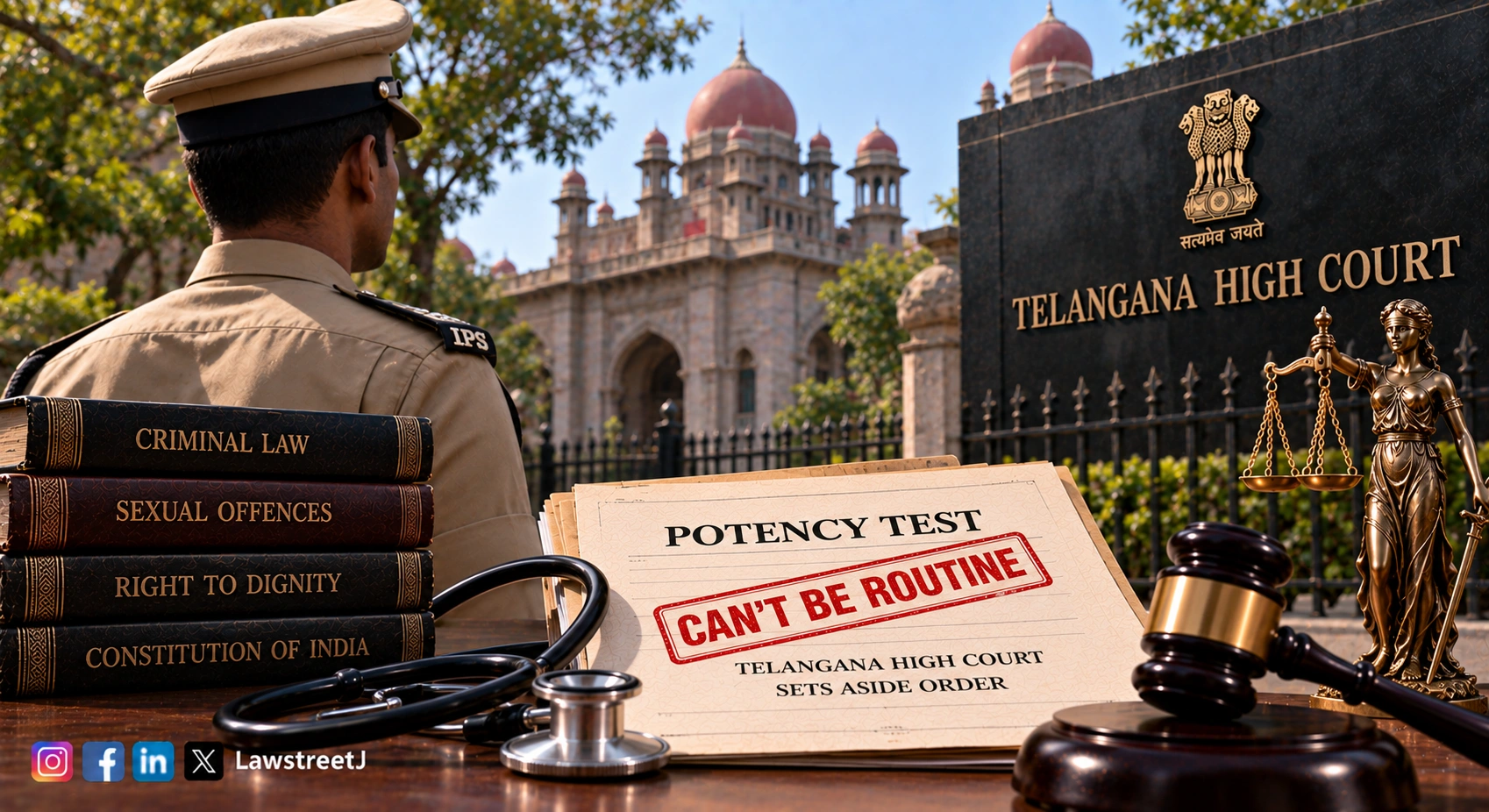
Hyderabad: The High Court of Telangana has set aside a trial court order permitting the police to subject an IPS officer trainee, accused of sexually assaulting a woman, to a potency test, holding that such an examination cannot be directed as a matter of routine and that the prosecution had failed to show any specific nexus between the test and the offence under investigation, which was one of digital penetration and not penile penetration.
Justice J. Sreenivas Rao was hearing a criminal petition challenging an order passed by the trial court at Rajendranagar, Ranga Reddy District, allowing a prosecution application under Section 52 of the Bharatiya Nagarik Suraksha Sanhita, 2023 to produce the petitioner before a Government Hospital for a medico-legal potency examination.
The case arose out of a complaint lodged by the de facto complainant against the petitioner, registered for offences including outraging modesty, stalking and voyeurism-type provisions of the Bharatiya Nyaya Sanhita and the Information Technology Act, to which offences of sexual assault by digital penetration were later added on the victim's statement. The prosecution had earlier sought police custody of the petitioner, inter alia, to conduct a potency test, but the trial court declined that specific relief for want of reasons while granting custody for recovery of a mobile phone. The prosecution subsequently filed a fresh application for the same medical examination, which the trial court allowed on the ground that the allegations were grave and the investigating agency was entitled to collect all incriminating material.
The petitioner's counsel argued that the fresh application amounted to an impermissible review of the earlier order declining a potency test, and that the prosecution had not shown any reasons or evidentiary nexus justifying the examination, particularly since the allegation was one of digital penetration and not penile penetration, rendering the petitioner's potency legally irrelevant to the charge.
The Public Prosecutor and senior counsel for the complainant defended the trial court's order, submitting that the allegations were grave, that the earlier refusal of custody for the purpose of a potency test did not bar a fresh application under Section 52 read with Section 187 of the BNSS, and that the examination was necessary to gather complete scientific and medical evidence in support of the prosecution case.
Relying on decisions of the Madras and Karnataka High Courts and the Supreme Court on DNA and potency testing, the court reiterated that such medical examinations of an accused cannot be ordered routinely or mechanically, and must satisfy the requirements of relevance, necessity and proportionality while safeguarding the accused's bodily autonomy, privacy and dignity under Article 21. It noted that potency testing, in particular, is not a mandatory feature of every sexual-offence case and cannot be insisted upon merely because an allegation touching potency has been raised, and that a direct and demonstrable nexus between the proposed examination and the specific offence under investigation must be shown.
Applying these principles, the court found that the prosecution's second application had been filed without assigning any reasons, much less specific reasons, as to why the potency test was now required or how it would assist the investigation, especially when the specific allegation against the petitioner was of digital penetration. The trial court's reliance on the general gravity of the allegations, without addressing this absence of nexus, was held to run contrary to the principles laid down in the cited precedents.
Holding that the impugned order was accordingly unsustainable, the court set it aside and allowed the criminal petition, while clarifying that the order would not preclude the prosecution from filing an appropriate application in future, in accordance with law, should the necessity arise.
Appearances:
For the Petitioner: Mr. G. Ashok Reddy, Advocate.
For Respondent No. 1/State: Mr. Palle Nageswara Rao, Public Prosecutor.
For Respondent No. 2: Mr. L. Ravichander, Senior Counsel, representing Mr. Mayur Mundra, Advocate.
Case Title: M. Uday Krishna Reddy vs. The State of Telangana and Another, Criminal Petition No. 13846 of 2026


!['No common intention to kill,' SC alters conviction from murder to culpable homicide not amounting to murder [Read Judgment]](/secure/uploads/2024/02/lj_7197_f77c706e-b667-41fe-9c36-9e633e880b85.jpg)
![Remaining silent during an investigation is a fundamental right: Telangana HC [Read Judgment]](/secure/uploads/2024/04/lj_3728_c8f7ecd3-a0e9-44f7-85aa-f77b9dae3a49.webp)