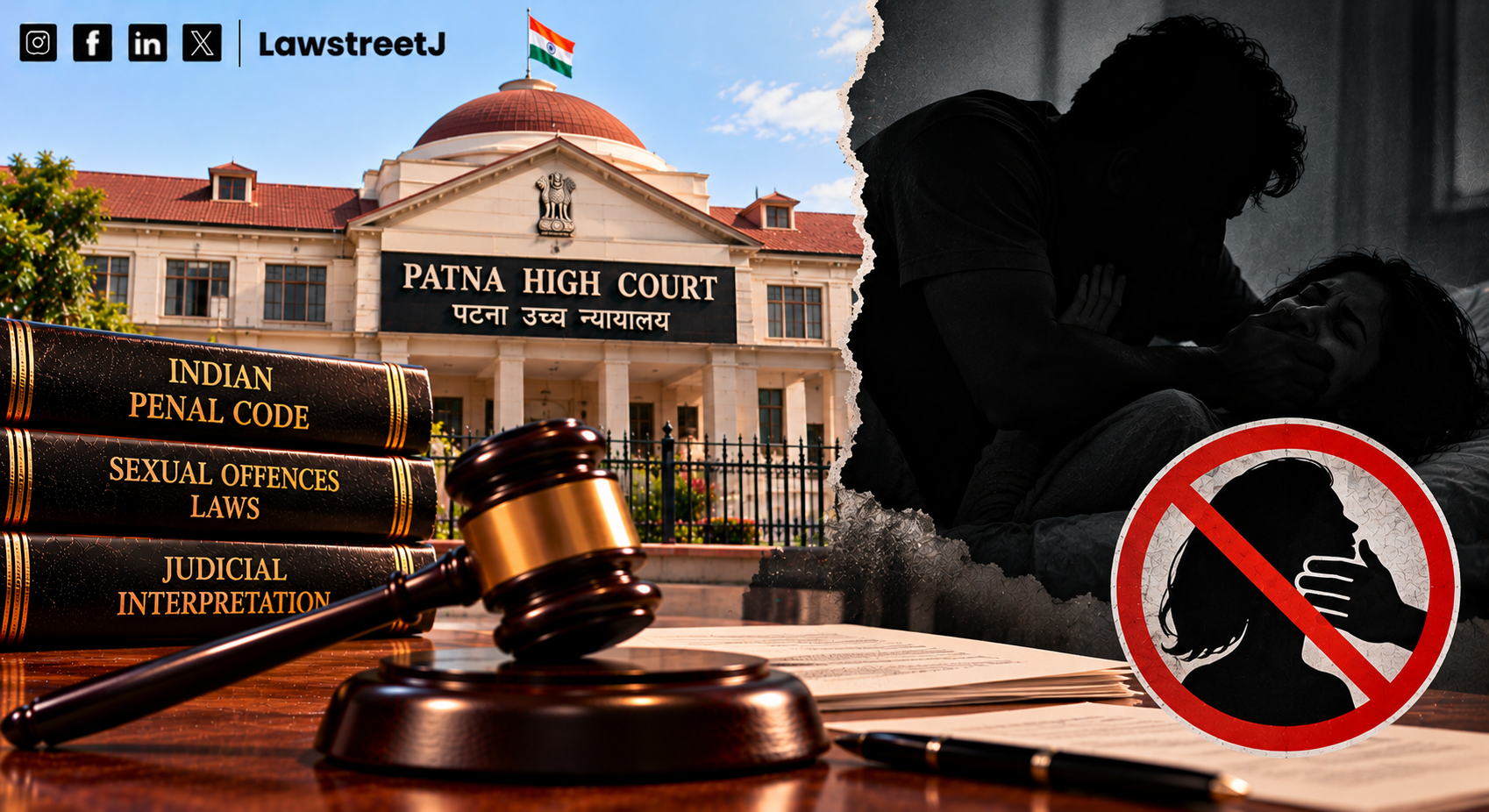
Patna: The Patna High Court has altered the conviction of a man from attempt to commit rape under Sections 376/511 of the Indian Penal Code to the offence of outraging the modesty of a woman under Section 354 of the Indian Penal Code, holding that, while his entry into the prosecutrix's house at night was proved, there was no evidence that he had gone beyond the stage of preparation towards committing rape. The court reduced his sentence to the period already undergone and directed him to pay a fine of Rs. 25,000 to the prosecutrix as compensation.
Justice Sandeep Kumar delivered the judgment on 08.10.2026 in Criminal Appeal (SJ) No. 579 of 2013, wherein the appellant had challenged the judgment and the order of sentence passed by the Additional Sessions Judge-V, Begusarai, in Sessions Trial No. 1052 of 2010, convicting him under Sections 376/511 and 448 of the Indian Penal Code and sentencing him to rigorous imprisonment for four years with a fine of Rs. 2,000 for the former offence and rigorous imprisonment for six months for the latter, to run concurrently.
According to the complaint filed before the Chief Judicial Magistrate, Begusarai, on 10.02.2010 (Complaint Case No. 257C of 2010), the complainant, a widow living with her children and earning by labour, was sleeping in her thatched house at about 10 p.m. on 08.02.2010 when the appellant entered, pressed her mouth and committed rape. Villagers who gathered on her alarm apprehended the appellant, and a settlement attempted through the village panchayat failed. As the local police did not register her case, the complaint was forwarded for investigation under Section 156(3) of the Code of Criminal Procedure, leading to Ballia P.S. Case No. 33 of 2010, and charges were framed on 17.01.2011 under Sections 376/511 and 448. Four witnesses were examined, of whom two turned hostile, and neither the Investigating Officer nor any medical witness was examined and no document was exhibited.
The appeal was admitted on 16.08.2013 and the appellant has been on bail since. Following the Supreme Court's directions in Bhola Mahto v. State of Jharkhand, the court verified on 22.06.2026 that the appellant is alive, and the Superintendent of Police, Begusarai, reported on 06.07.2026 that he is. The appellant's counsel argued that the case rested on the solitary, inconsistent and uncorroborated testimony of the prosecutrix, who deposed to an attempt and not rape, admitted that her clothes were not torn and that there was no injury, and did not undergo a medical examination, and that none of the villagers who apprehended him was examined. The Additional Public Prosecutor supported the conviction, submitting that the delay was explained by the abortive panchayat and that minor discrepancies in the evidence of a rustic village woman cannot be a ground to discard her testimony.
The court held that the presence of the appellant in the house at night was established beyond reasonable doubt by the consistent testimony of the prosecutrix and PW-1, a neighbour who reached the spot on her alarm, noting that PW-1 had not been cross-examined on this point and that no motive for false implication was suggested. It held that the delay of two days in filing the complaint was explained, relying on State of Punjab v. Gurmit Singh, and that, relying on Takhaji Hiraji v. Thakore Kubersing Chamansing, the non-examination of other villagers or the Investigating Officer was not fatal as it would have been a mere repetition.
On the crucial question of the nature of the act, the court noted that conviction can rest on the sole testimony of a prosecutrix who inspires confidence, but that the standard of a sterling witness laid down in Rai Sandeep @ Deepu v. State (NCT of Delhi) and Santosh Prasad @ Santosh Kumar v. State of Bihar requires consistency and support. It found her evidence reliable on the core fact that the appellant entered at night, extinguished the lamp, lay upon her and pressed her mouth, but inconsistent and unsupported on anything beyond it. There was no evidence that the appellant undressed himself or her, or did any act towards penetration, and the trial court's explanation of the discrepancy by calling her a rustic and illiterate woman, the court said, underscored rather than answered the difficulty.
Relying on Aman Kumar v. State of Haryana and Tarkeshwar Sahu v. State of Bihar, which draw the distinction between an attempt to commit rape and an indecent assault, and on Rupan Deol Bajaj and Raju Pandurang Mahale on the outraging of modesty, the court held that the act was unquestionably capable of shocking a woman's sense of decency and that all ingredients of Section 354 were established, but that the conviction under Sections 376/511 could not be sustained. Applying Section 222(2) and Section 386(b)(ii) of the Code of Criminal Procedure and Dalbir Singh v. State of U.P., it held that Section 354 is a cognate minor offence and that no prejudice was caused by the absence of a charge under it, since the facts were put to the witnesses and to the appellant under Section 313. The conviction under Section 448 for house-trespass was affirmed.
On sentence, the court applied Section 354 as it stood in February 2010, before the 2013 amendment, having regard to Article 20(1) of the Constitution. Noting that the appellant, now about 60, has no criminal antecedents, had undergone about two and a half months in custody and had remained on bail for more than thirteen years without any adverse report, with the occurrence being more than sixteen years old, it reduced the substantive sentence for both offences to the period already undergone.
Citing Section 357 of the Code of Criminal Procedure, Hari Singh v. Sukhbir Singh and Ankush Shivaji Gaikwad v. State of Maharashtra on the duty of courts to consider compensation to victims, the court imposed a fine of Rs. 25,000 under Section 354, the whole of which is to be paid to the prosecutrix as compensation, with simple imprisonment for six months in default. The appellant must deposit the fine before the trial court within eight weeks, any fine already deposited being adjusted, whereupon his bail bonds will stand discharged. The appeal was allowed in part and the lower court records were directed to be sent back.
Appearances:
For the Appellant: Mr. Parithosh Parimal and Md. Fahimuddin, Advocates.
For the Respondent: Ms. Anita Kumari Singh, Additional Public Prosecutor.
Case Title: Md. Ainul Haque vs. The State of Bihar, Criminal Appeal (SJ) No. 579 of 2013


![Immediately stop caste-based survey: Patna High Court to Bihar Government [Read Order]](/secure/uploads/2023/05/lj_2614_70fde4fe-1b94-4360-a3d2-e162d6022c46.jpg)

![Supreme Court refuses pre arrest bail to IPS officer accused of creating fake WhatsApp account of HC's CJ [Read Order]](/secure/uploads/2023/11/lj_1575_Fake_WhatsApp_account_of_Patna_HC_Chief.jpg)