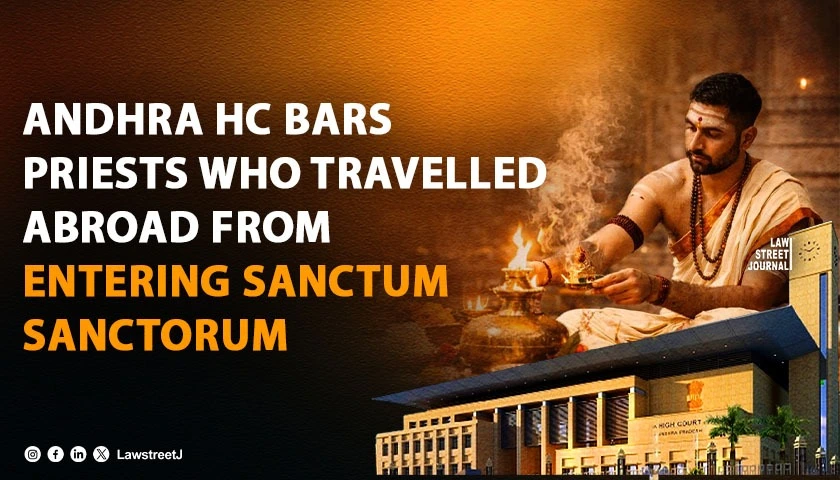
Amaravati: The High Court of Andhra Pradesh at Amaravati has directed the State Government and the Commissioner of Endowments to strictly follow Circular Memo No. 21 Rc.No.D.P/52200/2009 dated 10.11.2010 issued by the Endowments Department, as well as the Pramanika dated 20.12.2024 issued by Sri Bharati Tirtha Mahaswami, Jagadguru Shankaracharya of the Sringeri Sharada Peetham, in matters relating to temple rituals and Agama practices, including the restriction barring priests who have travelled abroad from entering the sanctum sanctorum and participating in the worship of the deity.
The order was passed by Justice Venkateswarlu Nimmagadda in Writ Petition No. 8102 of 2026, filed under Article 226 of the Constitution of India by the petitioner, who serves as a Sri Chakra Navavarana Archana Parayanadhar at Sri Durga Malleswara Swamy Varla Devasthanam, Indrakeeladri, Vijayawada, NTR District.
The petition sought a writ of mandamus declaring the respondents’ failure to follow the said Circular Memo and Pramanika as illegal, arbitrary, and contrary to Section 13 of the Andhra Pradesh Charitable and Hindu Religious Institutions and Endowments Act, 1987.
The petitioner submitted before the Court that hereditary archakas who traditionally perform the worship of the deity at Sri Durga Malleswara Swamy Varla Devasthanam are required to observe strict spiritual discipline, including Trikala Sandhyavandanam, Guru-Upadesha Mantra Japa, adherence to Vedic study, and maintenance of ritual purity in food habits, conduct, and personal discipline. Only such qualified hereditary priests are entitled to enter the sanctum sanctorum and perform the worship of the presiding deity.
The petitioner further submitted that, in pursuance of this tradition, Sri Bharati Tirtha Mahaswami, Jagadguru Shankaracharya of the Sringeri Sharada Peetham, established in the lineage of Adi Shankaracharya, issued the Pramanika dated 20.12.2024 clarifying the traditional norms governing worship and observance of temple rituals. In terms of the said Pramanika, persons who have travelled abroad, those who have undergone shaving or haircutting contrary to traditional norms, and those who do not adhere to the prescribed spiritual practices shall not enter the sanctum sanctorum or participate in the worship of the deity.
The petitioner also submitted that the Commissioner of Endowments had already issued a circular dated 10.11.2010 directing that temple rituals and religious ceremonies must be performed strictly in accordance with the Agama Shastras and established temple traditions. However, the respondents were not following either the circular memo dated 10.11.2010 or the Pramanika dated 20.12.2024, thereby affecting the sanctity of temple worship and the rights of hereditary priests to perform rituals in accordance with Agama traditions.
The petitioner further drew the Court’s attention to an earlier order dated 18.09.2025 passed by the Court in W.P. No. 41481 of 2022, wherein, on a similar grievance that an archaka who had travelled abroad was being considered senior to the petitioner and appointed as Pradhana Archaka in disregard of Circular No. 21, the matter was remanded to the temple authority for passing fresh orders in terms of the Circular, after affording an opportunity to both parties within one month.
The learned Government Pleader for the respondents submitted that the respondents would comply with Circular Memo No. 21 Rc.No.D.P/52200/2009 dated 10.11.2010 and the Pramanika dated 20.12.2024.
Having regard to the submissions of both sides and the material on record, the Court disposed of the writ petition with a direction to the respondents to follow the guidelines framed under the Circular Memo and the Pramanika. There was no order as to costs, and pending miscellaneous applications were also closed.
For the Petitioner: Sri K.R. Srinivas, Advocate
Case Title: D.S.S.S. Subrahmanyam Somayaji v. The State of Andhra Pradesh & Anr., Writ Petition No. 8102 of 2026