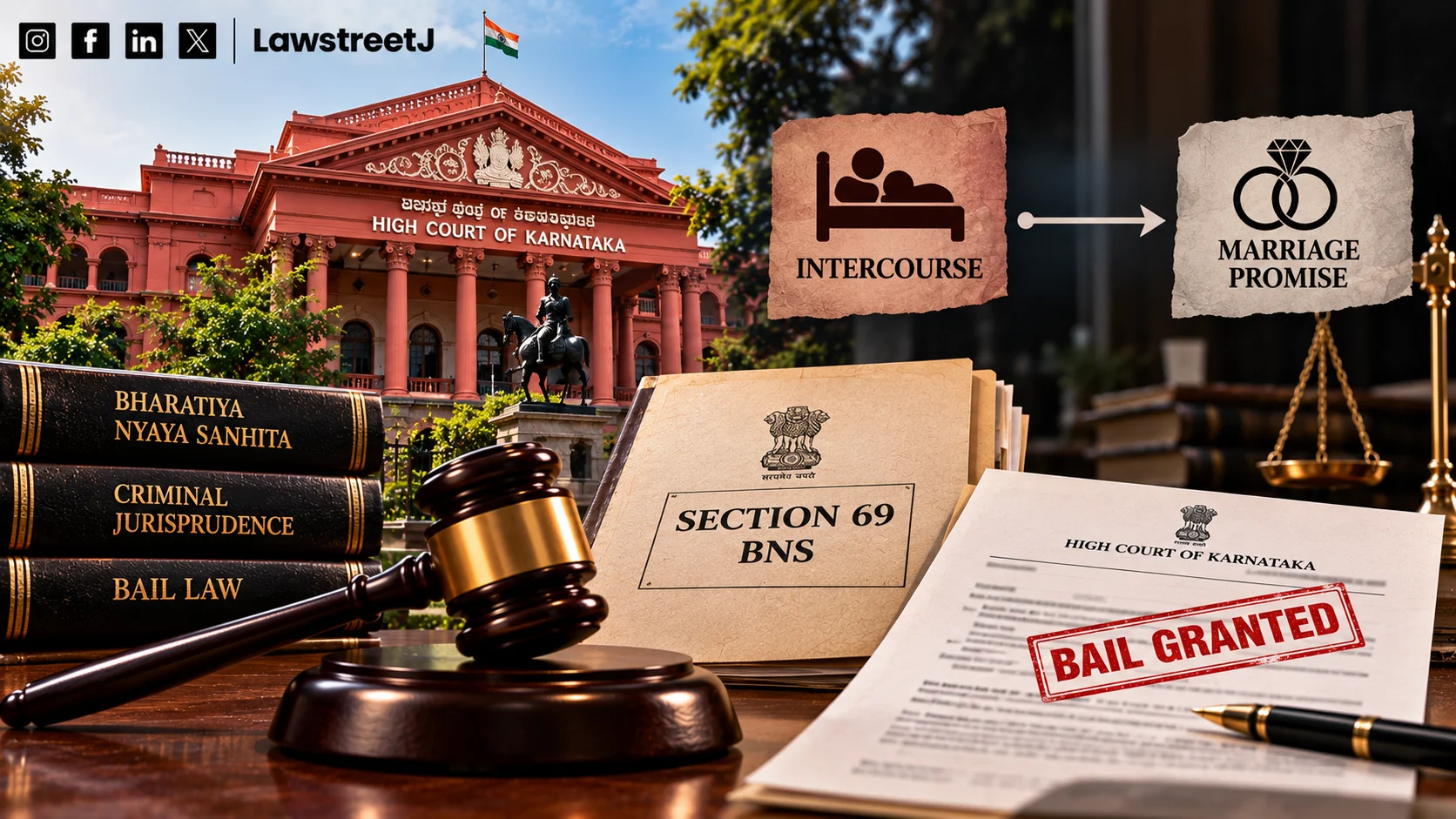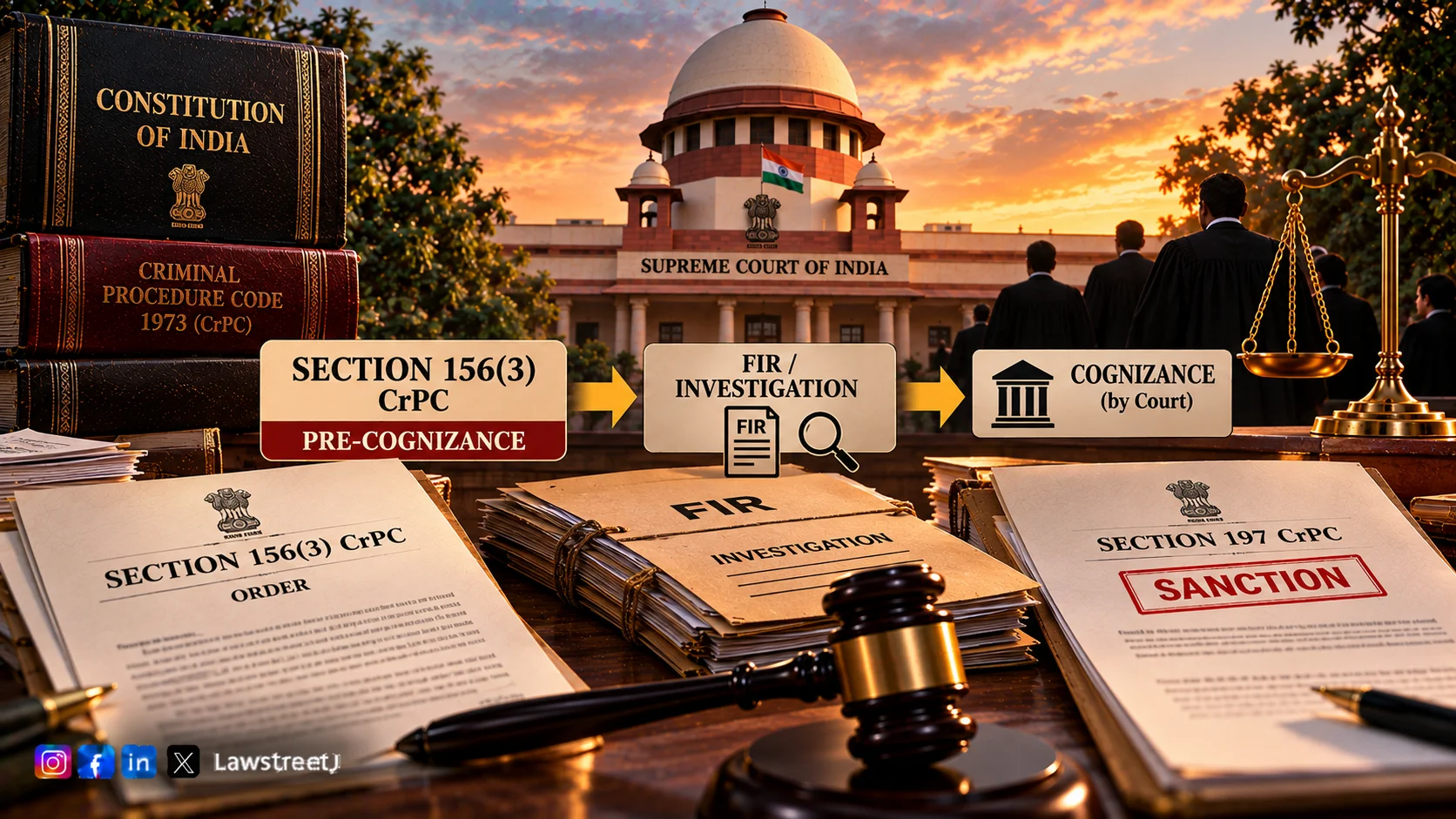
New Delhi: The Supreme Court has set aside a Karnataka High Court judgment that had quashed an FIR against certain police officials on the ground of absence of prior sanction under Section 197 CrPC, holding that the requirement of sanction operates only at the stage of taking cognizance of an offence and has no application at the earlier, pre-cognizance stage of directing registration of an FIR and investigation under Section 156(3) CrPC.
The bench of Justice Sandeep Mehta and Justice Vikram Nath, was hearing five connected appeals filed by Anumandala Rajesh Reddy against the judgment dated 29.05.2023 of the High Court of Karnataka at Bengaluru, which had quashed the order dated 01.08.2022 passed by the jurisdictional Magistrate under Section 156(3) CrPC directing registration of an FIR, and the consequential FIR bearing Crime No. 73 of 2022, insofar as it concerned a Police Sub-Inspector and four police constables named as accused.
According to the appellant, following a business dispute with a former associate, he was apprehended by police officials in Bengaluru in connection with an earlier crime, taken into custody, and, while in custody, allegedly coerced into signing documents relinquishing his shares in a jointly-owned enterprise. He further alleged mistreatment during custody and tampering with his digital devices. Aggrieved, the appellant made repeated complaints to the local police, followed by a detailed e-mail complaint to the Deputy Commissioner of Police and, upon continued inaction, a further complaint to the Director General and Inspector General of Police. When no action was forthcoming, he filed a private complaint under Section 200 CrPC, upon which the Magistrate, by order dated 01.08.2022, directed registration of an FIR and investigation under Section 156(3) CrPC.
The High Court quashed these proceedings against the police officials on two grounds: first, that since the acts complained of were committed in the discharge of official duty, prosecution was barred without sanction under Section 197 CrPC; and second, that the appellant had directly approached the Magistrate without first exhausting the remedies before the police as required by the guidelines in Priyanka Srivastava v. State of Uttar Pradesh, (2015) 6 SCC 287.
Mr. Nikhil Goel, learned senior counsel for the appellant, submitted that the appellant had, in substance, repeatedly approached the police authorities at multiple levels before moving the Magistrate, and that the High Court had misapplied both the law on sanction and the Priyanka Srivastava guidelines. Mr. Gaurav Agarwal, learned senior counsel for the respondents, fairly conceded that sanction under Section 197 CrPC would arise only at the stage of cognizance, but defended the High Court's judgment on the ground of non-compliance with the Priyanka Srivastava safeguards.
Relying on its recent decision in Ashwini Kumar Upadhyay v. Union of India, 2026 SCC OnLine SC 741, the Court held that an order under Section 156(3) CrPC directing registration of an FIR and investigation is a pre-cognizance step, and that the criminal process is sequential: information of an offence, registration of the FIR, investigation, and submission of a report under Section 173 CrPC must all precede the stage at which the question of cognizance, and consequently of sanction, arises.
On the second ground, the Court found that the appellant had in fact approached the local police repeatedly, and thereafter escalated his grievance to the DCP and to the Director General and Inspector General of Police, before finally moving the Magistrate, and that the object underlying the Priyanka Srivastava safeguards, namely, preventing casual or mechanical invocation of Section 156(3), stood substantially fulfilled on these facts.
The Court observed: “The law is governed by reason, and a judicial direction intended to prevent abuse of a statutory remedy cannot be applied in a manner which defeats the very purpose for which the safeguard was evolved.”
Holding that both grounds on which the High Court had quashed the proceedings were unsustainable in law, the Court set aside the impugned judgment. Noting that, pursuant to the High Court's order, the investigating agency had already filed a Final Report treating the proceedings against the police officials as closed, the Court directed that the Final Report be reopened and the investigation resumed from that stage, while clarifying that the Investigating Officer shall keep in mind the desirability of seeking sanction if it is ultimately found that the acts alleged were committed in the discharge of official duty.
The appeals were accordingly allowed.
Case Title: Sri Anumandala Rajesh Reddy vs. State of Karnataka and Anr



.jpeg)