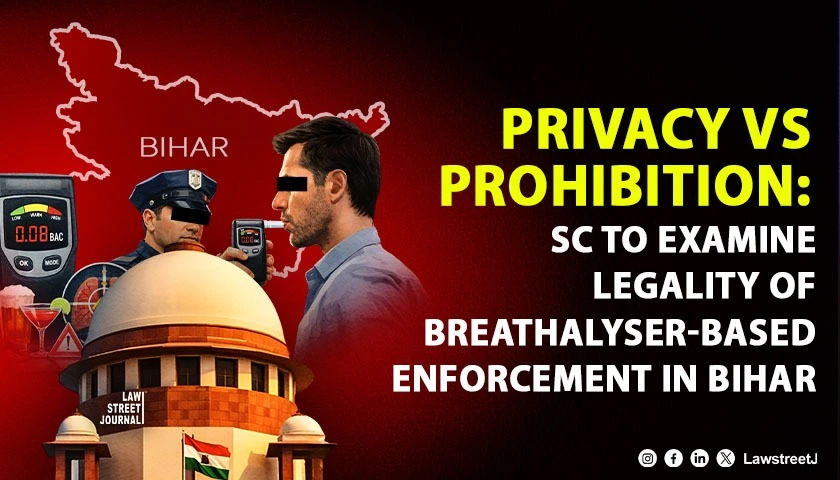
The Supreme Court on March 17, 2026, indicated that it will examine the constitutional validity of statutory provisions governing breath analyser tests under the Bihar Prohibition regime, while hearing a Special Leave Petition filed by the State of Bihar against a Patna High Court judgment which had quashed criminal proceedings based solely on such a test.
A Bench comprising Hon'ble Justice Sanjay Karol and Hon'ble Justice Nongmeikapam Kotiswar Singh was hearing the matter arising from a judgment of the Patna High Court which had interfered with prosecution initiated under the Bihar Prohibition and Excise Act.
The controversy originates from a case where the respondent was subjected to a breath analyser test, which formed the sole basis for initiating criminal proceedings alleging consumption of alcohol. According to the record, no corroborative material or confirmatory medical examination was relied upon by the authorities.
Before the Patna High Court, the respondent challenged the initiation of proceedings. The High Court, while allowing the writ petition, held that a breath analyser test by itself cannot constitute conclusive proof of alcohol consumption. It emphasised that determination of intoxication requires a proper medical examination, including blood and urine tests, and noted that no such confirmatory procedure had been undertaken. The High Court also took into account the petitioner’s medical explanation that the reading could have been influenced by prescribed medication containing alcohol-based solvents.
Relying on the decision of the Supreme Court in Bachubhai Hassanalli Karyani v. State of Maharashtra, the High Court reiterated that the presence and effect of alcohol in the human body must be established through scientifically reliable methods, and that reliance solely on a breath analyser report was legally insufficient. On this reasoning, the criminal proceedings were quashed.
The State has challenged this view before the Supreme Court.
In the proceedings before the Supreme Court, the respondent has additionally raised a constitutional challenge to the manner of enforcement under the statute. It has been contended that the act of entering a private dwelling and subjecting an individual to a breath analysis test constitutes an intrusion into bodily privacy, protected under Article 21 as recognised in K.S. Puttaswamy v. Union of India.
It has further been argued that while the statutory framework separately provides for powers of search and entry on the one hand and breath analysis on the other, the latter provision does not itself authorise entry into private premises, raising questions as to the legality of such action in the absence of express statutory backing.
Taking note of the nature of the issues involved, the Supreme Court has now expanded the scope of the case. In its order dated March 17, 2026, the Court recorded:
“we are also examining the issue of the validity of Section 74 of the Bihar Prohibition and Excise (Amendment) Act, 2022 and Section 75 of the Bihar Prohibition and Excise Act, 2016.”
The Bench has directed parties to file fresh written submissions on these aspects and has listed the matter for further hearing on April 22, 2026.
At an earlier stage, the Supreme Court had stayed the operation of the High Court’s judgment, thereby keeping the underlying proceedings alive pending final adjudication.
The matter now raises questions of broader significance concerning the evidentiary status of breath analyser tests, the permissible scope of coercive testing under prohibition laws, and the extent to which such statutory mechanisms comport with constitutional guarantees of privacy and personal liberty.
With the Court expressly examining the validity of the statutory provisions themselves, the outcome is likely to clarify the legal framework governing alcohol detection and enforcement under the Bihar Prohibition law.
Counsel for Petitioner(s): Mr. Maninder Singh, Senior Advocate; Mr. Rishi K. Awasthi, Advocate; Mr. Piyush Vatsa, Advocate; Mr. Amit V. Awasthi, Advocate; Mr. Rahul K. Gupta, Advocate; Mr. Rangasaran Mohan, Advocate; Mr. Amarpal Singh Dua, Advocate; Mr. Punit Vinay, Advocate-on-Record.
Counsel for Respondent(s): Mr. Ashwani Kumar Singh, Senior Advocate; Mr. Shivesh Sinha, Senior Advocate; Mr. Nitesh Ranjan, Advocate-on-Record; Mr. Amrit Kumar, Advocate; Ms. Avantika Chaudhary, Advocate; Ms. Diksha Meghali, Advocate.
Case Title: State of Bihar & Ors. v. Narendra Kumar Ram [SLP (Crl.) No. 5281 of 2025]