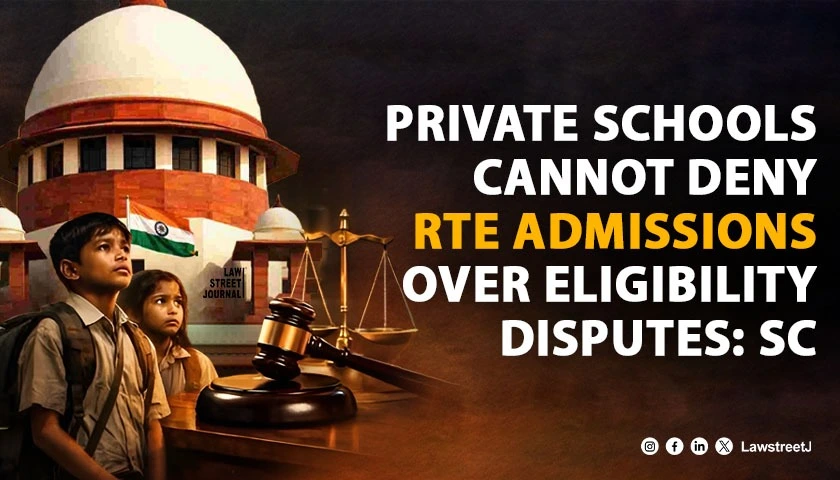
New Delhi: The Supreme Court of India has held that a private “neighbourhood school” is under an absolute constitutional and statutory obligation to grant immediate admission to students whose names have been forwarded to it by the State Government under the Right of Children to Free and Compulsory Education Act, 2009 (RTE Act, 2009), and cannot refuse or delay admission on the ground of any uncertainty regarding the student’s eligibility.
The Bench comprising Justice Pamidighantam Sri Narasimha and Justice Alok Aradhe affirmed that where a school has any disagreement with the selection made by the Government, its only recourse is to make a representation to the concerned authority; however, it is nonetheless mandated to grant admission to the student in the interregnum.
The Court reiterated the settled constitutional position that the right to education guaranteed under Article 21A of the Constitution will remain an empty promise if the mandate of the RTE Act, 2009 is not implemented in its letter and spirit. It further held that courts, whether constitutional or civil, must walk the extra mile to provide easy access and efficient relief to parents who complain of denial of this right.
The facts giving rise to the present Special Leave Petition are that Respondent No. 5, a minor student, had applied to the Basic Education Department of the State of Uttar Pradesh for admission to the pre-primary class in a neighbourhood school in accordance with the procedure prescribed under the U.P. Right of Children to Free and Compulsory Education Rules, 2011 (UP RTE Rules, 2011), for the academic year 2024–25. The student was duly selected, and the published list containing her name was forwarded to the petitioner, Lucknow Public School, Eldico, for admission to the pre-primary class. However, when the student approached the petitioner school to complete the admission formalities, she was neither granted admission nor permitted to attend classes on the ground of alleged uncertainty regarding her eligibility.
The student thereafter preferred a writ petition before the High Court of Allahabad, seeking a direction to the State and other authorities to grant her admission to the petitioner school. The High Court allowed the writ petition, holding that schools cannot sit in appeal over a decision taken by the State Government. It observed that once the admission process is completed, applications are duly scrutinised, and a list allocating children to schools is forwarded, the school has no option but to grant admission to the students named therein.
The High Court further noted that Rule 8 of the UP RTE Rules, 2011 mandates that the admission process shall be completely transparent, that details of all applicants who are not admitted shall be communicated in writing along with reasons, and that it shall be binding upon the school to follow the admission process prescribed by the State Government. The petitioner school challenged this order before the Supreme Court.
Before the Supreme Court, the petitioner school contended that there was genuine uncertainty regarding the student’s eligibility, which warranted reconsideration before admission could be granted. The State of Uttar Pradesh and the respondent student supported the High Court’s order.
The Supreme Court, however, affirmed the order of the High Court and dismissed the Special Leave Petition. It held that the mandate of Rule 8 of the UP RTE Rules, 2011 is unambiguous: once the Government assesses an application for admission, the school is bound by that decision and must proceed accordingly. The Court observed that the limited window available to a school to question the Government’s decision is a conscious legislative choice aimed at avoiding delays in securing children’s right to education.
The Court reaffirmed the constitutional significance of the neighbourhood school concept enshrined in Section 12 of the RTE Act, 2009, describing it as a deliberate statutory framework to operationalise equality of status and social integration during a child’s formative years. By mandating that schools admit children from weaker and disadvantaged sections to the extent of at least twenty-five percent of class strength, the law seeks to transform the social structure by envisioning schools as common civic spaces that break down entrenched barriers of caste, class, and gender, thereby advancing substantive social justice.
The Court placed reliance on its earlier judgment in Dinesh Biwaji Ashtikar v. State of Maharashtra & Ors. (2026 INSC 56), wherein it identified five duty bearers under the RTE Act, 2009: the appropriate government, the local authority, neighbourhood schools, parents or guardians, and elementary school teachers. It reiterated that the appropriate government is obligated under Section 6 to establish neighbourhood schools, while the local authority is obligated under Section 9 to maintain records, ensure admission, and monitor attendance and completion of elementary education. Neighbourhood schools, in turn, are obligated under Section 12(1)(c) to admit children from weaker sections and disadvantaged groups.
The Court also underscored two foundational constitutional values that Section 12 seeks to secure: first, that not less than twenty-five percent of entry-level seats shall be reserved for children from weaker sections and disadvantaged groups; and second, that such children must be admitted to unaided neighbourhood schools, thereby reinforcing the principle of inclusive and common schooling.
It described this legislative choice as a deliberate constitutional strategy to promote equality, dignity, and social integration among children.
The Court further observed that effective implementation of the RTE Act requires schools to publish available seats well in advance and to record any denial of admission with specific reasons, subject to review by educational authorities within strict timelines. The success of the RTE framework, the Court emphasised, ultimately depends on ensuring meaningful classroom participation.
Accordingly, the Court held that a school may make a representation against a Government selection but must grant admission to the student whose name appears in the forwarded list without awaiting the outcome of such representation. This immediacy, the Court held, is essential to realise the promise of Article 21A.
The Special Leave Petition filed by the school was accordingly dismissed.
Case Title: Lucknow Public School, Eldico and Anr. v. State of Uttar Pradesh & Ors.
Court: Supreme Court of India
Bench: Justice Pamidighantam Sri Narasimha and Justice Alok Aradhe
Case Number: Special Leave Petition (C) No. of 2026 @ Diary No. 60657 of 2024
Citation: 2026 INSC 422