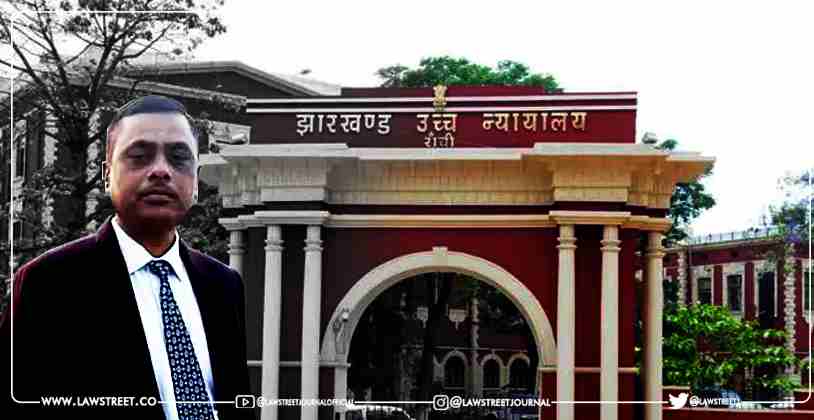
Ranchi: The Jharkhand High Court has set aside a Family Court judgment dismissing a doctor’s petition for divorce on the ground of cruelty, holding that the Family Court appreciated the evidence “in piece meal” and ignored the principle of preponderance of probability.
A Division Bench of Justice Sujit Narayan Prasad and Justice Pradeep Kumar Srivastava dissolved the marriage under Section 13(1)(i-a) of the Hindu Marriage Act, 1955, on the combined basis of physical cruelty, the husband’s alleged extra-marital relationship and the parties’ separation since 2019, and reserved the wife’s liberty to seek alimony under Section 25.
The appeal, F.A. No. 82 of 2024, was filed under Section 19(1) of the Family Courts Act, 1984 against the judgment dated 17.11.2023 of the Principal Judge, Family Court, Hazaribagh, in Original Suit No. 75 of 2022. The parties, both medical practitioners, were married on 24.02.2018, have no child, and have lived separately since 05.09.2019. The husband, obtained an ex parte decree of restitution of conjugal rights on 17.01.2023 in a suit filed on 18.01.2022, which the wife did not contest, while she filed her divorce suit on 05.04.2022.
The wife alleged that the husband was involved with another woman, that after family intervention he executed a bond undertaking not to repeat it, and that she was nevertheless beaten, causing slip-disc and traumatic osteoarthritis. The husband denied this, contending that her medical documents were frivolous and obtained from a nursing home owned by her father. The Family Court held that the suit was not maintainable and that she had failed to prove cruelty.
Before the High Court, the wife’s counsel, Abhishek Thakur and Pratyush Navneet, argued that the Family Court ignored the FIR (Charhi P.S. Case No. 64 of 2019) and the testimony of the wife, her father, her uncle and her brother, and overlooked that separation since 2019 was itself a ground. Counsel for the husband, Soumitra Baroi, argued that the Family Court decided on the available material and that the medical documents came from her father’s clinic.
On the scope of appeal, the Court held that Section 19 of the Family Courts Act is parallel to Section 96 CPC and permits reappraisal of evidence on facts and law, citing Jagdish Singh v. Madhuri Devi (2008) 10 SCC 497. It held that matrimonial cases are decided on preponderance of probability, not proof beyond reasonable doubt, citing A. Jayachandra v. Aneel Kaur (2005) 2 SCC 22. On perversity, it relied on Arulvelu v. State (2009) 10 SCC 206, noting that a finding is perverse if it ignores relevant material or defies logic, while stressing that “inadequacy of evidence or a different reading of evidence is not perversity” (Damodar Lal v. Sohan Devi, (2016) 14 SCC 197).
On cruelty, the Court surveyed Dr. N.G. Dastane v. S. Dastane (1975) 2 SCC 326, Shobha Rani v. Madhukar Reddi (1988) 1 SCC 105, Joydeep Majumdar v. Bharti Jaiswal Majumdar (2021) 3 SCC 742 and Manish Tyagi v. Deepak Kumar (2010) 4 SCC 339, and held that cruelty has “no static connotation”, may be physical or mental, intentional or unintentional, and depends on the social and economic setting. It added that normal wear and tear does not suffice, but conduct that the other spouse cannot reasonably be expected to put up with is enough.
Applying these principles, the Court accepted the wife’s testimony of repeated assaults with household implements, and of the husband’s alleged relationship with another woman which continued despite the bond. It treated his alleged insistence that she accept the other woman as a “younger sister” as “mental cruelty of the gravest kind”. It found her evidence corroborated by her father, uncle and brother and by the 2019 FIR, and held that the medical records could not be discarded merely because they came from her father’s nursing home:
“The settled principle is that the source of medical documentation does not ipso facto render it unreliable, unless specific infirmities are demonstrated.”
The Court held the Family Court’s finding perverse because it had appreciated the evidence piecemeal and had not considered the admitted separation since 2019, contrary to Samar Ghosh v. Jaya Ghosh (2007) 4 SCC 511, where prolonged separation was held to amount to mental cruelty. Citing A. Jayachandra, it observed that a long period of continuous separation may show that the matrimonial bond is beyond repair and the marriage “a fiction though supported by a legal tie”.
The husband’s professed wish to resume cohabitation, the Court held, “cannot override the appellant’s right to live free from cruelty”. It concluded that trust, the foundation of marriage, had been broken irreparably, and that the cumulative circumstances satisfy Section 13(1)(i-a).
The Family Court’s judgment was set aside and the marriage of 24.02.2018 dissolved by a decree of divorce. The wife was given liberty to approach the Family Court for alimony under Section 25 of the Hindu Marriage Act by instituting appropriate proceedings and leading evidence.
Appearances:
For the Appellant: Mr. Abhishek Thakur and Mr. Pratyush Navneet, Advocates.
For the Respondent: Mr. Soumitra Baroi, Advocate.
Case Title: F.A. No. 82 of 2024, 2026:JHHC:28726-DB