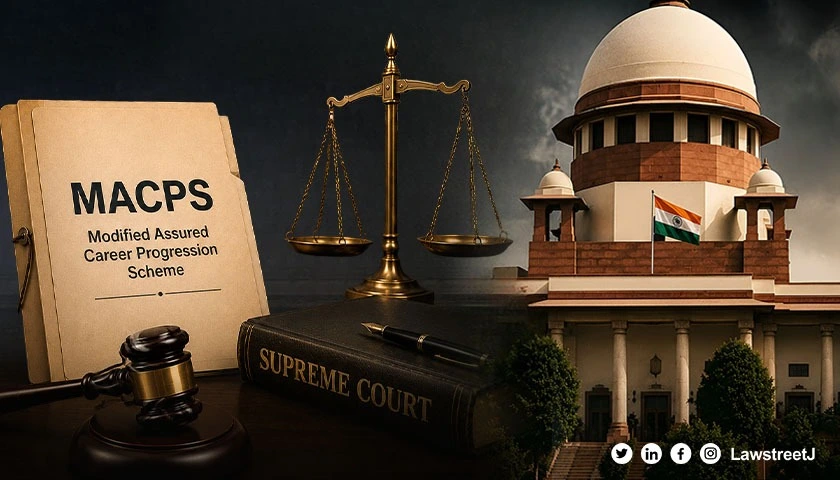
New Delhi: The Supreme Court has held that a functional promotion within a cadre does not lose its character as a promotion merely because it does not carry an increase in Grade Pay, ruling that Railway Guards who have risen through the promotional hierarchy of their cadre must have such promotions counted for the purpose of financial upgradation under the Modified Assured Career Progression Scheme (MACPS).
A Bench of Justices Sanjay Karol and Augustine George Masih was hearing appeals filed by the Union of India against a judgment of the Rajasthan High Court, Jaipur Bench, which had upheld the grant of MACP financial upgradations to Harbans Lal Verma, a retired Mail/Express Guard who had progressed through the Guard cadre Goods Guard, Passenger Guard, and finally Mail/Express Guard over a career spanning more than three decades.
Verma had joined the Railways as a Goods Guard in 1976 and was promoted to Mail/Express Guard, the highest post within the cadre, in 1993, retiring from that post in 2009. After the MACPS came into force, Railway authorities initially extended him the 2nd and 3rd financial upgradations, which were later withdrawn on the strength of Railway Board circular RBE No.76/2011, issued after consultation with the Department of Personnel and Training, holding that promotions within the Guard cadre had to be counted under Paragraph 8 of the Scheme. The Tribunal and the High Court had ruled in Verma’s favour, prompting the Union’s appeal.
The Court noted that although the Sixth Central Pay Commission had compressed several posts within the Guard cadre into a common Grade Pay of Rs.4200, this did not mean the promotions earned within that cadre ceased to be promotions. Rejecting the respondent's contention that such movements could be ignored under the illustration to Paragraph 5 of the MACPS, the Bench held that the defining features of a promotion are the formal selection process, the enhanced responsibilities of the higher post, and its place in a hierarchy specified under the Recruitment Rules not whether the Grade Pay label attached to it changes. The Court clarified that the Paragraph 5 illustration was a transitional provision confined to promotions and upgradations granted under the earlier ACP Scheme before the MACPS came into force, and could not be read to override Paragraph 8’s mandatory counting of promotions earned within the MACPS period itself.
The court observed, “A promotion does not cease to be a promotion merely because the promotee’s Grade Pay does not change.” It held that each movement within the Guard cadre carried a promotional increment and enhanced running-duty and post-specific allowances, resulting in materially higher emoluments at each stage despite the constancy of Grade Pay.
The Court held that Paragraph 8 of the MACPS, which requires promotions within the same Grade Pay to be counted for the purpose of the Scheme, squarely applied to the Guard cadre, and that Railway Board circulars RBE No.76/2011 and RBE No.142/2012, being clarifications issued after consultation with the Department of Personnel and Training, were binding on all authorities in terms of this Court’s earlier ruling in Union of India v. M.V. Mohanan Nair. Relying further on Union of India v. Mukti Singha, the Bench reiterated that an employee cannot be granted a Grade Pay higher than what would be available to him on actual promotion within the cadre's hierarchy. Since the respondent had already earned three counted promotions by the time he reached the terminal post of Mail/Express Guard, he was held to have exhausted his MACP entitlement and was not entitled to further financial upgradation.
The Court also rejected reliance placed by the respondent on the dismissal of an earlier Special Leave Petition raising the same question, holding that the dismissal, having expressly left the question of law open, could not amount to a declaration of law binding on it under Article 141 of the Constitution.
The Court accordingly allowed the appeals, set aside the judgment of the Rajasthan High Court and the orders of the Central Administrative Tribunal granting MACP upgradations to the respondent, and restored the order of the Divisional Railway Manager, Kota, rejecting the claim. No recovery of benefits already disbursed was directed.
Appearances:
For the Appellants: Mr. Vikramjit Banerjee, Additional Solicitor General; Mr. Nachiketa Joshi, Senior Advocate.
For the Respondent: Dr. Sumant Bharadwaj, Advocate.
Case Title: Union of India and Others vs. Harbans Lal Verma, Civil Appeal @ SLP (C) No.35363 of 2025 (with connected appeals)






.jpeg)