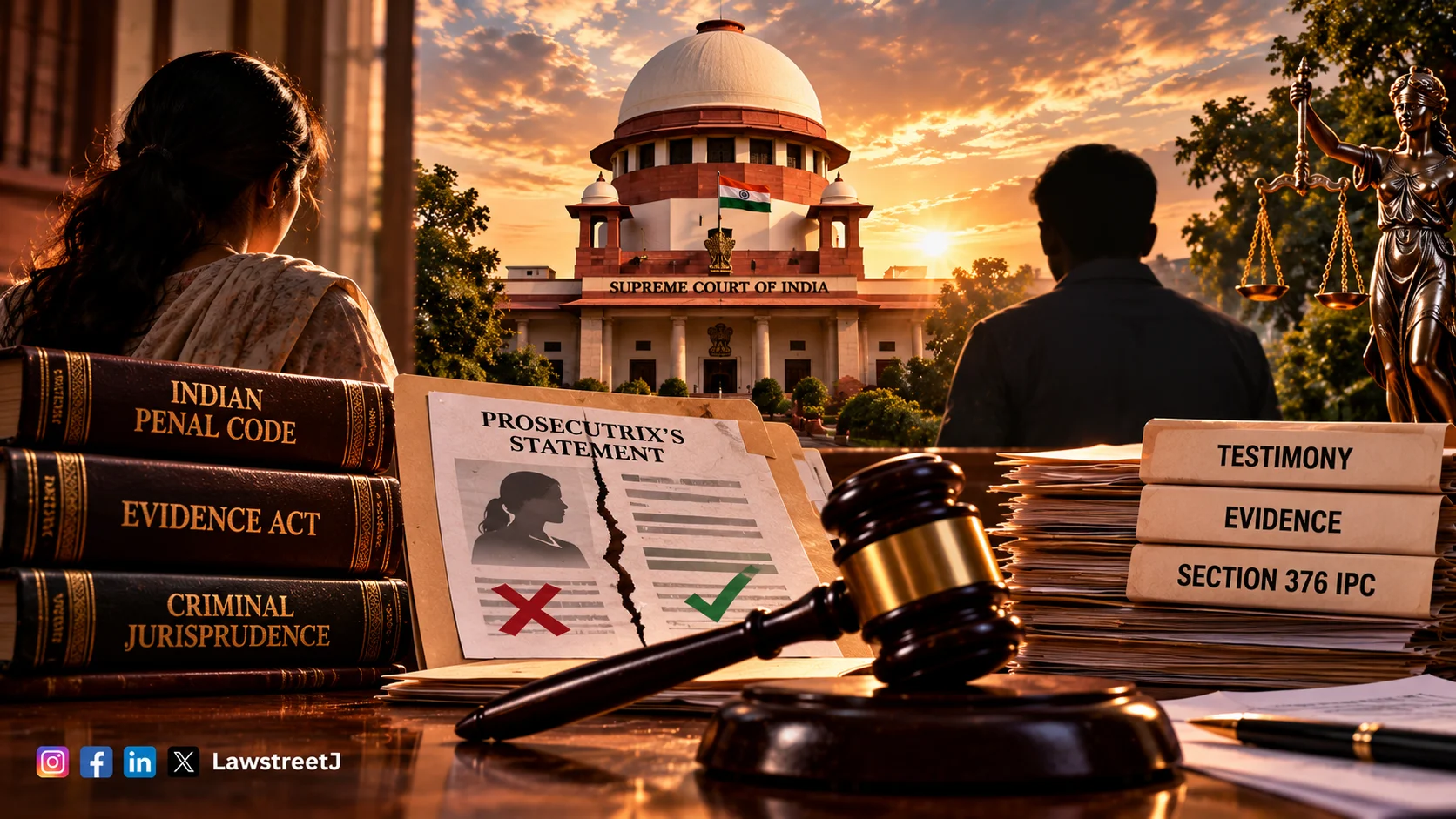
New Delhi: The Supreme Court has set aside the conviction of a man under Section 376 IPC and acquitted him, holding that where a trial court has already disbelieved a prosecutrix's version while acquitting the accused of a kidnapping or abduction charge, the very same version of events cannot then be selectively accepted to sustain a conviction for rape arising out of the identical set of facts.
A bench of Justice Ujjal Bhuyan and Justice Atul S. Chandurkar, was hearing an appeal filed by Paramjit Singh Bedi against the judgment dated 12.09.2013 of the High Court of Punjab and Haryana, which had affirmed the judgment dated 01.06.2012 of the Sessions Judge, Ludhiana convicting the appellant under Section 376 IPC and sentencing him to ten years' rigorous imprisonment.
As per the prosecution's case, the appellant was alleged to have taken the prosecutrix away from near her home in June 2009 on the pretext of introducing her to his daughter, kept her first at a flat in Ludhiana for two days and thereafter at an abandoned factory in Malerkotla, where she alleged she was subjected to intercourse against her will, until she was recovered along with the appellant by her father and the police six days later. On these facts, the Sessions Judge had convicted the appellant under Section 376 IPC, but simultaneously acquitted him of the connected charge of kidnapping or abduction under Section 366 IPC, holding that the prosecutrix, whom the ossification report placed at about 19 years of age, had accompanied the appellant of her own volition, since she had passed through crowded, well-lit streets and intersections on multiple occasions without raising any alarm or attempting to escape.
Learned counsel for the appellant submitted that the same body of evidence could not be disbelieved for the purpose of the kidnapping charge and yet accepted for the purpose of the rape charge, that the prosecutrix's testimony was riddled with material contradictions, including conflicting accounts of the mode of her return journey, and that medical examination had found no external or internal injury on her person. Learned counsel for the State defended the conviction, relying on the presumption under Section 114A of the Evidence Act, 1872 once the prosecutrix denied consent.
Examining the prosecutrix's testimony in detail, the Court found it self-contradictory on material particulars, including her own account of the mode of return journey, and noted that despite repeated opportunities to seek help while passing through busy, well-lit areas, she raised no alarm and made no attempt to disembark or escape. The Court held that the Sessions Judge, having found this very conduct inconsistent with an absence of consent for the purpose of the kidnapping charge, had erred by nonetheless holding, on a value judgment that some women may travel with and even stay with a man without consenting to intercourse, that the rape charge stood proved, an approach the High Court had further compounded by mechanically invoking the statutory presumption of absence of consent.
The Court held: “There cannot be partial rejection of the evidence of the prosecutrix for the purpose of Section 366 IPC and partial acceptance of the very same statement for the purpose of proving the charge under Section 376 IPC.”
Holding that mere presence of spermatozoa in the vaginal swab could not, in the surrounding circumstances, establish the absence of consent, and that a conviction for rape must rest on credible, unimpeachable evidence rather than the presiding judge's surmises or conjecture, the Court held that the prosecution had failed to prove its case beyond reasonable doubt.
Accordingly, the conviction and sentence of the appellant under Section 376 IPC, as affirmed by the High Court, were set aside, the appellant was acquitted, and the appeal was allowed.
Appearances:
For the Appellant: Mr. Rajiv Kataria, Advocate.
For the Respondent-State: Ms. Nupur Kumar, Advocate.
Case Title: Paramjit Singh Bedi vs. State of Punjab, Criminal Appeal No. 203 of 2015