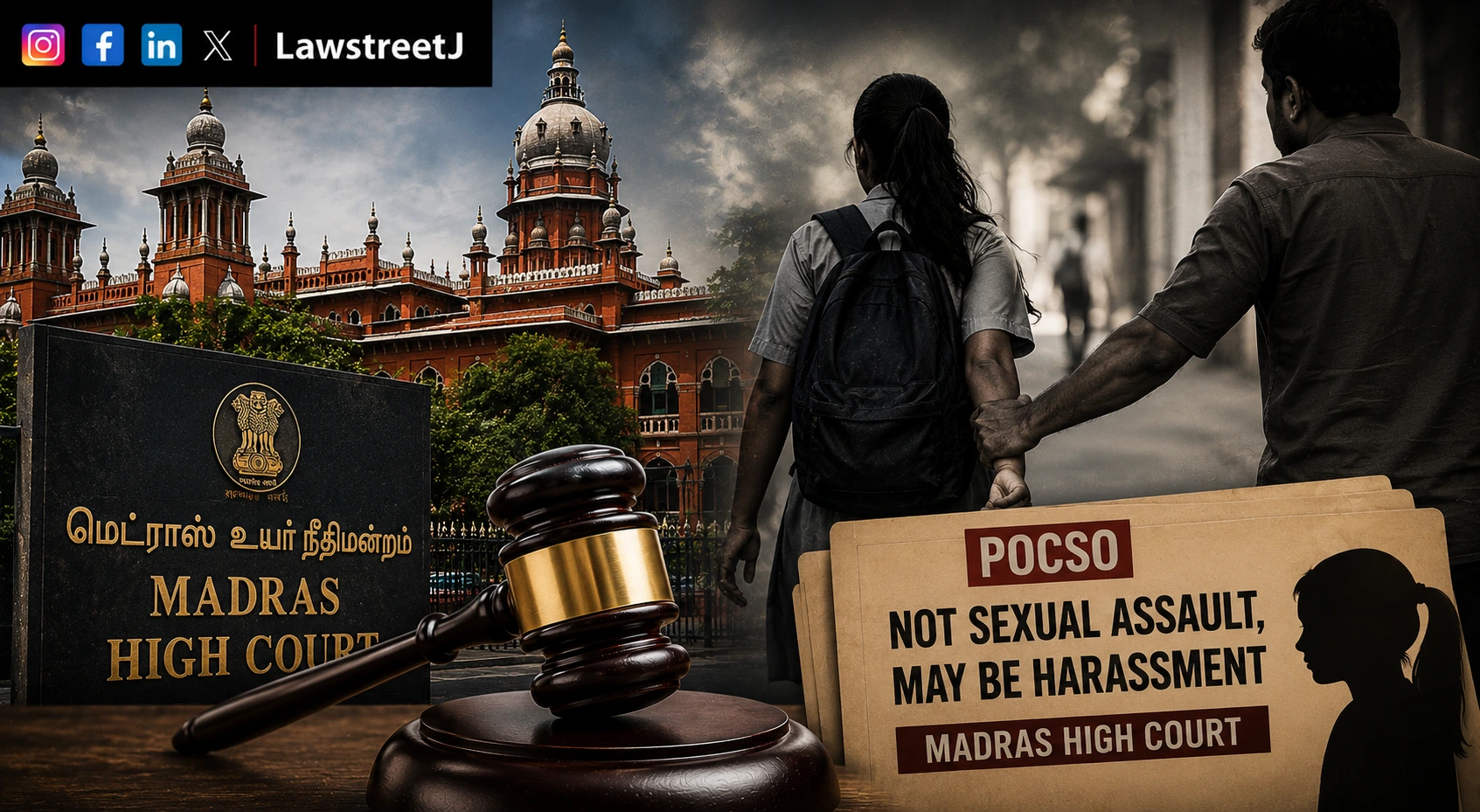
Madurai: The Madras High Court has held that the act of pulling a minor's hand after she ignored a whistle and a call from the accused cannot straightaway be termed as one done with sexual intent, and may at most amount to harassment under Section 11 of the Protection of Children from Sexual Offences Act, 2019 ('POCSO Act'), rather than sexual assault under Section 8 of the Act.
On this finding, the Court suspended the three-year sentence imposed on the convict and granted him bail pending disposal of his criminal appeal.
A Single Bench of Justice M. Nirmal Kumar was hearing a criminal miscellaneous petition filed under Section 430(1) of the BNSS by the petitioner, seeking suspension of the sentence imposed on him by the Sessions Judge, Special Court for the Exclusive Trial of Cases under the POCSO Act, Chennai, in Spl. S.C. No. 115 of 2021, pending disposal of his appeal.
The petitioner had been convicted by the trial Court for the offence under Section 8 of the POCSO Act and sentenced to three years' rigorous imprisonment along with a fine of Rs. 1,000, in default of which he was to undergo three months' simple imprisonment. The prosecution case was that on 01.03.2020, when the minor victim, who resided in the same compound as the petitioner, was passing by, the petitioner, standing in his balcony, whistled and called out to her. When she did not respond, he came down, pulled her by the hand and smiled at her, an act the prosecution alleged was done with sexual intent.
Counsel for the petitioner submitted that the case arose out of a prior altercation between the petitioner and the victim's father, during which blows were exchanged, and that the victim's parents had taken advantage of the child's minority to project a false case against the petitioner. It was submitted that of the four witnesses examined, the victim herself, examined as PW2, had confirmed only that the petitioner had pulled her hand by force and nothing more, and that on these admitted facts, the ingredients of Section 8 of the POCSO Act were not made out, at best amounting to an offence of harassment under Section 11.
It was further submitted that although a conviction of three years or less is ordinarily suspended by the trial Court itself, the petitioner's counsel had failed to appear at the time the judgment was pronounced and had not filed a suspension of sentence petition before the trial Court, as a result of which the petitioner was remanded to custody. He had already undergone 65 days in custody as an undertrial and had been in prison for over 30 days since the judgment dated 06.06.2026.
Opposing the plea, counsel for the State submitted that the victim, in her statement to the police, her statement under Section 164 of the Cr.P.C. and her deposition before the trial Court, had consistently confirmed the petitioner's act, and that the trial Court had rightly convicted him after considering all these aspects. While fairly acknowledging that a three-year sentence is normally suspended by the trial Court itself, the State's counsel submitted that it was unclear why no suspension petition had been filed on the petitioner's behalf.
Such act cannot be straightaway termed as sexual intent and at most, it can be termed as harassment and not an act of sexual assault. Hence, the judgment needs to be re-considered.
On a perusal of the material on record, the Court noted that the victim, examined as PW2, was the sole witness to the occurrence, and that the overt act attributed to the petitioner was limited to whistling, calling out to her, and pulling her by the hand when she did not respond, after which she freed herself and informed her mother. The Court held that this narrow factual matrix, an unanswered whistle followed by a single instance of the accused pulling the victim's hand, did not, without more, support an inference of sexual intent essential to sustain a conviction under Section 8 of the POCSO Act.
At most, the Court observed, the conduct could be characterised as harassment falling under Section 11 of the Act, a materially lesser offence, and found that this distinction raised arguable points warranting reconsideration of the trial Court's judgment at the appellate stage.
Considering the fact that there are arguable points involved in this appeal and it would take some time for the appeal to be taken up for final hearing, this Court is inclined to suspend the sentence imposed on the petitioner.
Accordingly, the Court suspended the substantive sentence of imprisonment till disposal of the appeal and ordered that the petitioner be enlarged on bail, on condition that he execute a bond of Rs. 5,000 with two sureties for a like sum, to the satisfaction of the trial Court. The petitioner was further directed to appear before the trial Court once every three months on the first working day at 10:30 a.m. until disposal of the appeal.
Appearances
For Petitioner(s): Mr. K. Sudhakar, Advocate
For Respondent(s): Mrs. Sharada Vivek, Counsel for Government of Tamil Nadu (Crl. Side)
Case Title: XXX v. The State rep. by the Inspector of Police, W-12, All Women Police Station, Harbour Range, Chennai, Crl. MP No. 11962 of 2026 in Crl. A. No. 830 of 2026



![Madras High Court Directs Tamil Nadu Government to Ensure Quota for Transgenders in Local Body Elections [Read Order]](/secure/uploads/2023/08/lj_2507_7a03d113-08b1-4670-b6fb-9058aee481d0.jpg)