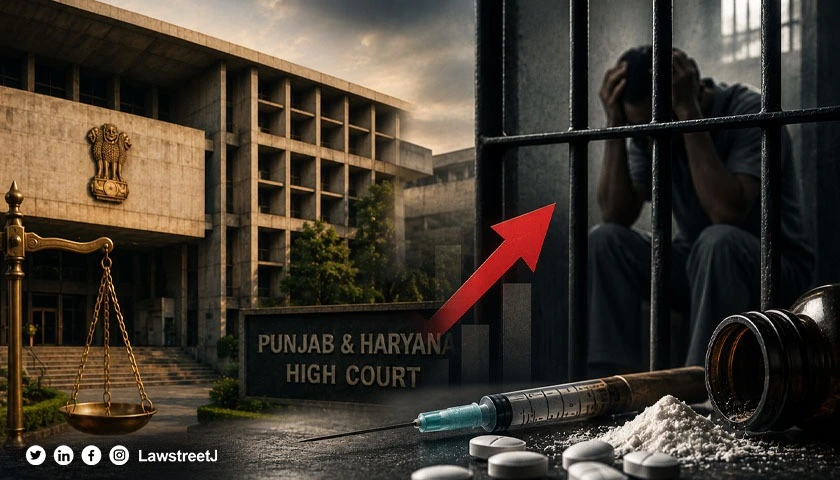
Chandigarh: The Punjab and Haryana High Court, in a suo motu PIL concerning drug dependence among jail inmates, has expressed serious concern over data showing an 83% increase in the number of drug-dependent inmates in Punjab's jails after their entry into custody, and has directed the States of Punjab and Haryana as well as the Union of India to place further affidavits on record clarifying the steps taken to address the issue.
A Division Bench comprising Chief Justice Ashwani Kumar Mishra and Justice Rohit Kapoor was hearing the matter with Ms. Tanu Bedi, Advocate, assisting the Court as Amicus Curiae.
The learned Amicus Curiae pointed out from the affidavit filed by the State of Punjab that, while 2,540 inmates were already registered under the Out Patient Opioid Assisted Treatment (OOAT) Clinic and receiving medication at the time of their entry into jail, the number of inmates presently drug dependent stood at 15,768, reflecting an 83% increase. The Court observed that this indicated not only that a significant number of persons entering jail were already drug dependent, but also that there had been a four-to-five-fold growth in the number of inmates who became drug dependent after their entry into custody, with no indication of any strategy to protect their right to life.
Referring to Rule 29.22 of the Punjab Prison Rules, 2022, which requires implementation of a scientific de-addiction programme for drug addicts to cure them and restore them as useful citizens, the Court directed the State of Punjab to clarify what action had been taken pursuant to the Rule over the nearly four years since its notification.
The Court took on record an affidavit filed by the State of Haryana, which showed that out of a total of 27,111 jail inmates, 1,295 were undergoing treatment for drug dependence, down from an earlier figure of 1,829 — a reduction of 534 following the availability of treatment. The affidavit referred to a Standard Operating Procedure formalized by the State on 23.02.2026 providing for counselling and medical treatment of drug-dependent inmates, but was silent on whether trained counsellors were available in all jails where required. The Court directed the State of Haryana to file a further affidavit clarifying the manner in which the SOP had been implemented.
The Union of India was directed to place on record the methodology suggested for bringing drug-dependent inmates to a state of normalcy. The Court also took on record the appearance and power of attorney filed by counsel for respondent No. 7, PGIMER, and requested the Director, PGIMER, Chandigarh, to ensure that an affidavit outlining a clear medical protocol for such patients was filed by the departmental head, for the guidance of the relevant authorities.
The Court directed that all affidavits filed pursuant to these observations be served on the learned Amicus Curiae before the next date of hearing, and observed that “this is a serious issue,” expecting the authorities to remain alive to their obligations to help such inmates secure their right to life under the Constitution.
The matter has been adjourned to 15.09.2026 and directed to be shown in the Urgent List.
Appearances:
Ms. Tanu Bedi, Advocate (Amicus Curiae) with Mr. Akshat Sharma, Advocate and Mr. Gaurav Mishra, Advocate; Mr. Salil Sabhlok, Senior DAG, Punjab; Mr. Abhinav Sood, Advocate, Ms. Ekakshra Mahajan Mandhar, Advocate, Mr. Nitesh Jhajhria, Advocate and Mr. Arsh Bir, Advocate for respondent-UT, Chandigarh; Mr. Satya Pal Jain, Additional Solicitor General of India with Mr. Prajwal Chauhan, Central Government Counsel for respondents-Union of India; Mr. Deepak Balyan, Addl. AG, Haryana; and Mr. Avinit Avasthi, Advocate for respondent No. 7-PGIMER.
Case Title: Court On Its Own Motion vs. State of Punjab and Others, CWP-PIL-196-2026



![Police protection to fund manager alleging threat from Kirron Kher & aide: Punjab & Haryana HC [Read Order]](/secure/uploads/2023/12/lj_9007_Police_Kirron_Kher.jpg)
![Most interested witness being the father of deceased, SC upholds acquittal of 6 accused for murder [Read Judgment]](/secure/uploads/2023/12/lj_9904_df2c02a2-d8c5-4dd6-8b58-a59e17b8635b.jpg)
![Supreme Court Collegium approves new Chief Justices for five key High Courts in India [Read Recommendations]](/secure/uploads/2023/12/lj_8000_380d1135-6f3a-4988-a00a-4d5cd5901815.jpg)