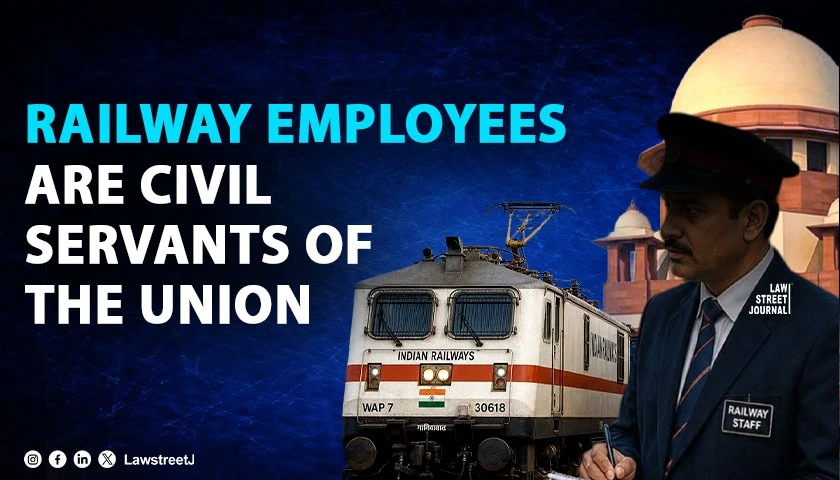
New Delhi: The Supreme Court of India has held that a railway servant does not cease to be a member of the civil service of the Union merely because his conditions of service are regulated by rules specific to the Railways.
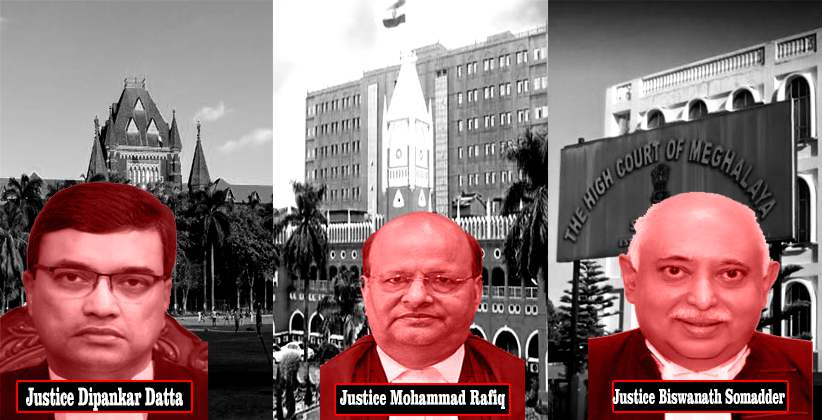
Deciding a batch of appeals filed by a former Junior Draftsman in the Indian Railways who subsequently joined the Kerala State Electricity Board as a Sub-Engineer, a Bench of Justices Dipankar Datta and Satish Chandra Sharma ruled that service rendered in the Indian Railways must be reckoned as Central Government service for the purpose of computing qualifying service and granting weightage in pay fixation.
The appellant had joined the Indian Railways in 1990 and rendered more than ten years of regular pensionable service before being relieved in 2001 to join the Board. Upon his joining, the Railways remitted an amount towards pro-rata pension liability against a demand raised by the Board itself, and this was duly noted in his Service Book with an acknowledgment that his railway service was liable to be reckoned for pension. The Board’s own order of 1996 explicitly provided that regular pensionable Central Government service followed by Board service would be counted for computing qualifying service for weightage, and Long Term Settlements entered into in 2000 and 2007 consistently reiterated this position.
Acting on these provisions, the appellant’s prior railway service was reckoned, and weightage was granted to him for pay fixation and other benefits. However, in 2012, the Chief Internal Auditor of the Board issued a letter objecting to this fixation, cancelling the weightage, and ordering recovery of the alleged excess amount, on the sole ground that railway service could not be reckoned as Central Government service. His representations were rejected, leading him to approach the High Court of Kerala.
A Single Judge allowed his writ petition, following an earlier ruling in favour of another similarly situated employee, holding that service in the Railways is required to be reckoned as Central Government service. The Board challenged both judgments in writ appeals, and a Division Bench reversed the Single Judge’s orders, holding that railway service could not be reckoned for weightage because the Central Civil Services (Conduct) Rules, 1964 and the Central Civil Services (Classification, Control and Appeal) Rules, 1965 do not apply to railway servants, who have their own separate rules. Challenging this reversal, the appellant approached the Supreme Court.
The Board contended before the Supreme Court that the expression “Central Government Service” in its own orders referred only to Central Government Civil Service as understood under the CCS (Conduct) Rules, and that a railway servant, governed by a separate statutory framework under the Railway Services (Conduct) Rules and the Indian Railway Establishment Code, did not fall within the definition of a “Government Servant” under those rules.
It was further argued that railway service may be counted only for pensionary benefits but not for weightage in pay fixation, and that a clarificatory order issued in 1997 by the Chief Personnel Officer had specifically excluded railway service from the scope of the 1996 Board Order.
The Supreme Court examined the constitutional and statutory framework at length and rejected the Board’s position. The Court observed that Article 309 of the Constitution, which empowers the President to make rules regulating recruitment and conditions of service of persons appointed to public services in connection with the affairs of the Union, is the source of both the CCS Rules applicable to general Central Government employees and the Railway Services Rules applicable to railway servants. All these rules flow from the same constitutional provision and are made in the exercise of the same presidential power.
The Court also noted that the CCS Rules themselves, in their proviso, expressly carve out railway servants, and that this carve-out, rather than excluding railway servants from the category of Government servants, actually confirms that they are Government servants; for if they were not, there would have been no need to exclude them.
The Court relied on a seven-Judge Bench decision holding that permanent railway employees enjoy the constitutional protection of Article 311, which applies only to members of the civil services or persons holding civil posts under the Union. Since railway servants are entitled to this protection, it necessarily follows that they hold civil posts under the Union.
The Court also drew upon the Railways Act, 1989, which defines a “railway servant” as a person employed by the Central Government or by a railway administration in connection with the service of a railway, as well as the jurisdiction of the Central Administrative Tribunal over railway servants, which further fortifies their status as Central Government employees.
The Railway Board itself, the Court held, functions as the Government of India for railway administration, and that service under the Railway Board is, in the broader sense, service under the Central Government.
On the second question, the Court held that the Board was estopped from unilaterally withdrawing the weightage benefit. Having accepted the pro-rata pension contribution from the Railways, having issued its own Board Order treating Central Government service as qualifying for weightage, and having acted on that position for years, the Board could not resile from its solemn commitments. The Court expressed surprise that benefits once extended to the appellant under the Board’s own orders were sought to be withdrawn on the basis of a subsequent internal note and a purported order, and found that the Division Bench had erred in upholding such withdrawal on a misconception regarding the inapplicability of the CCS Rules to railway servants.
Setting aside the Division Bench’s orders and restoring the Single Judge’s judgment, the Supreme Court directed that the appellant be entitled to all benefits flowing from the Single Judge’s order within three months of production of an authenticated copy of the judgment, and that no benefit accrued in his favour be withdrawn.
The Court also observed that the other employee whose writ petition had similarly been allowed by the Single Judge but whose appeal was decided adversely may approach the Board for grant of similar relief, and expressed the hope that the Board would not subject him to any discrimination.
Case Title: Bency John v. Kerala State Electricity Board Ltd. & Ors., Civil Appeal Nos. __ of 2026 [arising out of SLP (C) Nos. 1377–1380 of 2021]