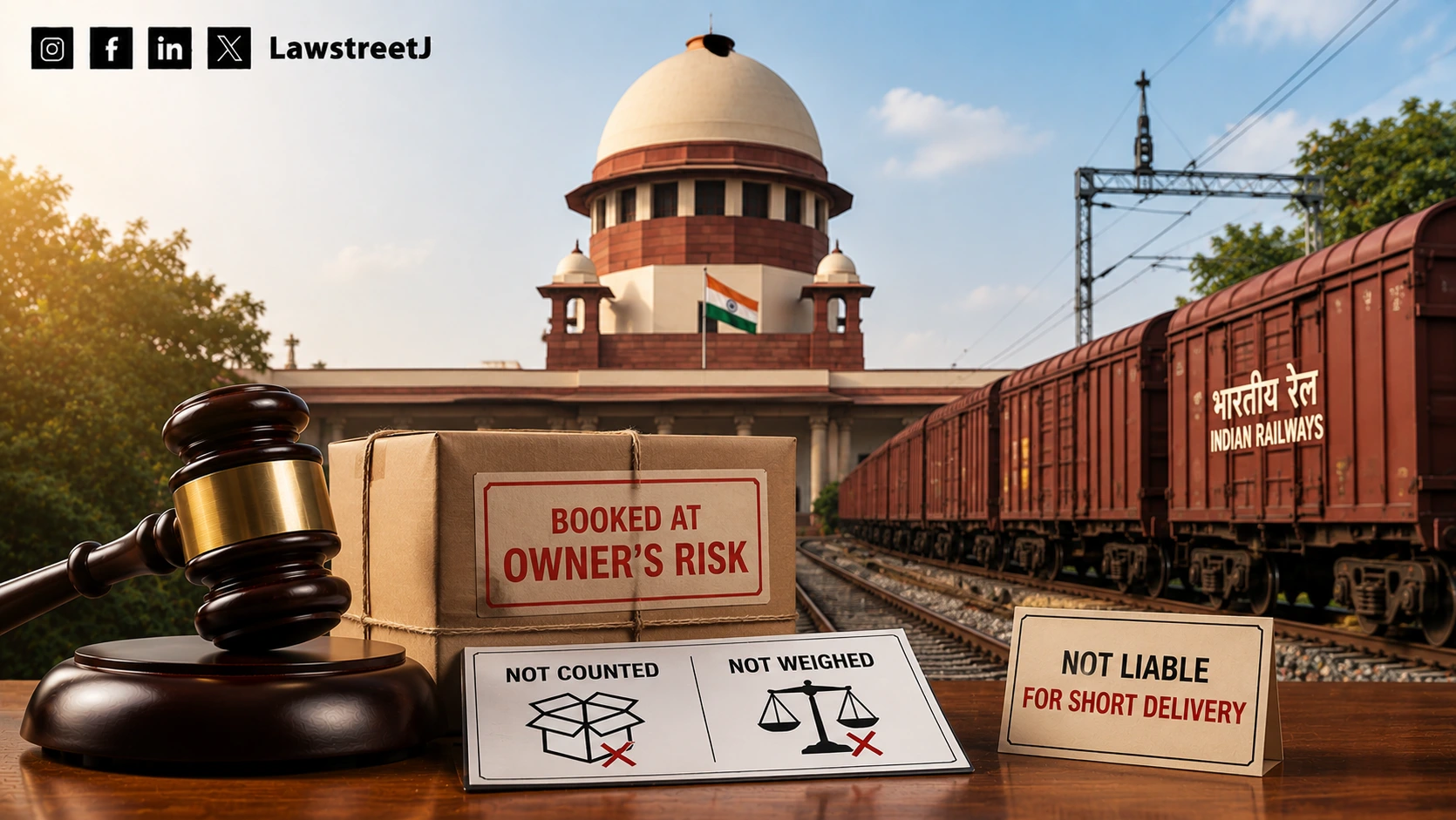
New Delhi: The Supreme Court has held that railway authorities cannot be held liable for short delivery of goods booked under the 'owner's risk' rate unless negligence or misconduct on the part of the Railways or its employees is established, holding that the non obstante clause in Section 97 of the Railways Act, 1989 excludes the general responsibility otherwise cast on the Railways under Section 93 of the Act.
A Bench of Justices Sanjay Karol and Vipul M. Pancholi dismissed an appeal filed by M/S Bajaj Trading Company against concurrent findings of the Railway Claims Tribunal, Guwahati Bench, and the Gauhati High Court, both of which had rejected the appellant's claim for compensation over a shortage in a consignment of salt.
The appellant had entrusted 40,444 bags of salt for carriage from Chirai Junction, Gujarat, to Dharmanagar, Assam, on 10th November 2009. On reaching the destination, only 38,702 bags were delivered, resulting in a shortage of 1,742 bags. The Railway Authorities themselves issued a shortage certificate, following which the appellant lodged a claim for Rs.3,48,400 at the rate of Rs.200 per bag.
The Railway Claims Tribunal rejected the claim, relying on transshipment tallies which recorded discrepancies in the wagons used for the consignment and concluding that short delivery could not be established. A statutory appeal before the Gauhati High Court also failed, the Court noting that the goods had been loaded directly from truck to wagon by the consignor's own employees without railway supervision, that the sender's weight had been accepted, that packing conditions were non-compliant, and that the railway receipt carried a 'said to contain' remark.
Before the Supreme Court, the appellant argued that even where booking is at owner's risk, the general obligation under Section 93 of the 1989 Act could not be displaced; that loading ought to have been supervised by a Goods Clerk under Rule 1512 of the Indian Railway Commercial Manual; that a 'said to contain' endorsement is meant only for goods loaded at a private siding and not at a railway siding; and that Section 97 itself fastens liability on the Railways where negligence is shown. The Union of India, represented by the learned Additional Solicitor General, countered that the shortage certificate was not an admission of liability, that the proviso to Section 65(2) of the Act placed the burden of proving the quantity of goods on the consignor where the same had not been checked by a railway servant, and that neither Section 93 nor Section 97 assisted the appellant on the facts.
Examining the statutory scheme, the Court explained that while Section 93 casts a general responsibility on the Railways for loss or non-delivery of consignments in transit, Section 97 carves out a distinct regime for goods carried at owner's risk, absolving the Railways of liability except where negligence or misconduct is proved. Tracing the effect of the non obstante clause through precedent, including Mohd. Abdul Samad v. State of Telangana, A.G. Varadarajulu v. State of T.N., and Chandavarkar Sita Ratna Rao v. Ashalata S. Guram, the Court held:
“the non obstante clause contained in Section 97 would exclude the general obligations cast on the Railway by Section 93. Since, in the present case the goods were booked at 'owner's risk', if liability is to be fastened on the authorities, it can only be done if negligence or misconduct on its part or its employees.”
Turning to the question of negligence, the Court surveyed dictionary and judicial definitions of the term, including from Poonam Verma v. Ashwin Patel and Rajkot Municipal Corpn. v. Manjulben Jayantilal Nakum, before holding that liability could be fastened on the Railways only if a duty of care towards the goods was first shown to exist. The Court observed that such a duty would arise only if the Railways had, at some stage, been actively involved in counting or weighing the consignment, which was not the case here in view of the 'said to contain' endorsement permitted under Rule 1811 of the Indian Railway Code for Traffic (Commercial) Department. The Court held:
“For it to be established that the Railway authorities were negligent, it has to be shown that they had a duty of care. Had they, at any stage been involved in the noting, counting or weighing of goods, thereby being actively aware of the amount being transported by them, then, it could be said that they had duty to ensure that the total amount that they have counted or weighed, was the amount they ought to safely transit to the end destination. This was not the case.”
Applying the proviso to Section 65(2), the Court further noted that once the number of packages had not been verified by railway staff at the time of booking, the burden shifted to the consignor to prove the quantity actually entrusted for carriage. The Court found this burden had not been discharged, since the appellant had produced no material to show that a specific number of bags had been procured, processed, and readied for despatch before the consignment was handed over to the Railways. In the absence of such proof, the Court held, the question of negligence or misconduct on the part of the Railways did not arise, and the appeal accordingly failed.
Appearances: Mr. Gunjan Kumar, Advocate-on-Record, appeared for the appellant. Ms. Archana Pathak Dave, Additional Solicitor General, appeared for the respondent-Union of India.
Case Title: M/S Bajaj Trading Company v. Union of India | (arising out of SLP(C) No.22748 of 2025) | 2026 INSC 711