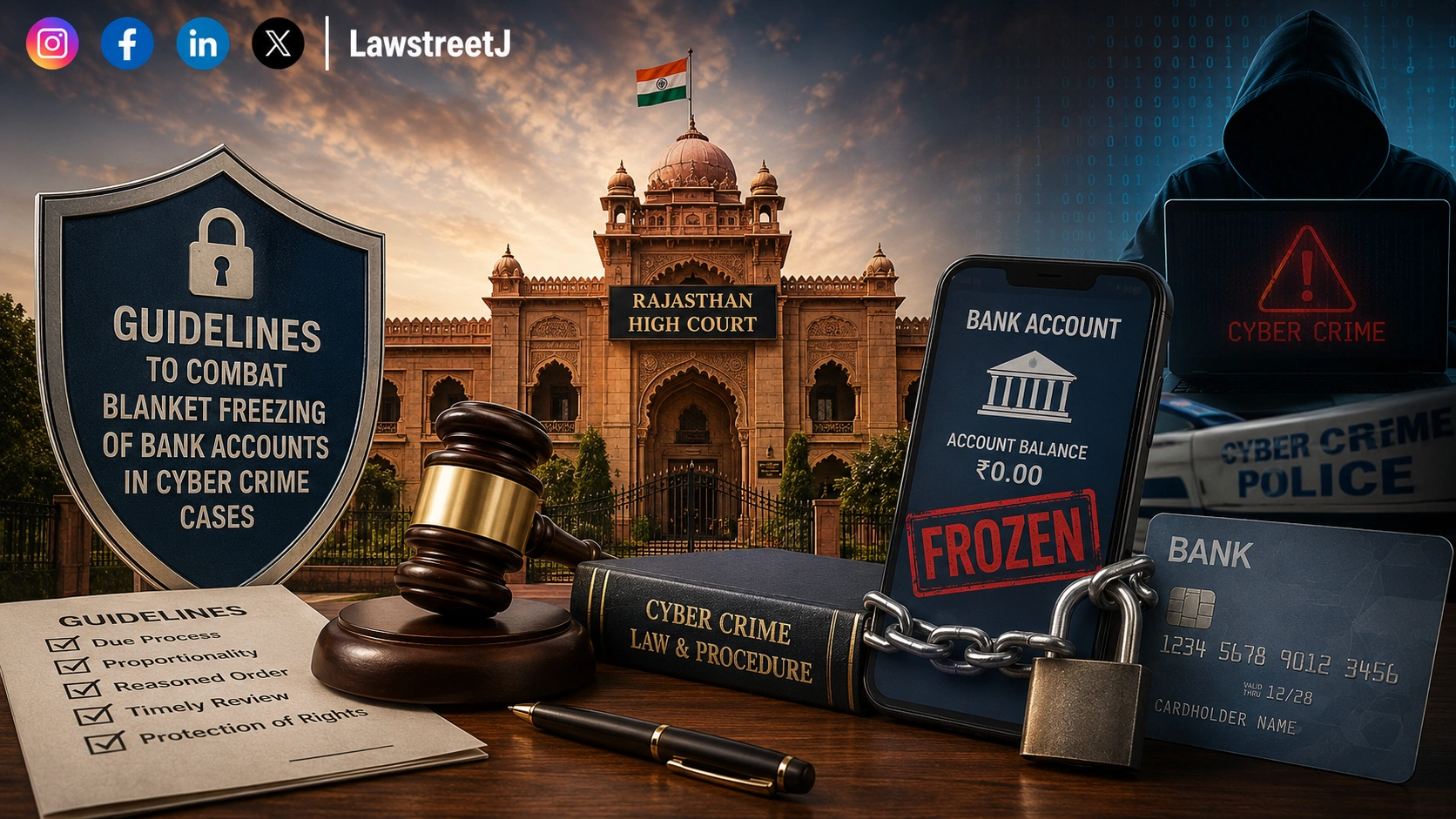
Jaipur: The Rajasthan High Court has laid down a detailed set of guidelines to check arbitrary and disproportionate freezing of bank accounts by investigating agencies in cyber financial fraud cases, holding that an indefinite blanket freeze cannot be imposed merely on suspicion and that, wherever the disputed amount is identifiable, the ordinary course must be to secure that amount through a lien rather than immobilise the entire account.
Justice Anand Sharma was disposing of a batch of one hundred and five writ petitions filed by individuals, firms and companies whose bank accounts had been frozen, debit-frozen or placed under lien on communications from investigating agencies probing alleged cyber financial frauds. In several matters the disputed transaction was as small as a few hundred rupees, yet accounts holding substantially larger balances had been rendered completely inoperative. In some cases the disputed amount had not even been crystallised, while in others the petitioners had already been exonerated, yet the restraint continued.
Counsel for the petitioners argued that a bank account today is not merely a repository of money but the principal instrument through which salaries and business receipts are received and livelihoods sustained, and that mere existence of a suspected transaction could not justify depriving an account holder of his entire lawful balance. The State and investigating agencies opposed the petitions, contending that cyber fraud proceeds move rapidly through several layers before disappearing from the financial system, making immediate freezing an essential investigative measure, while banks submitted that they acted on lawful police instructions besides their own KYC and anti-money-laundering obligations.
Examining the statutory framework, the Court noted that Section 106 of the Bharatiya Nagarik Suraksha Sanhita, 2023, empowers seizure of suspect property but mandates that the seizure be forthwith reported to the jurisdictional Magistrate, while Section 107 separately provides for attachment of proceeds of crime through a judicially supervised process involving notice and hearing. It held that an investigating agency cannot achieve, by merely labelling its communication a "freeze", "lien" or "seizure", a result that in substance amounts to indefinite attachment of a citizen's property without following the procedure prescribed by law.
Relying on the Delhi High Court's ruling in Neelkanth Pharma Logistics Pvt. Ltd. v. Union of India, where an account with a large balance had been frozen over a credit of merely Rs.200, and on its own earlier decision in Jinat Bano v. State Bank of India, the Court applied the doctrine of proportionality to hold that protection of cyber fraud victims cannot automatically translate into punishment of an account holder who has not been found guilty, particularly where the funds bear no demonstrated connection with the alleged offence.
The Court observed that a mere expression such as "suspicious transaction" or "mule account" cannot by itself justify indefinitely immobilising an entire account, and that continuing a restraint without periodic review "amounts to imposing punishment without trial."
The judgment lays down that four requirements must ordinarily govern such restraints: lawful authority for the action; tangible material disclosing a prima facie nexus between the account and the offence; identification, so far as practicable, of the specific transaction and amount requiring protection; and proportionality, which cannot continue mechanically once the investigative necessity ceases. A blanket freeze may still be justified in exceptional situations, such as a deliberately operated mule account or a named accused with material showing conscious participation, provided reasons for the wider restraint are recorded in writing and periodically reviewed.
The Court further directed that every police communication to a bank must identify the Investigating Officer, the FIR or CFCFRMS reference, the legal provision invoked, and the transaction and disputed amount involved. Where an investigation concludes or an account holder is exonerated, the restraint must be withdrawn forthwith without requiring the citizen to approach multiple authorities, and banks were directed not to mechanically convert a transaction-specific alert into a blanket freeze.
Emphasising that firm safeguards would strengthen rather than weaken the fight against cyber fraud, the Court held that "the fight against cyber-crime will be strengthened, rather than weakened," when investigating agencies distinguish between a genuine mule account and an innocent account into which an isolated transaction has incidentally travelled.
The Director General of Police, Rajasthan, was directed to issue a General Circular within four weeks incorporating the principles laid down, to designate a senior officer to monitor complaints of prolonged or disproportionate account freezes, and, along with the Reserve Bank of India, to file a compliance report before the Registrar General within eight weeks. The Reserve Bank of India was separately directed to issue an advisory to all scheduled banks requiring periodic training of officials handling cyber fraud complaints, account freezing and grievance redressal under the Standard Operating Procedure issued by the Indian Cybercrime Coordination Centre.
Disposing of all the writ petitions with these general directions, the Court directed the concerned banks and Investigating Officers to review the restraints imposed on the petitioners' accounts in light of the principles laid down and confine the freeze, wherever possible, to the identifiable disputed amount, permitting the remaining balance to be operated in the ordinary course.
Appearances:
For the Petitioners: Mr. Ankur Jain and other Advocates.
For the Respondents: Ms. Devakriti Vashishtha, Additional Government Counsel, and other Advocates.
Case Title: Shree Balaji Enterprises & Ors. vs. Reserve Bank of India & Ors., S.B. Civil Writ Petition No. 2679/2026 with connected matters


![Collegium Recommends Chief Justices of Delhi, Rajasthan, and Gauhati High Courts for Elevation to Supreme Court [Read Order]](/secure/uploads/2023/11/lj_9736_933a94de-bdaf-43de-944b-b0e58e17edb5.jpg)
![Rajasthan HC directs police to consider protection for couple in live-in relationship outside marriage [Read Order]](/secure/uploads/2024/08/lj_9448_Live-In_relation_protection.webp)
!['Tears have to be understood for what they are worth,' SC sets aside HC's judgment in child sexual assault case [Read Judgment]](/secure/uploads/2025/03/lj_9096_Tears_have_to_be_understood_for.webp)