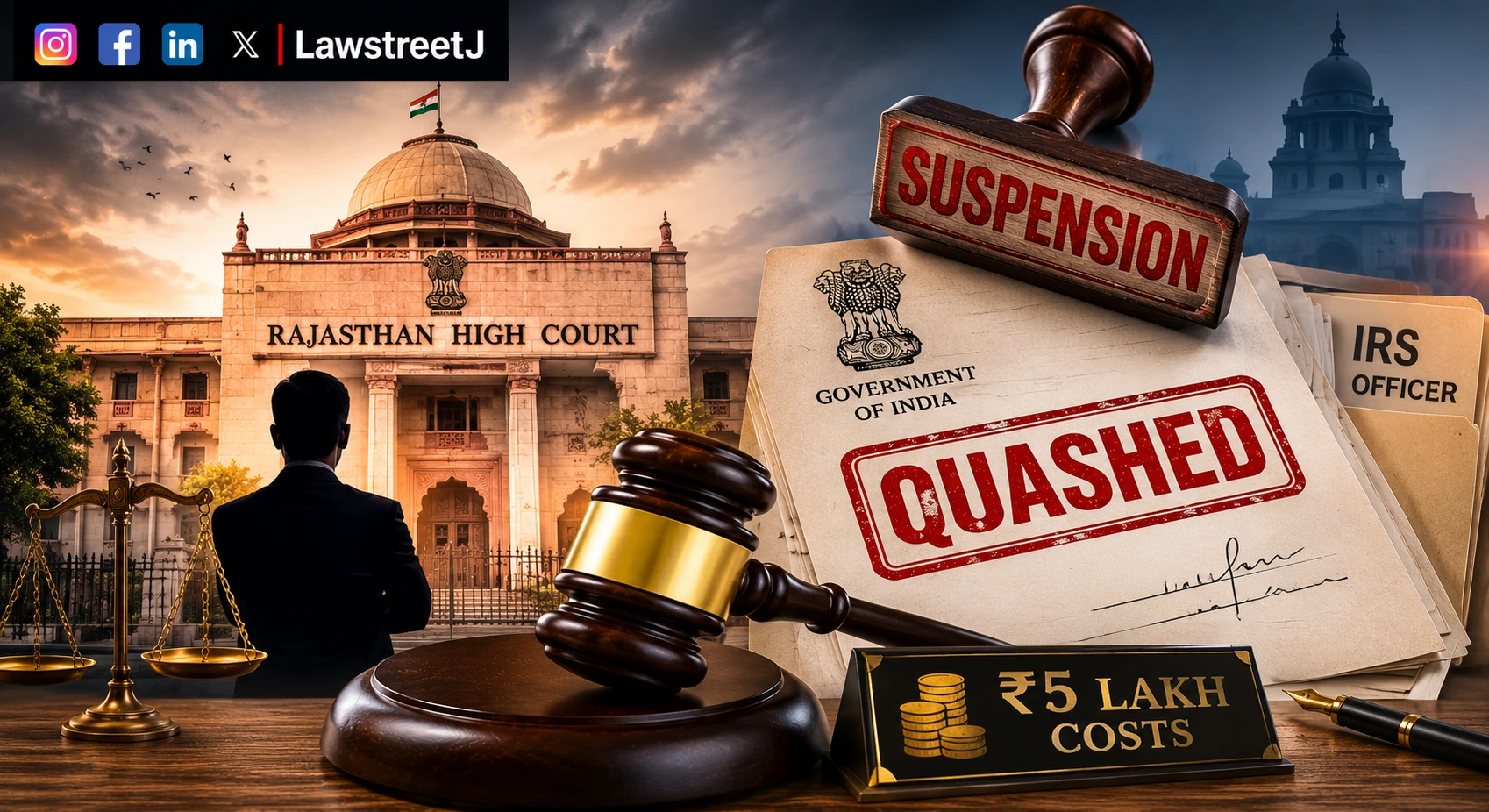
Jodhpur: The Rajasthan High Court, Jodhpur Bench, has set aside two orders extending the suspension of an Indian Revenue Service (Customs and GST) officer, holding that the extensions were arbitrary, unreasonable, and suffered from mala fides in law, and reflected 'personal vendetta' on the part of certain high-ranking officials rather than any genuine service requirement.
A Division Bench of Justices Munnuri Laxman and Anuroop Singhi was hearing a writ petition filed by Manmeet Singh Ahluwalia, a 2012-batch IRS officer, challenging an order of the Central Administrative Tribunal, Jodhpur Bench, which had rejected his prayers for quashing the suspension-extension orders, for promotion pursuant to a Departmental Promotion Committee (DPC) meeting, and for consequential financial and promotional benefits.
The dispute traced back to an incident on the night of 3rd/4th September 2019 at the petitioner's government-allotted residence at Vatika Apartments, Mayapuri, New Delhi, where his mother and widowed sister were alleged to have misbehaved with an Under Secretary of the GST Council and an Assistant Commissioner. A departmental enquiry committee found the petitioner's family members, not the petitioner himself, responsible for the misconduct. This was followed by further complaints from other residents of the government colony, an eviction notice, and the petitioner's transfer from Delhi to Jodhpur.
The petitioner was placed under suspension on 04.05.2021, which was extended twice by orders dated 16.07.2021 and 13.01.2022 before lapsing without further extension after 28.07.2022. A charge-sheet was eventually issued only on 18.08.2022, well after the DPC meeting of 23.03.2022 at which his juniors were promoted while his own case was kept in a sealed cover on account of the pending suspension.
The petitioner, appearing in person, contended that no charge-sheet had been issued within 90 days of suspension as mandated by the Supreme Court in Ajay Kumar Choudhary v. Union of India, AIR 2015 SC 2389, and by the DoPT Office Memorandum dated 23.08.2016, and that the extensions were resorted to only to keep his promotion sealed and deprive him of career advancement. The respondents, represented by counsel, argued that the Tribunal had rightly declined interference since the suspension already stood revoked, and relied on the Delhi High Court's ruling in Vikash Kumar v. Union of India to submit that non-issuance of a charge-sheet within 90 days does not automatically invalidate a suspension order.
The Bench clarified that it was not deciding the consequence of a delayed charge-sheet, but examining whether the power to extend suspension had been exercised arbitrarily. Reviewing the record, the Court noted that the principal charge concerned a purely domestic dispute between the petitioner's family and fellow residents of the government colony, unconnected with his official duties, while the only other charge unauthorised absence during the COVID-19 pandemic pertained to leave taken before formal sanction, a circumstance the Court found could not 'by itself, be regarded as grave or serious' given the pandemic conditions.
The manner in which these allegations were brought forth prima facie demonstrates personal vendetta on the part of certain high-ranking officials against the petitioner. Even assuming that such allegations are ultimately proved, they would not ordinarily warrant the extreme penalty of removal or dismissal from service... The manner in which petitioner's suspension is dealt with, it is clear abuse of power and process, unjustified action, excessive and arbitrary exercise of administrative power and also suffer from malice in law.
Applying the principle from Union of India v. K.V. Jankiraman, AIR 1991 (4) SCC 109, the Court observed that had the second extension not been granted, the petitioner would have been promoted alongside his juniors, since no departmental proceedings were pending against him as on the date of the DPC. The extensions, the Bench held, effectively converted the suspension into a punitive measure and caused 'destruction of his bright service carrier', despite the petitioner having an otherwise unblemished seven-year career prior to the incident.
On the question of compensation, the Bench invoked the Supreme Court's exposition in Lucknow Development Authority v. M.K. Gupta, (1994) 1 SCC 243, on exemplary damages for abuse of power by public authorities:
A public functionary if he acts maliciously or oppressively and the exercise of power results in harassment and agony then it is not an exercise of power but its abuse. No law provides protection against it. He who is responsible for it must suffer it.
Holding that the Tribunal's finding was 'perverse' for having failed to examine the legality of the extension orders despite their direct bearing on the petitioner's right to be considered for promotion, the Court allowed the writ petition in its entirety.
Accordingly, the Court set aside the Tribunal's order dated 16.04.2025 as well as the extension orders dated 16.07.2021 and 13.01.2022, directed that the petitioner be treated as reinstated from the expiry of the original 90-day suspension period with full salary for the extended period, and directed the respondents to open the sealed cover and grant him notional promotion with all consequential benefits from the date his juniors were promoted, within two months.
The Court further directed Respondents No. 1 and 2 to pay Rs 5,00,000 as exemplary costs to the petitioner within three months.
Appearances
For Petitioner(s): Mr. Manmeet Singh Ahluwalia (Present-in-person)
For Respondent(s): Mr. Rajvendra Saraswat, Advocate, with Mr. Jitesh Kumar Suthar, Advocate, and Mr. Rishab Dadhich, Advocate
Case Title : Manmeet Singh Ahluwalia v. Union of India & Ors., D.B. Civil Writ Petition No. 11000/2025


![Collegium Recommends Chief Justices of Delhi, Rajasthan, and Gauhati High Courts for Elevation to Supreme Court [Read Order]](/secure/uploads/2023/11/lj_9736_933a94de-bdaf-43de-944b-b0e58e17edb5.jpg)
![Rajasthan HC directs police to consider protection for couple in live-in relationship outside marriage [Read Order]](/secure/uploads/2024/08/lj_9448_Live-In_relation_protection.webp)
!['Tears have to be understood for what they are worth,' SC sets aside HC's judgment in child sexual assault case [Read Judgment]](/secure/uploads/2025/03/lj_9096_Tears_have_to_be_understood_for.webp)