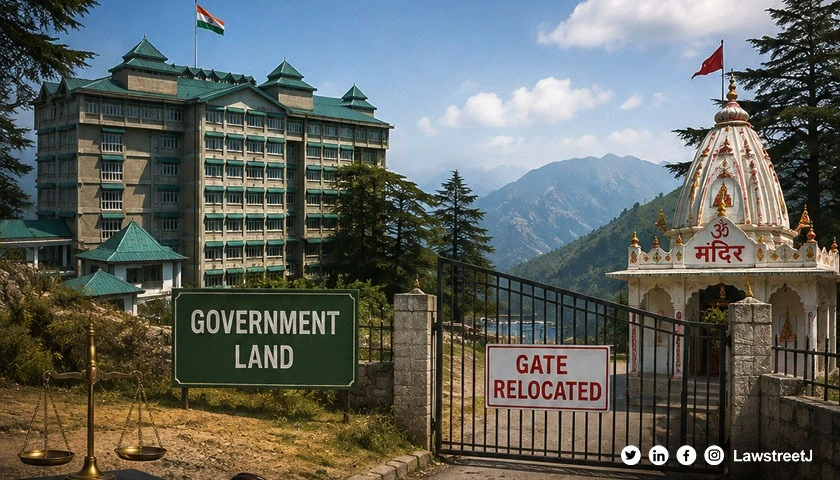
Shimla: The High Court of Himachal Pradesh has held that a gate unauthorisedly erected on government land, obstructing a villager's access to his property, cannot be allowed to remain merely on the ground that it also serves the purpose of protecting a nearby temple, observing that religious sentiment cannot be used as a tool to subvert the legal process.
A Single Bench of Justice Jyotsna Rewal Dua was hearing a writ petition filed by Sunil Kumar, a resident of Village and Post Office Mandhala, Tehsil Baddi, District Solan, against the Baddi Barotiwala Nalagarh Development Authority (BBNDA) and Amar Nath, the private respondent who had installed the gate.
The petitioner's case was that his land in Village Mandhala is adjacent to government land which also leads to a Shiv Temple situated in the village. Respondent No.2 had installed an iron gate at a distance of about 300 metres from the temple, on a path constructed by the BBNDA over government land, thereby obstructing the petitioner's access to his property. On the petitioner's representation, the Assistant Town Planner, BBNDA, issued a show cause notice on 09.03.2023 under Section 38 of the Himachal Pradesh Town & Country Planning Act, 1977, followed by a notice dated 22.03.2023 under Section 39(1) of the Act directing removal of the gate.
Acting on the complaint, the Chief Executive Officer of BBNDA, on 16.06.2023, in exercise of powers under Section 39(1)(6)(b) of the Act, ordered removal of the gate from its existing location, with a direction to erect it instead at a convenient site near the temple for the temple's protection. The petitioner's grievance was that this order, which redressed his difficulty, was subsequently withdrawn by BBNDA on 10.08.2023, prompting him to approach the High Court.
During the pendency of the petition, the Court, by order dated 06.08.2025, had observed that it would be in the interest of all concerned to have the dispute amicably resolved, failing which the Court would be bound to decide the matter strictly in accordance with law. The Court had also cautioned that no one should be permitted to take the law into their own hands on the pretext of hurting religious sentiments.
Religion cannot be allowed to be used as a tool to subvert the legal process.
Subsequently, on 14.10.2025, a Resolution Committee was constituted by the Court, headed by the Deputy Commissioner, Solan, with the Superintendent of Police, Baddi, the Chief Executive Officer of BBNDA and the Sub Divisional Magistrate, Baddi, as members, to inspect the site and attempt an amicable resolution involving the petitioner and other interested parties.
The Committee's report dated 11.12.2025, and a separate compliance affidavit filed by the Deputy Commissioner, Solan, both recommended that the gate structure be allowed to remain in place, with its shutters either removed or permanently fixed in an open position to keep the passage open for vehicular traffic. A site map placed on record confirmed that the path in question ran over government land.
The Court, however, was not persuaded that leaving the gate in place, even with open shutters, adequately protected the petitioner's rights. It noted that the petitioner's property lay closer to the gate than the temple itself, which was about 300 metres away, and that the genuineness of his difficulty in accessing his land was not disputed on record.
Due credence is required to be given to the concern raised by learned Senior Counsel for the petitioner that in case the gate is allowed to be remain as it is, its closure in future in turn causing harassment to the petitioner, cannot be ruled out. It is also an admitted position that the gate has been installed unauthorizedly over the Government land. If there is any need of gate, it should be positioned in the vicinity of temple area, rather than on public land far away where it infringes upon rights of others.
Holding that the original order dated 16.06.2023 passed by the Chief Executive Officer, BBNDA, directing relocation of the gate to the vicinity of the temple, was 'just and in accordance with law', the Court found that its withdrawal could not be sustained. Erection of the gate 300 metres away from the temple, the Court held, served no purpose beyond creating a direct hindrance and unlawfully obstructing the petitioner's right of unhindered access to his property.
Disposing of the writ petition, the Court directed that the shutters of the gate at its current location be forthwith and permanently removed, and that if the gate is considered necessary at all, it be installed no more than 50 to 75 metres away from the temple, after obtaining all requisite sanctions and approvals in accordance with law. Respondent No.1, the Sub Divisional Magistrate, Baddi, was directed to ensure compliance, with the office of the Advocate General directed to apprise the concerned authority of the order.
Appearances
For Petitioner(s): Mr. Ashwani Sharma, Senior Advocate, with Mr. Ishan Sharma, Advocate
For Respondents: Mr. Anup Rattan, Advocate General, with Ms. Seema Sharma, Deputy Advocate General, for Respondent No.1; Respondent No.2 ex-parte
Case Title : Sunil Kumar v. Baddi Barotiwala Nalagarh Development Authority and Anr., CWP No. 9804 of 2023


![Himachal HC Grants Bail to Man Accused of Unnatural Acts with Cow [READ ORDER]](/secure/uploads/2020/11/lj_8855_Himachal_Pradesh_High_Court.jpeg)
![Remaining in India after expiry of visa is offence, Himachal Pradesh HC reiterates while denying bail [Read Petition]](/secure/uploads/2023/12/lj_3841_e40384f4-2611-4a51-b179-97824c5e53c7.jpg)

![Supreme Court Stays Himachal Pradesh HC Order, Sanjay Kundu to Remain as State DGP Amid Businessman's Complaint [Read Order]](/secure/uploads/2024/01/lj_5499_5a926c6d-aa3b-4344-b54d-2c7fc5145ace.jpg)