A bench of Justices Amit Mahajan and Anil Kshetarpal holds that eligibility must be assessed as on the last date of application, that members of a disciplinary force cannot plead ignorance of revised MHA medical guidelines, and that post-examination tattoo removal cannot remedy the disqualification incurred at the time of the LDCE-2023.
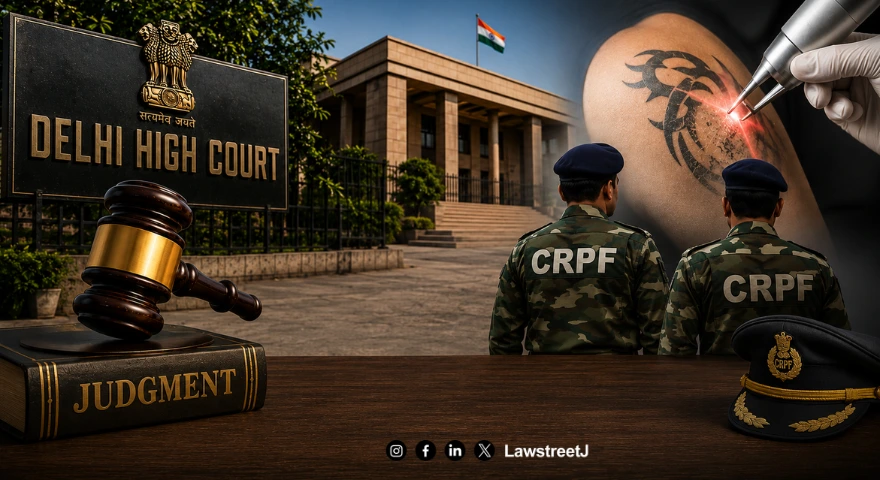
The Delhi High Court has denied relief to two CRPF officers who were declared unfit for promotion to the post of Assistant Commandant (General Duty) through the Limited Departmental Competitive Examination (LDCE) 2023 in the Central Armed Police Forces (CAPFs), on account of having a tattoo on the right forearm, the saluting arm. The High Court held that the subsequent removal of the tattoos did not cure the ineligibility that had already attached at the time of the examination and could not be remedied through judicial review by granting an additional opportunity.
A Bench of Justices Amit Mahajan and Anil Kshetarpal passed the judgment on July 1, 2026 in the petition filed by the two officers, Ankit Mann and Pradhan Chaudhary, both of whom underwent surgery to have the tattoos removed immediately after being found unfit at the review medical examination.
Background
The two petitioners appeared for a detailed medical examination as part of LDCE-2023 for selection to the post of Assistant Commandant (GD) in the CAPFs. Both were found unfit owing to the presence of a tattoo on their right forearm. The right forearm is the saluting arm and is specifically excluded from the list of permissible tattoo sites under the revised Medical Guidelines issued by the Ministry of Home Affairs (MHA) for recruitment of Gazetted Officers and Non-Gazetted Officers in the CAPFs and Assam Rifles.
The Union of India informed the Court that the rejection of the petitioners’ candidatures was in accordance with the revised MHA guidelines, which permit tattoos only on traditional sites of the body such as the inner aspect of the forearm, but only the left forearm, being the non-saluting limb, or the dorsum of the hands, and only if the size of the tattoo is less than one-fourth of the particular part of the body (elbow or hand) concerned.
Following their medical disqualification, the petitioners underwent surgery and got their tattoos removed. Before the High Court, they argued that they had remained in unhindered service throughout and that the subsequent removal of the tattoos ought to be taken into account in their favour.
The Court’s Reasoning
The High Court rejected the petitioners’ case at both levels. First, it held that the existence of the tattoos on the prohibited site was not disputed, and that the petitioners were therefore ineligible to be considered for promotion as Assistant Commandant through the LDCE at the relevant time.
“The existence of tattoos which are not permissible as per the revised guidelines is not disputed by the Petitioners. Thus, the Petitioners were ineligible to be considered for promotion as Assistant Commandant through LDCE.” - Delhi High Court
Second, the Court held that under the applicable framework, eligibility is required to be examined as on the last date for submitting the application. The removal of the tattoo after the medical examination was therefore irrelevant to the question of whether the petitioners were eligible at the material time. The Court held that in the exercise of its powers of judicial review, it was not expected to provide an additional opportunity to the petitioners, and that the subsequent removal of the tattoo could not cure the ineligibility already incurred.
“Furthermore, the eligibility of the Petitioners is required to be examined on the last day of submitting the application. In exercise of powers of judicial review, the Court is not expected to provide an additional opportunity to the Petitioners. Consequently, subsequent removal of the tattoo would not cure the ineligibility suffered by the Petitioners.” - Delhi High Court
Third, the Court firmly rejected the argument that the petitioners were unaware of the revised guidelines. Noting that the petitioners were already serving members of a disciplinary force, the Court held that they could not be permitted to plead ignorance of the MHA’s revised medical guidelines, more particularly when they were seeking selection to the higher post of Assistant Commandant through the LDCE.
The Court, however, clarified that the petitioners were not foreclosed from applying for the next LDCE examination, having removed their tattoos in the interim.
Case Details
- Case Title: Ankit Mann v. Union of India
- Court: Delhi High Court
- Bench: Justice Amit Mahajan and Justice Anil Kshetarpal
- Date of Judgment: July 1, 2026

![Delhi High Court Sets Aside Arbitral Tribunal's Award Against NHAI in Highway Project Delay Case [Read Judgment]](/secure/uploads/2023/07/lj_9605_23374c2e-392c-4491-a2fe-f2f12fc5272f.jpg)
![Delhi Court Rejects Stay Request in Defamation Case Against Rajasthan CM Ashok Gehlot [Read Order]](/secure/uploads/2023/08/lj_5208_80de1ddc-d76a-4f7f-b180-408e3ae14fb4.jpg)