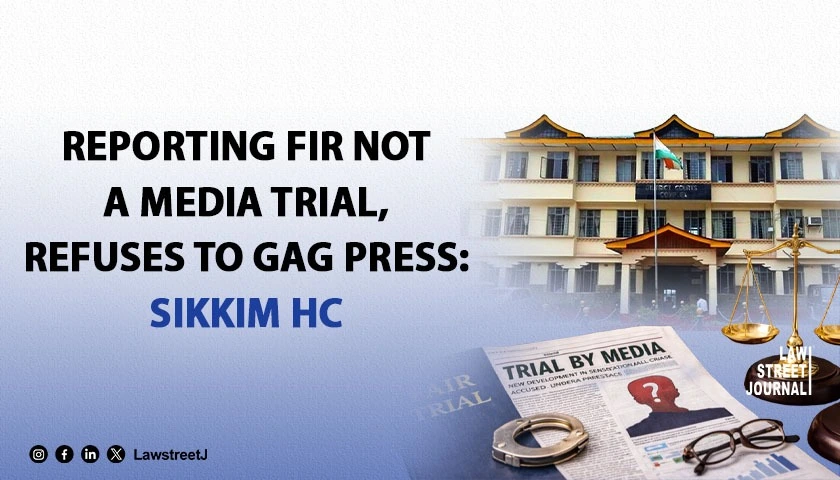
Sikkim: A Single Judge of the High Court of Sikkim at Gangtok has held that accurate reporting of the registration of a First Information Report and its contents, without disclosing the identity of the victim and without prejudging the guilt of the accused, does not constitute a “media trial” warranting judicial interference.
The Court dismissed the writ petition preferred by an accused under Article 226 of the Constitution of India, seeking, inter alia, a direction to the State Police not to disclose investigative material to the media, removal of publications by a local newspaper naming him, and restraint on further coverage during the pendency of investigation and trial.
The petitioner was the subject of an FIR registered on 11.02.2026 at the instance of the State Police for offences under Sections 68, 75, 64, and 351 of the Bharatiya Nyaya Sanhita, 2023. The fourth respondent, Sikkim Chronicle, published a news report concerning the registration of the FIR, which, according to the petitioner, was sourced from the Police Daily Situation Report. The petitioner additionally complained that a subsequent report by the same newspaper disclosed the name of his minor son. He argued that the publication of his name, the contents of the FIR, and the identity of his minor child amounted to an invasion of his right to privacy, the right to a fair trial, and the rights of the child guaranteed under Article 21 of the Constitution.
Justice Bhaskar Raj Pradhan rejected the contentions of the petitioner on each count. On the primary grievance regarding disclosure of the FIR’s contents, the Court noted that the Supreme Court in Youth Bar Association of India v. Union of India, (2016) 9 SCC 473, had issued directions mandating the upload of FIRs on public police websites within 24 hours of their registration. Far from prohibiting disclosure, the Court observed that the direction in Youth Bar Association was premised on the understanding that an accused is entitled to a copy of the FIR at an early stage to enable him to take effective remedial steps. Accepting the petitioner’s argument, the Court held, would render that direction “otiose.”
The Court equally found no support for the petitioner’s case in the directions issued by the Supreme Court in Peoples Union for Civil Liberties v. State of Maharashtra, 2026 INSC 79, wherein States were directed to formulate a policy for media briefing with reference to a Police Manual for Media Briefing prepared by the Amicus Curiae. Scrutinising the provisions of the said manual, the Court noted that the petitioner’s counsel could not point to any specific provision requiring non-disclosure of the name of an accused or the contents of an FIR for the purpose of protecting privacy. The Court further recorded that the petitioner had not even alleged that the publication in question resulted from a media briefing by police officers, rendering the entire line of argument inapplicable on facts.
On the question of whether the publication constituted a “media trial,” the Court was clear. Relying on the Supreme Court’s judgment in Harendra Rai v. State of Bihar, (2023) 13 SCC 563, which affirmed that an FIR is a public document under Section 74 of the Indian Evidence Act, 1872 (now the Bharatiya Saksha Adhiniyam, 2023), the Court held that once a matter becomes part of the public record, the right to privacy no longer subsists, and it becomes a legitimate subject for comment by the press and media. The Court drew upon the foundational privacy law judgment in R. Rajagopal v. State of Tamil Nadu, (1994) 6 SCC 632, which held that publication based upon public records, including court records, is unobjectionable, subject only to the protection of the identity of victims of sexual offences, kidnapping, and similar crimes.
Addressing the contention that the press coverage infringed the petitioner’s right to a fair trial, the Court acknowledged the principle recognised in Sahara India Real Estate Corporation Ltd. v. SEBI, (2012) 10 SCC 603, that a person who genuinely apprehends that media coverage will infringe his right to a fair trial may approach a writ court for postponement of offending publications or for protection of the identity of victims and witnesses. However, the Court declined to apply that principle to the present case, observing that the facts disclosed in the writ petition did not warrant such intervention. It also referred to the Supreme Court’s observations in Sidhartha Vashisht alias Manu Sharma v. State (NCT of Delhi), (2010) 6 SCC 1, regarding the cardinal principles of the Indian criminal justice system, including the presumption of innocence and the right to a fair and transparent investigation, while underscoring that these principles do not translate into a right to suppress legitimate press reporting.
On the minor son’s identity, the Court found that the subsequent publication by Sikkim Chronicle was, in fact, a verbatim reproduction of a communication voluntarily sent by the petitioner’s son to the newspaper, seeking to place his father’s side of the story before the public. The Court characterised this as “a mature effort” by the son to present his father’s defence and held that since the disclosure was at the son’s own instance and request, there was no basis to treat it as a violation of the child’s right to privacy.
The Court concluded with a broader observation on the role of the press in a democratic society. Describing the media as “the fourth pillar of democracy” and a watchdog of society, the Court held that reporting a crime is an integral part of the press’s duty. It noted that freedom of the press is subsumed within the fundamental right to freedom of speech and expression under Article 19(1)(a) of the Constitution and that an informed citizenry and the pursuit of truth are among its central purposes.
While acknowledging that the right is not absolute and is subject to reasonable restrictions, the Court found that this was not a case warranting any such restriction. It added that where the press is discharging its duty fairly and accurately, courts should be slow to drag them into litigation “on the mere asking.”
The writ petition was dismissed in limine along with the interim application.
For the Petitioner: Mr. Abhinav Kant Jha, Advocate
For Respondents 1–3 (State): Mr. S.K. Chettri, Government Advocate
Case Title: Rabden Sherpa v. State of Sikkim & Ors., W.P.(C) No. 07 of 2026, High Court of Sikkim


!['Can't Enter into a Fishing Enquiry Based On Conjectures': Sikkim High Court Dismisses Plea Alleging Misappropriation of Covid-19 Funds [READ ORDER]](/secure/uploads/2021/06/lj_8739_Sikkim_High_Court.jpg)
![Sikkim High Court Announces Menstrual Leave for Female Employees [Read Order]](/secure/uploads/2024/05/lj_5902_b04a0317-5014-42ea-ae28-2dc35893580c.webp)
![Sikkim HC allows revision petition, Condones delay in filing criminal appeal, Emphasizes justice over technicalities [Read Judgement]](/secure/uploads/2024/06/lj_8117_Sikkim_HC_Justice_Over_Technicalities.webp)