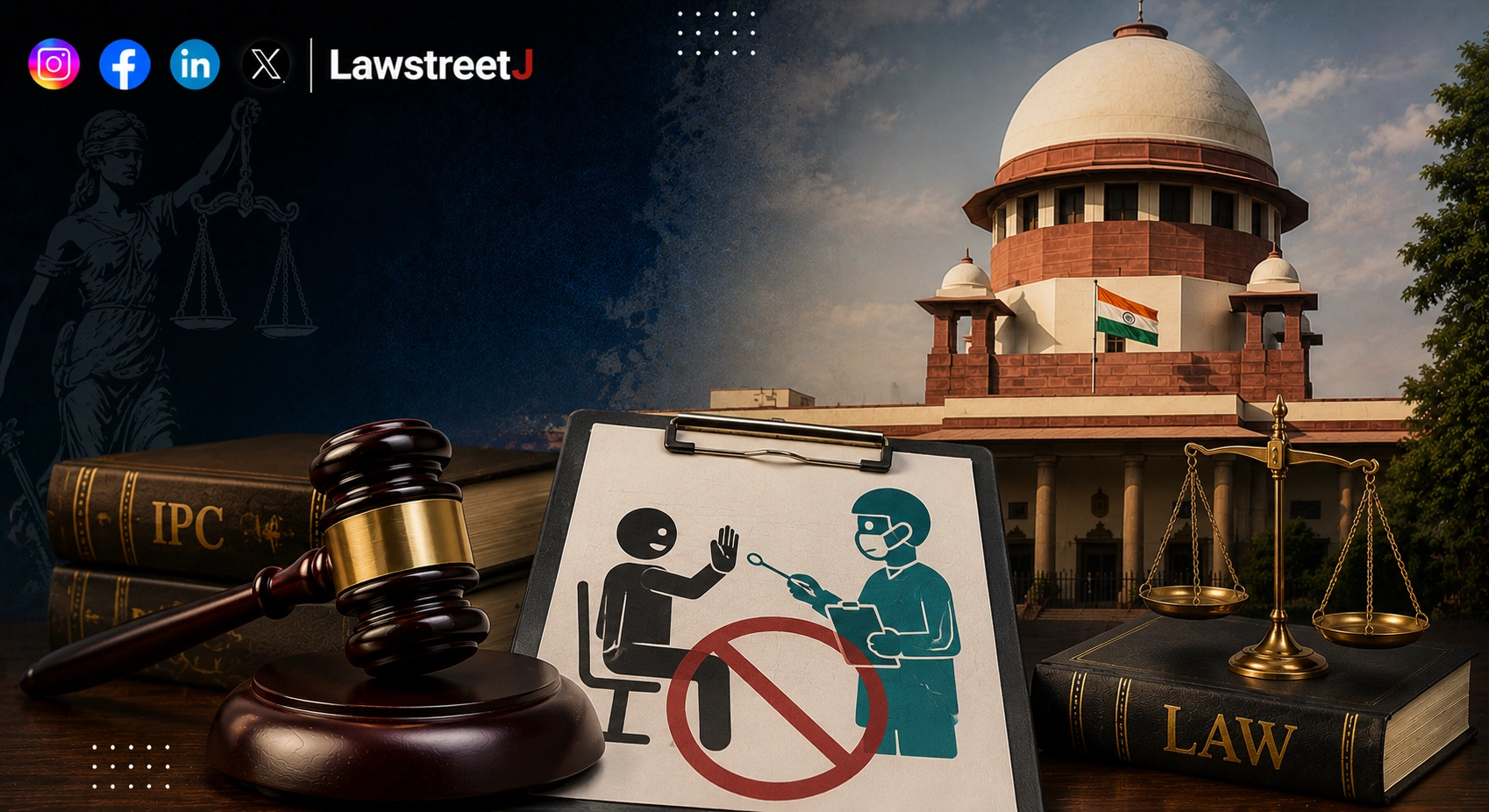
New Delhi: The Supreme Court has quashed an FIR registered against a Lekhapal attached to the Forest Range Office, Paratwada, holding that her act of resisting a medical examination would not amount to the offence of voluntarily obstructing a public servant in the discharge of public functions under Section 186 of the Indian Penal Code.
The Bench of Justices K.V. Viswanathan and Arun Palli was hearing an appeal against a judgment of the High Court of Judicature at Bombay, Nagpur Bench, which had declined to exercise its inherent jurisdiction under Section 528 of the Bharatiya Nagarik Suraksha Sanhita, 2023, to quash FIR registered, for offences under Sections 186 and 189 of the IPC and Sections 110 and 117 of the Maharashtra Police Act, 1951, as well as the consequential chargesheet.
As per the prosecution's case, the Forest Range Officer had informed the police that the appellant was found in an intoxicated state and was causing a disturbance. She was thereafter taken to the Sub-District Hospital, Achalpur, for medical examination along with forest department staff and police personnel. It was alleged that she tried to resist the examination and created a scene, but was ultimately persuaded, following which her blood sample was collected and a report was submitted to the police station for further action.
Taking the prosecution's case at its highest, the Court held that the allegations, at best, disclosed that the appellant had resisted her own medical examination and had subsequently undergone it. The Court observed that such conduct could not be said to fall within the scope of Section 186 IPC, noting that the statements of the prosecution witnesses themselves showed that the appellant had ultimately undergone the examination.
On the applicability of Section 189 IPC, the Court noted that the provision is attracted only where a person holds out a threat of injury to a public servant, or to a person in whom such public servant is interested, so as to induce the public servant to do, forbear, or delay an act connected with the discharge of public functions. The Court found that this requirement was, on the face of it, not made out.
The Court expressed similar difficulty in appreciating how Sections 110 and 117 of the Maharashtra Police Act, 1951, were attracted. It noted that Section 110 deals with indecent language or disorderly behaviour in a public place, while Section 112 concerns threatening, abusive, or insulting words or behaviour intended to provoke a breach of the peace, and Section 117 merely prescribes the penalty for contravention of Sections 99 to 116 of the Act.
Holding that none of the offences alleged were attracted even on the prosecution's own showing, the Court observed that "the act attributed to the appellant will not be covered in the phrase 'voluntarily obstructs any public servant in the discharge of his public function.'"
Accordingly, the Court allowed the appeal, set aside the order of the High Court and quashed the proceedings along with the consequential Chargesheet/Final Report pending before the Court of the Judicial Magistrate First Class, Achalpur.
Appearances:
For the Appellant: Mr. Subodh S. Patil, Advocate-on-Record.
For the Respondent: Mr. Shrirang B. Varma, Advocate; Mr. Siddharth Dharmadhikari, Advocate; Mr. Aaditya Aniruddha Pande, Advocate-on-Record.
Case Title: Ashwini Anantrao Deshpande vs. State of Maharashtra